Key Findings
NTHRYS Biotech Labs has introduced an AI-powered software suite poised to dramatically accelerate bioprocess development. This comprehensive suite includes AI Design of Experiment (DoE) automation specifically for media formulation and screening, streamlining traditionally time-consuming and costly experimental processes. The technology significantly shortens development cycles by intelligently predicting optimal media compositions and prioritizing the most informative experiments.
Technical/Clinical Details
NTHRYS’s AI software utilizes advanced machine learning algorithms to analyze historical experimental data and real-time process data. This capability allows for precise prediction of optimal conditions for specific cell line growth and target protein production from a vast array of media component combinations. For instance, it can quantitatively model the impact of varying concentrations of different nutrients, growth factors, and buffers on cell productivity and product quality. The system also automatically generates experimental plans based on its predictive models, minimizing manual labor in the laboratory. Furthermore, through real-time prediction and control of bioprocess parameters, it enhances process stability and reproducibility, and contributes to early detection of deviations.
Background & Context
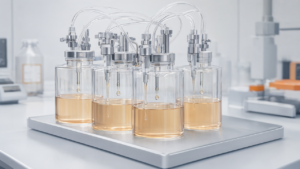
Biopharmaceutical development necessitates extensive experimentation and data analysis, involving complex cell culture processes and the optimization of numerous parameters. Media development, in particular, has been a critical bottleneck in bioprocess development, directly impacting product yield and quality. Traditional DoE methodologies required many experiments and considerable time to identify optimal conditions. The introduction of AI fundamentally transforms this process, enabling better results with fewer experiments. This accelerates the development and market entry of cell and gene therapies and antibody drugs by reducing their development time and cost.
Strategic Significance & Outlook
The NTHRYS Biotech Labs AI DoE automation suite will transform decision-making in bioprocess development into a data-driven approach, enhancing industry competitiveness. In the future, this technology is expected to support seamless scale-up from lab to commercial production and potentially streamline regulatory approval processes by strengthening the Quality by Design (QbD) approach. Further advancements in AI algorithms and integration with other digital biomanufacturing technologies are anticipated to contribute to the realization of fully autonomous bioprocess optimization systems, forming the foundation for next-generation biopharmaceutical manufacturing.
Get our weekly technology intelligence — free
Receive an infographic that lets you judge at a glance whether each field’s analysis report is worth reading.
Subscribe Free — Weekly Tech Intelligence
By subscribing, you’ll receive Troy-Technical’s weekly technology intelligence newsletter.
- Your email and selected fields are used only to deliver the newsletter.
- We never share your information with third parties.
- You can unsubscribe anytime via the link in each email.
See our Privacy Policy for details.
Takes about a minute · Unsubscribe anytime