Key Findings
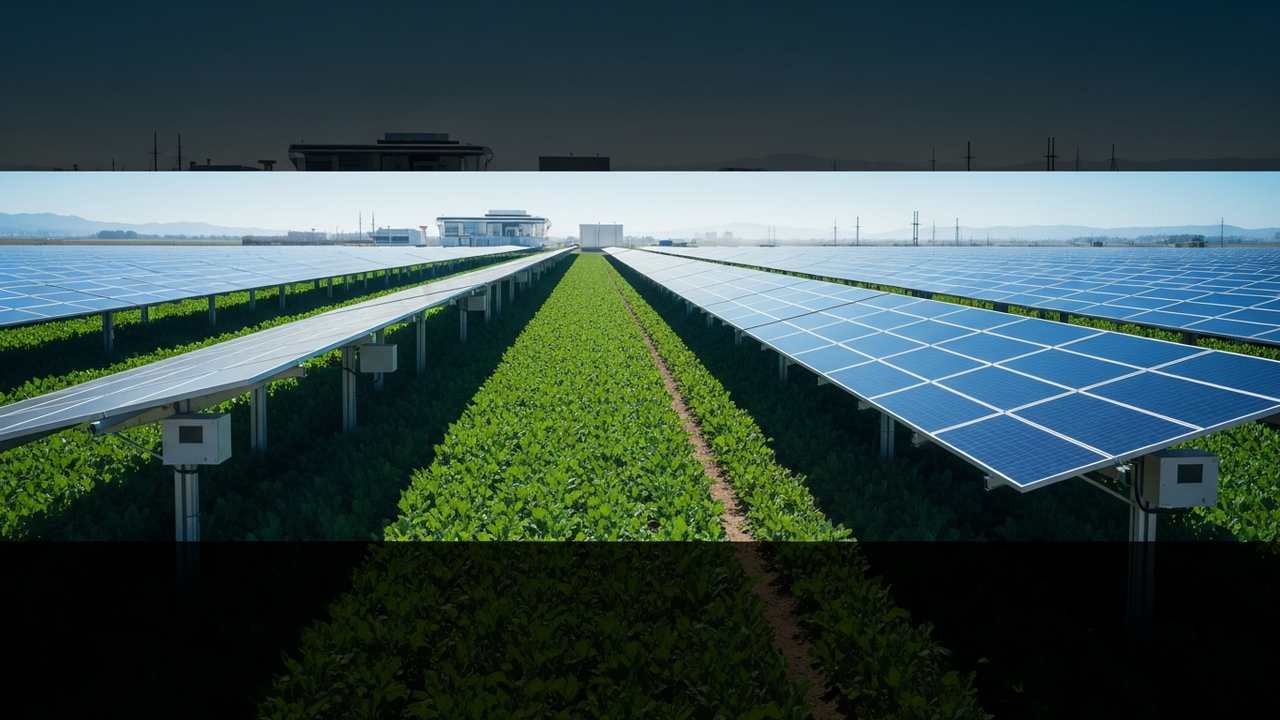
Researchers at Cornell University have quantitatively evaluated the environmental and resource-saving benefits of integrating perovskite tandem agrivoltaics into lettuce production systems across the United States. Their findings reveal an astonishing potential under optimized scenarios: an annual reduction of up to 30.9 million tons of CO2 equivalent emissions and the conservation of approximately 840 million cubic meters of water. This groundbreaking study underscores the profound positive impact that a sustainable coexistence of renewable energy and food production can have on the global environment.
Technical / Clinical Details
The study modeled two types of perovskite tandem technologies: perovskite-silicon (P-S) tandem and all-perovskite (P-P) tandem. These technologies were simulated with varying power conversion efficiencies of 25%, 30%, and 35%, and system lifetimes ranging from 2 to 10 years. Agrivoltaic systems involve deploying solar modules over agricultural land, allowing for power generation while simultaneously optimizing sunlight exposure for crop growth. Perovskite solar cells are particularly well-suited for agrivoltaics due to their tunable light transparency, enabling efficient power generation alongside an ideal light environment for crops. The model demonstrated that integrating agrivoltaics into lettuce production optimizes land use, facilitating the simultaneous creation of clean energy and food. The water conservation effects were particularly significant, attributed to reduced evaporation and improved irrigation efficiency under the partial shade provided by the panels.
Background & Context
Global population growth and climate change present severe challenges on both food and energy security fronts. Critically, securing agricultural land and deploying renewable energy often result in competing land-use demands. Agrivoltaics emerges as an innovative approach to resolve this conflict, maximizing the utilization of limited land resources, and is gaining worldwide attention. Perovskite solar cells, with their high efficiency, manufacturing flexibility, and tunable transparency, are considered particularly advantageous for agrivoltaic applications. They can achieve efficient power generation while minimizing adverse effects on crops, a task that has been challenging for traditional silicon solar cells.
Strategic Significance & Outlook
This Cornell University research unequivocally demonstrates that perovskite tandem agrivoltaics offer a powerful solution for achieving sustainable food and energy production simultaneously. The projections of tens of millions of tons of annual CO2 emission reductions and billions of cubic meters of water savings provide compelling justification for large-scale investments in this technology for policymakers and investors. As demonstration projects for this technology expand and further validation of agricultural productivity impacts and economic viability are conducted, agrivoltaics holds the potential to fundamentally transform global agriculture and energy systems. Its adoption is expected to accelerate, especially in water-stressed regions and countries with limited land, significantly contributing to the achievement of Sustainable Development Goals (SDGs).
Source: https://www.perovskite-info.com/farm-fork-life-cycle-impacts-perovskite-tandem-agrivoltaics
Get our weekly technology intelligence — free
Receive an infographic that lets you judge at a glance whether each field’s analysis report is worth reading.
Subscribe Free — Weekly Tech Intelligence
By subscribing, you’ll receive Troy-Technical’s weekly technology intelligence newsletter.
- Your email and selected fields are used only to deliver the newsletter.
- We never share your information with third parties.
- You can unsubscribe anytime via the link in each email.
See our Privacy Policy for details.
Takes about a minute · Unsubscribe anytime