Key Findings
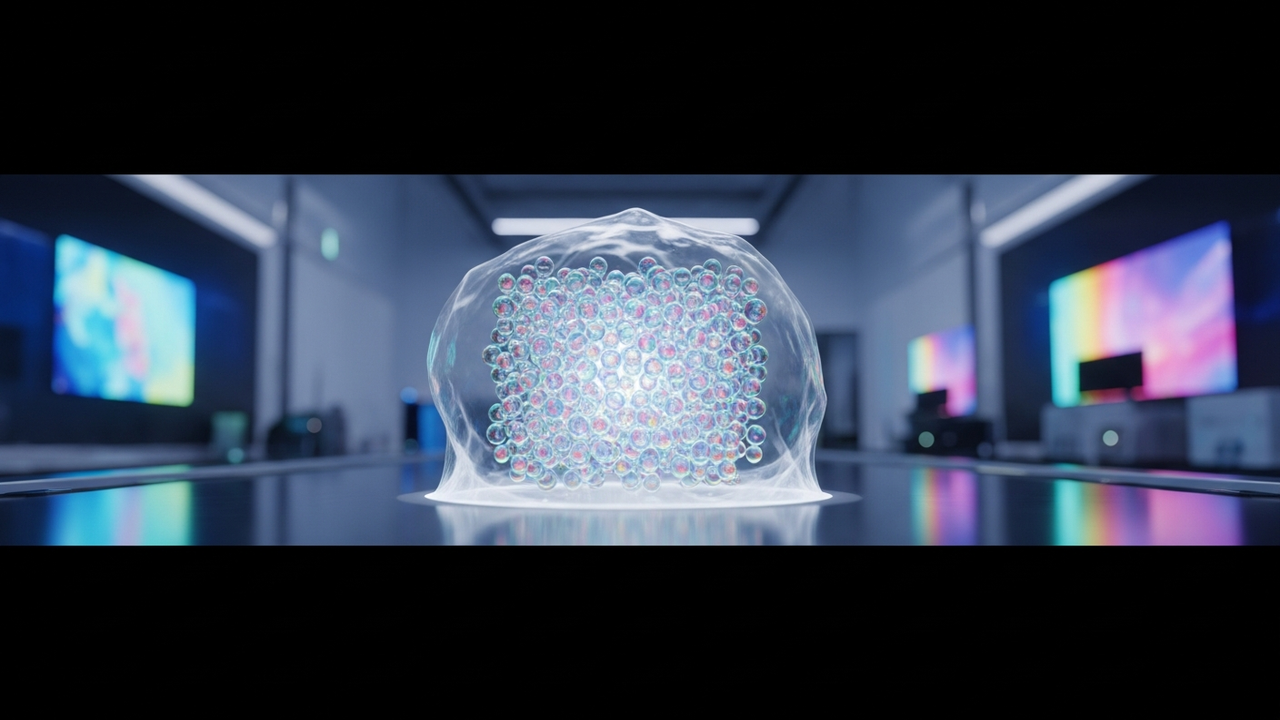
An international research team has developed an innovative solution to address the intrinsic stability issues faced by inorganic halide perovskite nanocrystals (NCs), which hold immense promise for next-generation display and lighting technologies. By introducing a robust, low-cost silica aerogel (AGs) encapsulation strategy, CsPbX3 NCs successfully demonstrated unprecedented stability under severe environmental stressors such as moisture, heat, and light irradiation. This breakthrough significantly advances the practical application of perovskite materials.
Technical Details
Inorganic halide perovskite NCs have garnered significant attention as key materials for next-generation displays due to their superior optoelectronic properties, particularly their high photoluminescence quantum yield (PLQY) and wide color gamut reproduction capabilities. However, their vulnerability to external environmental factors like humidity, heat, and UV light has been the primary barrier to widespread commercialization. The silica aerogel encapsulation strategy developed in this study uniformly disperses CsPbX3 NCs within a porous yet transparent aerogel matrix, providing both physical protection and a barrier against environmental elements. This aerogel creates nanoscale isolated spaces around the NCs, effectively inhibiting the ingress of moisture and oxygen. Experimental results confirmed that these encapsulated CsPbX3 NCs remarkably maintained their optical properties and stability even after prolonged moisture exposure, high-temperature environments, and continuous light irradiation. This significantly enhances device long-term reliability and expands their potential as next-generation emissive materials, potentially replacing or complementing quantum dots.
Background & Context
Display technology continually strives for sharper, more realistic image quality, demanding wide color gamuts, high brightness, and superior contrast. Perovskite NCs were expected to meet these demands as ideal emissive materials, but their instability remained the biggest hurdle. This stability issue, similar to that in perovskite solar cell research, is a critical topic in materials science. The silica aerogel encapsulation technology not only enhances the durability of perovskite NCs but also provides new insights into stability mechanisms, opening avenues for application in other perovskite-based optoelectronic devices, such as LEDs and photodetectors.
Strategic Significance & Outlook
The successful silica aerogel encapsulation strategy for CsPbX3 NCs marks a crucial milestone towards realizing wide-color-gamut, high-brightness, and long-lifetime next-generation display and lighting technologies. This technology holds the potential to further improve the performance of OLED and LCD displays and offers new options to the market as an alternative or complement to quantum dot technology. Moving forward, as this encapsulation technology is adapted for large-scale manufacturing processes and more cost-effective materials are developed, the commercialization of high-performance perovskite-based optoelectronic devices will accelerate. This is expected to enable consumers to enjoy more immersive visual experiences and contribute to the widespread adoption of energy-efficient lighting solutions.
Source: https://pubs.acs.org/doi/10.1021/acsami.6c00834
Get our weekly technology intelligence — free
Receive an infographic that lets you judge at a glance whether each field’s analysis report is worth reading.
Subscribe Free — Weekly Tech Intelligence
By subscribing, you’ll receive Troy-Technical’s weekly technology intelligence newsletter.
- Your email and selected fields are used only to deliver the newsletter.
- We never share your information with third parties.
- You can unsubscribe anytime via the link in each email.
See our Privacy Policy for details.
Takes about a minute · Unsubscribe anytime