Key Findings
State-of-the-art 1.6T optical transceivers, leveraging silicon photonics technology, have reportedly initiated trial deployments within AI data centers of several prominent cloud providers. These cutting-edge transceivers successfully combine the immense bandwidth demanded by next-generation AI workloads with the imperative of low power consumption for environmental sustainability, achieving an approximately 30% improvement in power efficiency compared to previous 800G generation optical modules.
Technical / Clinical Details
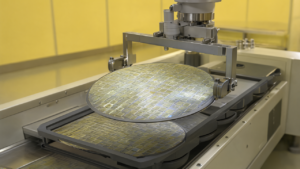
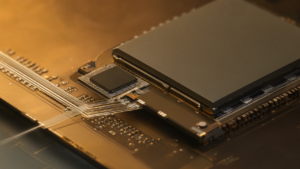
- These 1.6T transceivers are built upon a silicon photonics platform manufactured using standard CMOS processes. This enables a high degree of integration between optical and electronic circuits, resulting in reduced footprint and optimized manufacturing costs.
- The modulation scheme employed is PAM4 (Pulse Amplitude Modulation 4-level) technology, facilitating a total data transmission speed of 1.6 terabits per second (Tbps) through parallel processing across multiple lanes. This effectively mitigates bandwidth bottlenecks in inter-rack and GPU-to-GPU connections within data centers.
- The reduction in power consumption is achieved through optimization of the digital signal processing (DSP) chip and enhanced efficiency of optical components within the silicon photonics platform, directly translating to lower operational costs for large-scale AI clusters.
Background & Context
The escalating complexity of AI models and the explosive growth in data volumes demand ultra-high-speed and high-capacity data transfer capabilities in data centers, particularly within AI/HPC clusters, far beyond what traditional network infrastructure can provide. While 800G optical modules are only just beginning to proliferate, demand for 1.6T and even 3.2T is already anticipated, with power efficiency and cost remaining primary concerns. Silicon photonics, due to its inherent scalability and cost advantages, has emerged as the most promising technology to address these challenges.
Strategic Significance & Outlook
These trial deployments represent a pivotal milestone for 1.6T silicon photonics transceivers as they move towards full-scale mass production in 2025. Real-world evaluation by major cloud providers will provide final validation of compatibility, reliability, and performance. The widespread adoption of this technology is expected to dramatically enhance the computational power of AI clusters and serve as a foundational technology supporting data center sustainability. This will, in turn, accelerate the further evolution of generative AI and large language models (LLMs), contributing significantly to the advancement of digital society.
Source: https://www.eetimes.com/silicon-photonics-1-6t-transceiver-trials-data-centers/
Get our weekly technology intelligence — free
Receive an infographic that lets you judge at a glance whether each field’s analysis report is worth reading.
Subscribe Free — Weekly Tech Intelligence
By subscribing, you’ll receive Troy-Technical’s weekly technology intelligence newsletter.
- Your email and selected fields are used only to deliver the newsletter.
- We never share your information with third parties.
- You can unsubscribe anytime via the link in each email.
See our Privacy Policy for details.
Takes about a minute · Unsubscribe anytime