Key Findings
ESA Space Solutions is backing the Microgravity Automated Screening & Tissue Modeling (MAST) feasibility study, which aims to evaluate the viability of Exobiosphere’s proposed On-Orbit High-Throughput Screening (OHTS) platform. This pioneering initiative seeks to provide access to more physiologically relevant biological models for fields such as neurodegenerative diseases and oncology—models that are difficult to replicate on Earth—thereby significantly accelerating the drug discovery process.
Technology and Study Details
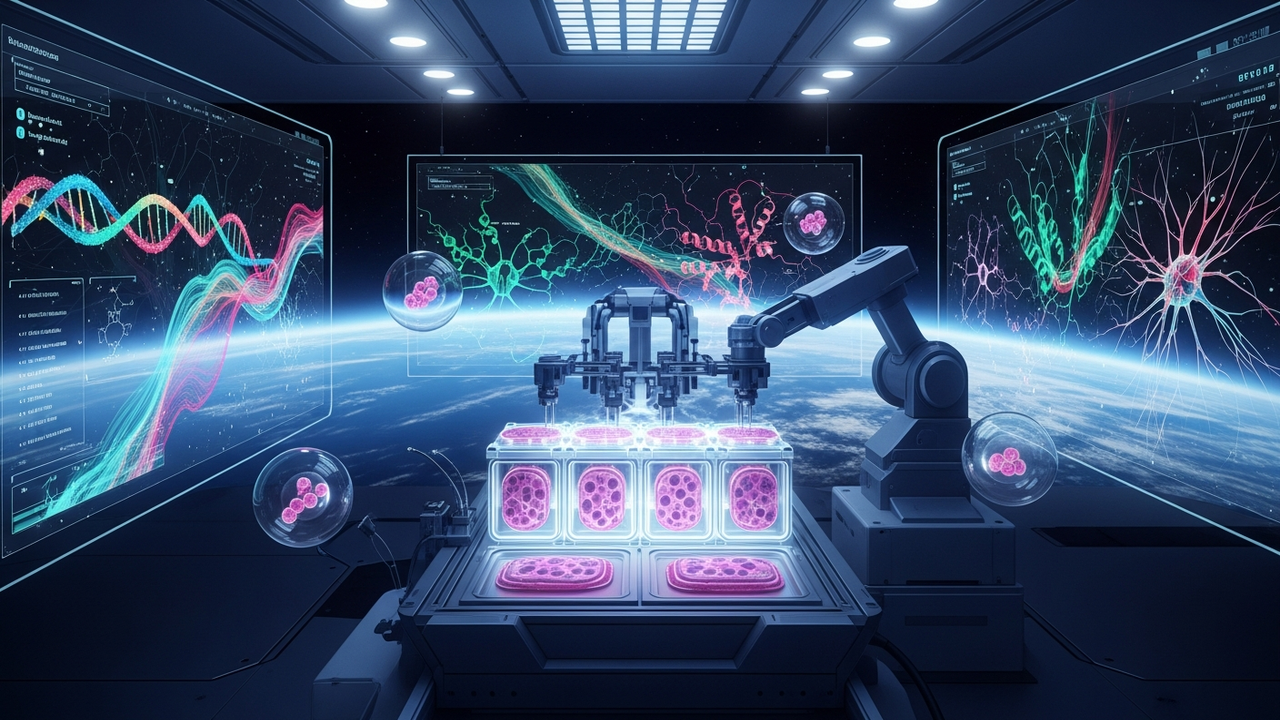
Exobiosphere’s OHTS platform is envisioned as a commercial service that leverages orbital environments, such as the International Space Station (ISS), to automate high-throughput cell culture experiments, drug screening, and tissue modeling. The MAST feasibility study will conduct a detailed assessment of OHTS’s technical and commercial viability.
- Benefits of Microgravity: The microgravity environment is known to facilitate the formation of 3D cellular structures (like spheroids and organoids), which can better mimic in vivo tissue structures and functions. This allows for more accurate drug response assessments by preserving cell-to-cell interactions and signaling pathways often lost in terrestrial 2D cultures.
- High-Throughput Automation: On-orbit experiments require a high degree of automation to minimize astronaut intervention. OHTS aims to enhance experimental efficiency and reproducibility by simultaneously processing numerous samples, automating tasks such as cell seeding, media exchange, drug addition, imaging, and data collection.
- Application Areas:
- Neurodegenerative Diseases: For conditions like Alzheimer’s, Parkinson’s, and Amyotrophic Lateral Sclerosis (ALS), terrestrial models often fail to fully capture disease complexity. 3D neuronal cell cultures in microgravity could provide more physiologically relevant models, potentially accelerating the discovery of new therapies and drug candidates.
- Oncology: Promotes spheroid formation of cancer cells, offering realistic tumor models for anticancer drug screening and personalized medicine.
Background and Industry Context
The pharmaceutical industry faces escalating costs and low success rates in new drug development, driving a demand for more efficient and predictive drug screening models. Current terrestrial cell culture and animal models often cannot fully replicate complex human physiological responses, contributing to high failure rates in clinical trials. The microgravity environment is gaining attention as a unique research platform with the potential to bridge this gap, with many countries, including the U.S., UK, and Japan, investing in space-based biotechnology research.
ESA Space Solutions is an ESA program dedicated to leveraging space technologies for terrestrial commercial applications and societal challenges. It aims to foster innovation in space and create new business opportunities through collaborations with SMEs. Feasibility studies like MAST represent early-stage investments towards technological commercialization, reducing risks while paving the way for future commercial services.
Strategic Significance and Outlook
The successful outcome of the MAST feasibility study will indicate the potential for Exobiosphere’s OHTS platform to be commercialized, providing the pharmaceutical industry with an innovative drug discovery tool. If high-throughput screening and tissue modeling in orbit become viable, it could uncover drug mechanisms of action and toxicity profiles previously overlooked in terrestrial research, leading to the development of more effective and safer medicines. This is a critical factor driving growth in the biotechnology and healthcare sectors of the space economy, opening a new frontier that promises to contribute significantly to human health and well-being. It also helps Europe establish technological leadership in this cutting-edge domain.
Source: https://business.esa.int/projects/mast
Get our weekly technology intelligence — free
Receive an infographic that lets you judge at a glance whether each field’s analysis report is worth reading.
Subscribe Free — Weekly Tech Intelligence
By subscribing, you’ll receive Troy-Technical’s weekly technology intelligence newsletter.
- Your email and selected fields are used only to deliver the newsletter.
- We never share your information with third parties.
- You can unsubscribe anytime via the link in each email.
See our Privacy Policy for details.
Takes about a minute · Unsubscribe anytime