Key Findings
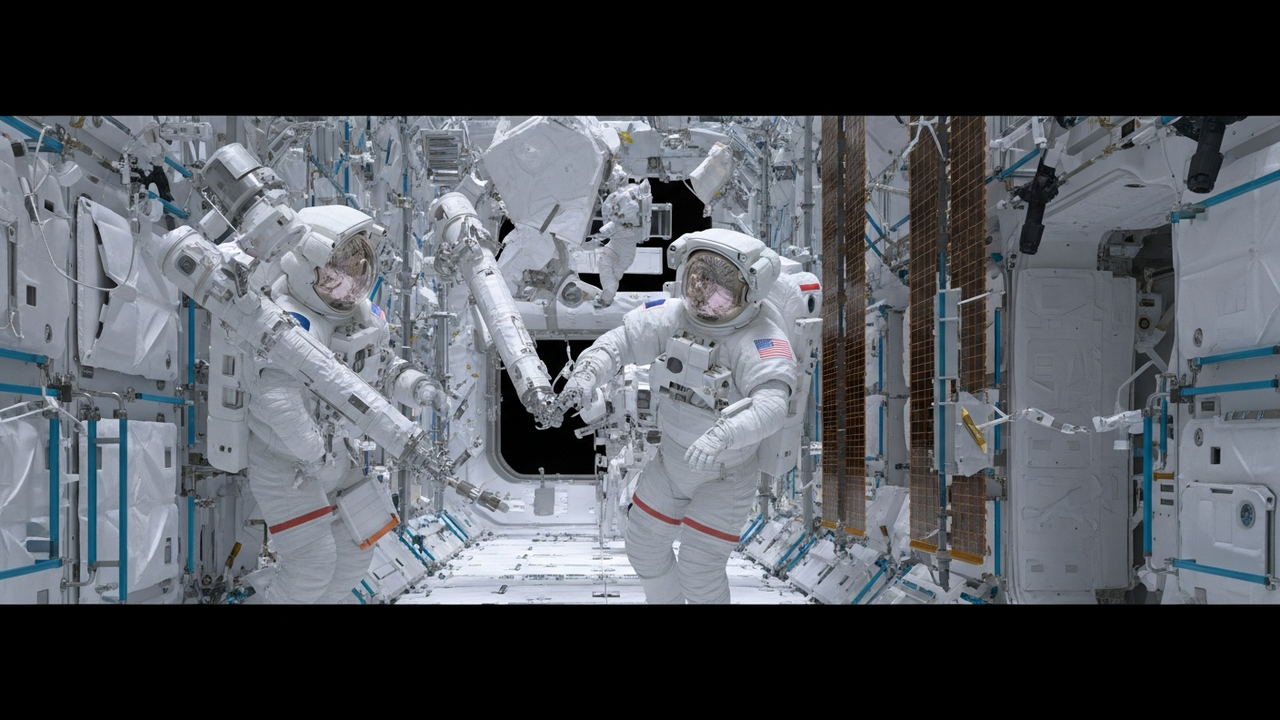
NASA astronauts Chris Williams and Jessica Meir performed an Extravehicular Activity (EVA) to carry out critical repair work on the International Space Station’s (ISS) Canadarm2 robotic arm. This marks the third spacewalk of 2026 and the 280th cumulative EVA in support of ISS maintenance, assembly, and upgrades.
Mission Details and Technical Aspects
- Importance of Canadarm2: Canadarm2 is the primary robotic arm of the ISS, responsible for a wide range of crucial tasks including station assembly, capturing resupply vehicles, assisting astronauts during spacewalks, and manipulating payloads. Its dysfunction significantly impacts ISS operations, necessitating prompt repair.
- EVA Preparation and Execution: Astronauts undergo extensive training beforehand, mastering the donning of the Extravehicular Mobility Unit (EMU), the airlock depressurization sequence, and the use of tools in space. This particular EVA focused on precise tasks involving specific damaged components or their replacement.
- Safety and Risk Management: Spacewalks are conducted in an extremely hazardous environment characterized by the vacuum of space, extreme temperature variations, cosmic radiation, and the risk of micrometeoroid impacts. NASA prioritizes astronaut safety through rigorous procedures, coordination with ground control teams, and backup plans.
- Continuity of ISS Operations: Regular maintenance and repairs are indispensable for the ISS to continue functioning as an outpost for scientific research, technological development, and international cooperation. The repair of Canadarm2 is a critical element in ensuring the ISS can continuously perform its missions.
Background & Industry Context
For over two decades, the International Space Station has been humanity’s sole platform for long-duration presence in space and conducting scientific research in microgravity. Its operation requires the meticulous maintenance of complex systems and components, with EVAs being one of the primary means for this. The ability for astronauts to perform manual repairs is extremely valuable for responding to unexpected failures or aging infrastructure, thereby extending the lifespan of the ISS.
Future Outlook
The success of this spacewalk supports the long-term operation of the ISS and contributes significantly to accumulating technology and experience for in-orbit maintenance and repair in future commercial space stations and human missions to the Moon and Mars. The restoration of the robotic arm’s functionality enables the continuation of scientific experiments on the ISS and ensures a safe working environment for astronauts. Such manual intervention capabilities will remain indispensable for emergencies and complex repairs, even as autonomous robotic systems become more prevalent.
Source: https://www.youtube.com/watch?v=VUBDUXZPQbM
Get our weekly technology intelligence — free
Receive an infographic that lets you judge at a glance whether each field’s analysis report is worth reading.
Subscribe Free — Weekly Tech Intelligence
By subscribing, you’ll receive Troy-Technical’s weekly technology intelligence newsletter.
- Your email and selected fields are used only to deliver the newsletter.
- We never share your information with third parties.
- You can unsubscribe anytime via the link in each email.
See our Privacy Policy for details.
Takes about a minute · Unsubscribe anytime


Comments