Key Findings
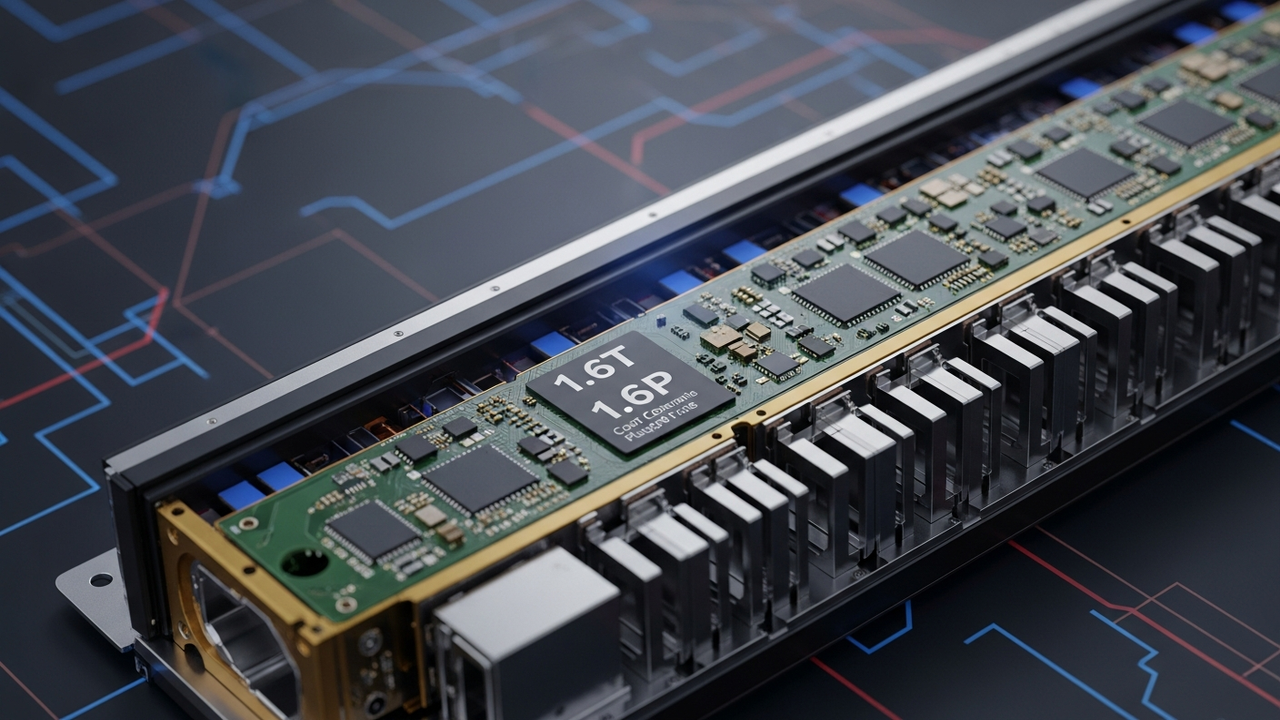
The optical communications industry is undergoing a significant engineering transformation towards 1.6 Terabit (1.6T) coherent pluggable modules, with critical advancements focusing on symbol rate scaling, stringent DSP power consumption limits, and innovative host thermal designs. Key drivers for this evolution include the OIF’s 1600ZR, 1600ZR+, and 1600CL projects, alongside the IEEE 802.3dj task force’s work on 200 Gb/s/lane electrical interfaces.
Technical / Clinical Details
- Symbol Rate Scaling: While 800G modules typically operate at symbol rates around 130 Gbaud, 1.6T modules demand even higher rates. This necessitates the development of new optical components and DSP architectures capable of high-frequency performance.
- DSP Power Consumption Limits: Next-generation coherent pluggable modules require increased processing power but must adhere to strict power consumption envelopes due to form factor constraints. Leading vendors such as Cisco, Ciena, and Nokia have established specific power targets for 800G and 1.6T modules. Marvell, for instance, is developing 2nm DSPs for 1.6T modules, which are anticipated to deliver significant power efficiency improvements, crucial for meeting these targets.
- Host Thermal Design: As power dissipation in pluggable modules increases, host system thermal design becomes more complex and critical. Traditional air-cooling methods may prove insufficient, leading to exploration of advanced cooling solutions and new integration paradigms like Co-Packaged Optics (CPO).
- Standardization Progress: OIF and IEEE are laying essential groundwork for the interoperability and widespread adoption of 1.6T coherent pluggables. OIF’s 1600ZR/ZR+/CL projects are defining specifications for Data Center Interconnect (DCI) and metro networks, while IEEE 802.3dj is standardizing electrical interfaces for future Ethernet generations.
Background & Context
The explosive growth of AI/ML workloads is driving unprecedented demand for bandwidth within and between data centers. This necessitates continuous evolution in optical communication technologies. As 800G coherent modules become mainstream, the transition to the 1.6T generation is an urgent imperative. However, the associated challenges of power consumption and thermal management are pushing the physical limits of pluggable modules, demanding fundamental shifts in approach to overcome these barriers. Addressing these challenges is paramount for sustaining the rapid pace of AI infrastructure development.
Strategic Significance & Outlook
The success of 1.6T coherent pluggable modules hinges on innovations in symbol rate technology, DSP capabilities, and thermal management. The development of 2nm process node DSPs by semiconductor manufacturers like Marvell signals a significant leap in power efficiency, garnering substantial industry attention. Furthermore, emerging technologies such as Co-Packaged Optics (CPO) and Linear Pluggable Optics (LPO), which aim to reduce DSP dependence, offer promising avenues for further optimizing power and cost. These technological advancements are set to enable higher speeds and greater energy efficiency in AI data centers, contributing to the development of sustainable digital infrastructure globally.
Source: https://mapyourtech.com/1600zr-class-coherent-pluggables-what-changes-beyond-800g/
Get our weekly technology intelligence — free
Receive an infographic that lets you judge at a glance whether each field’s analysis report is worth reading.
Subscribe Free — Weekly Tech Intelligence
By subscribing, you’ll receive Troy-Technical’s weekly technology intelligence newsletter.
- Your email and selected fields are used only to deliver the newsletter.
- We never share your information with third parties.
- You can unsubscribe anytime via the link in each email.
See our Privacy Policy for details.
Takes about a minute · Unsubscribe anytime








Comments