Key Findings
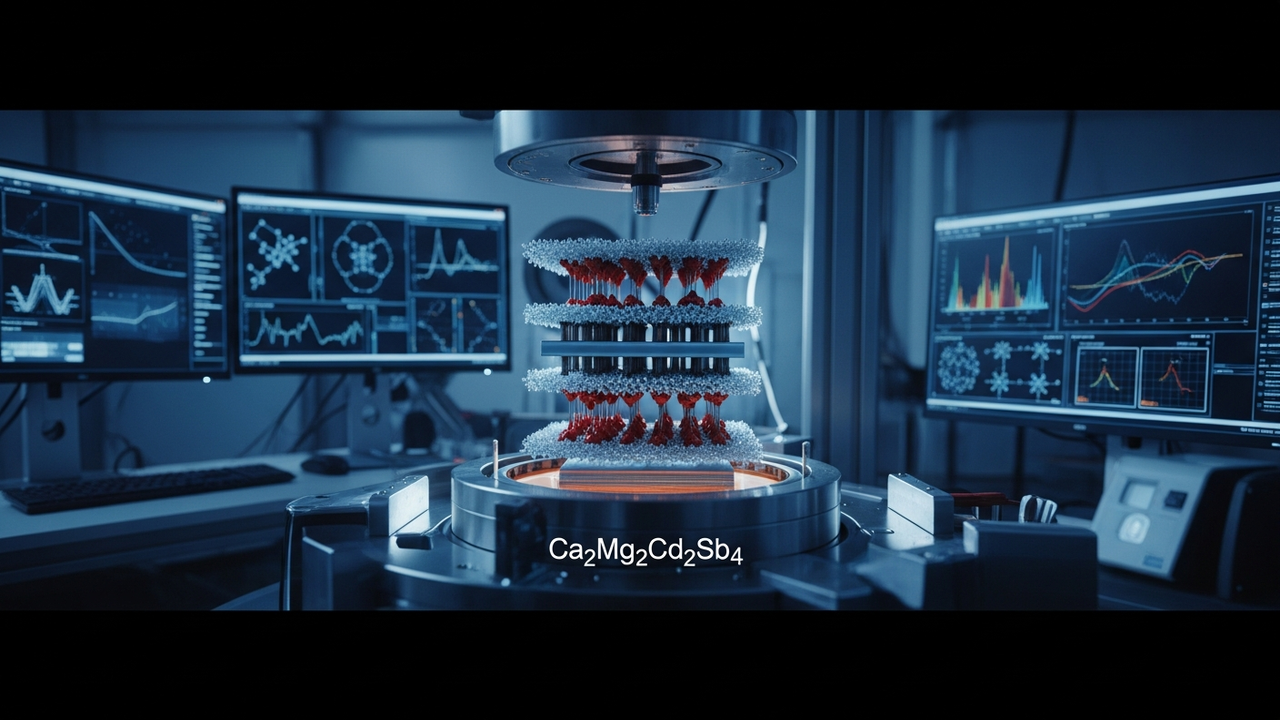
Thermoelectric (TE) materials are critical technologies poised to contribute to the mitigation of the energy crisis by directly converting waste heat into electricity. This research highlights the exceptional thermoelectric performance of nanolayered Ca₂Mg₂Cd₂Sb₄ superlattices. This superior performance is attributed to a significant contrast in ionization degrees between its constituent layers: the highly ionized [Mg₂Sb₂]²⁻ layer (76.6%) and the weakly ionized [Cd₂Sb₂]²⁻ layer (32.8%). This unique characteristic gives rise to an anisotropic electronic structure that effectively balances carrier mobility and the Seebeck coefficient (S), leading to exceptionally high dimensionless figures of merit (ZT) of 1.68 for n-type and 1.38 for p-type at a mid-to-high temperature range of 700 K (approximately 427°C).
Technical / Clinical Details
The Ca₂Mg₂Cd₂Sb₄ superlattice is a type of Zintl phase compound characterized by its atomic-level layered structure. The periodic arrangement of layers with differing ionization degrees creates a distinctive anisotropy in its electronic structure. The highly ionized [Mg₂Sb₂]²⁻ layers promote high electrical conductivity and carrier mobility, while the relatively weakly ionized [Cd₂Sb₂]²⁻ layers enhance phonon scattering, thereby effectively reducing thermal conductivity. This alternating arrangement of layers with distinct properties achieves ‘electrical-thermal decoupling,’ a crucial factor in maximizing the performance of thermoelectric materials. The reported ZT value of 1.68 at 700 K is remarkably high compared to conventional thermoelectric materials, representing a groundbreaking performance, especially for an n-type material. This high performance signifies a substantial improvement in heat-to-electricity conversion efficiency.
Background & Context
As global energy consumption continues to rise and reliance on fossil fuels exacerbates environmental problems, the effective utilization of waste heat has become an urgent challenge for achieving a sustainable society. Vast amounts of thermal energy are discharged unused from sources such as automotive exhausts, industrial factories, and data centers. Thermoelectric conversion technology, capable of directly transforming this waste heat into electrical energy, is gaining attention as a clean power generation method that contributes to reducing greenhouse gas emissions and improving energy efficiency. However, the conversion efficiency of commercially available thermoelectric modules remains low, prompting a strong demand for the development of high-efficiency novel materials. The results of this research hold the potential to break through this material development bottleneck and accelerate the widespread adoption of thermoelectric technology.
Strategic Significance & Outlook
This Ca₂Mg₂Cd₂Sb₄ superlattice is an extremely promising candidate for thermoelectric power generation applications operating in the mid-to-high temperature range. For example, it could be integrated into automotive exhaust heat recovery systems to improve fuel efficiency or used to generate additional electricity from industrial waste heat. The research team plans to continue further studies on the material’s long-term stability, scalable manufacturing methods, and integration into actual devices. The excellent performance, with an n-type ZT value of 1.68 at 700 K, represents a monumental leap forward in bringing thermoelectric module conversion efficiency to practical levels, and is expected to contribute significantly to the realization of sustainable energy solutions.
Source: https://pubs.acs.org/doi/abs/10.1021/acs.chemmater.6c01343
Get our weekly technology intelligence — free
Receive an infographic that lets you judge at a glance whether each field’s analysis report is worth reading.
Subscribe Free — Weekly Tech Intelligence
By subscribing, you’ll receive Troy-Technical’s weekly technology intelligence newsletter.
- Your email and selected fields are used only to deliver the newsletter.
- We never share your information with third parties.
- You can unsubscribe anytime via the link in each email.
See our Privacy Policy for details.
Takes about a minute · Unsubscribe anytime








Comments