Key Findings
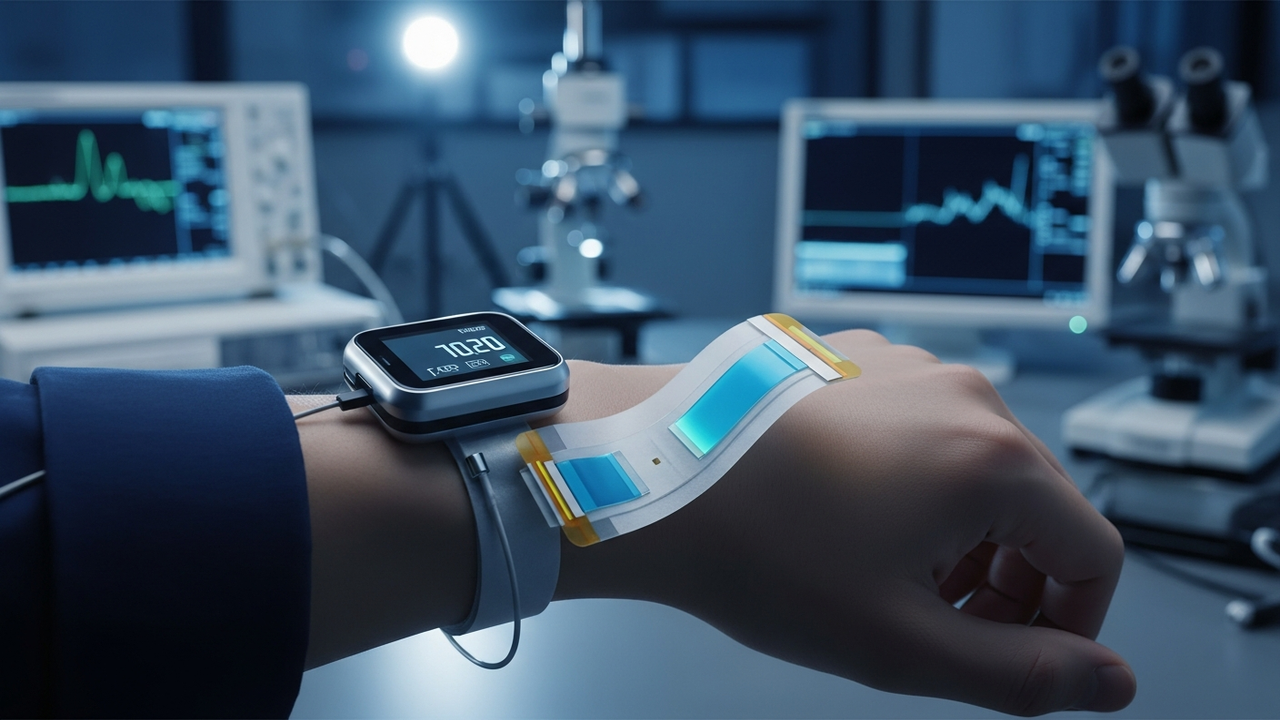
Flexible thermoelectric generators (f-TEGs) hold immense potential as wearable power systems and autonomous sensors, owing to their ability to directly convert low-grade waste heat energy from the human body and surrounding environment into electricity. This research successfully fabricated a high-performance Bi₂Te₃ (bismuth-tellurium compound)/hydroxypropyl methylcellulose (HPMC)@paper composite thermoelectric film using a simple vacuum filtration method. This composite film achieved synergistic enhancements in both flexibility and high thermoelectric performance. Critically, in human body wear tests when integrated into a smart wristband, it continuously powered a low-power pedometer, explicitly demonstrating the feasibility of wearable thermoelectric energy harvesting.
Technical / Clinical Details
Bi₂Te₃ is a prominent thermoelectric material known for its high ZT value (thermoelectric figure of merit) near room temperature, but its inherent brittleness has hindered its application in flexible devices. The research team overcame this by utilizing HPMC and paper fibers as a matrix, uniformly dispersing Bi₂Te₃ nanoparticles to achieve both flexibility and mechanical strength. The vacuum filtration method is a simple and scalable manufacturing process, suitable for large-scale production. This composite film allows for precise control of thickness, ranging from a few micrometers to several hundred micrometers, enabling the integration of high-density thermoelectric elements. In human body tests, the system generated electricity by leveraging the temperature difference between the body and ambient air (approximately 5°C), consistently supplying several microwatts of power. This power was sufficient to operate a commercial low-power pedometer continuously without an external battery.
Background & Context
In modern society, various wearable electronics such as smartphones, smartwatches, and fitness trackers are ubiquitous. These devices critically rely on battery power, but the inconvenience of frequent charging and the environmental burden of battery disposal pose significant challenges. Thermoelectric energy harvesting offers a promising solution as an autonomous power source for these devices, by converting the constantly generated body heat or minute environmental temperature differences into electricity. The development of flexible thermoelectric materials is crucial for enhancing the comfort and design freedom of wearable devices, representing a frontier in materials science and device engineering.
Strategic Significance & Outlook
The developed Bi₂Te₃/HPMC@paper composite thermoelectric film holds the potential to significantly extend the battery life of wearable electronics and ultimately contribute to the realization of battery-less devices. The research team plans to continue efforts to further enhance thermoelectric performance, evaluate durability, and reduce manufacturing costs. In the future, this technology is expected to be applied to a wide range of autonomous wearable devices, including health monitoring sensors, environmental sensors, and various IoT devices. This innovation marks a crucial step towards achieving a sustainable electronics society.
Source: https://www.sciopen.com/article/10.26599/NR.2026.94908713
Get our weekly technology intelligence — free
Receive an infographic that lets you judge at a glance whether each field’s analysis report is worth reading.
Subscribe Free — Weekly Tech Intelligence
By subscribing, you’ll receive Troy-Technical’s weekly technology intelligence newsletter.
- Your email and selected fields are used only to deliver the newsletter.
- We never share your information with third parties.
- You can unsubscribe anytime via the link in each email.
See our Privacy Policy for details.
Takes about a minute · Unsubscribe anytime







Comments