Record-Setting Efficiency Achieved
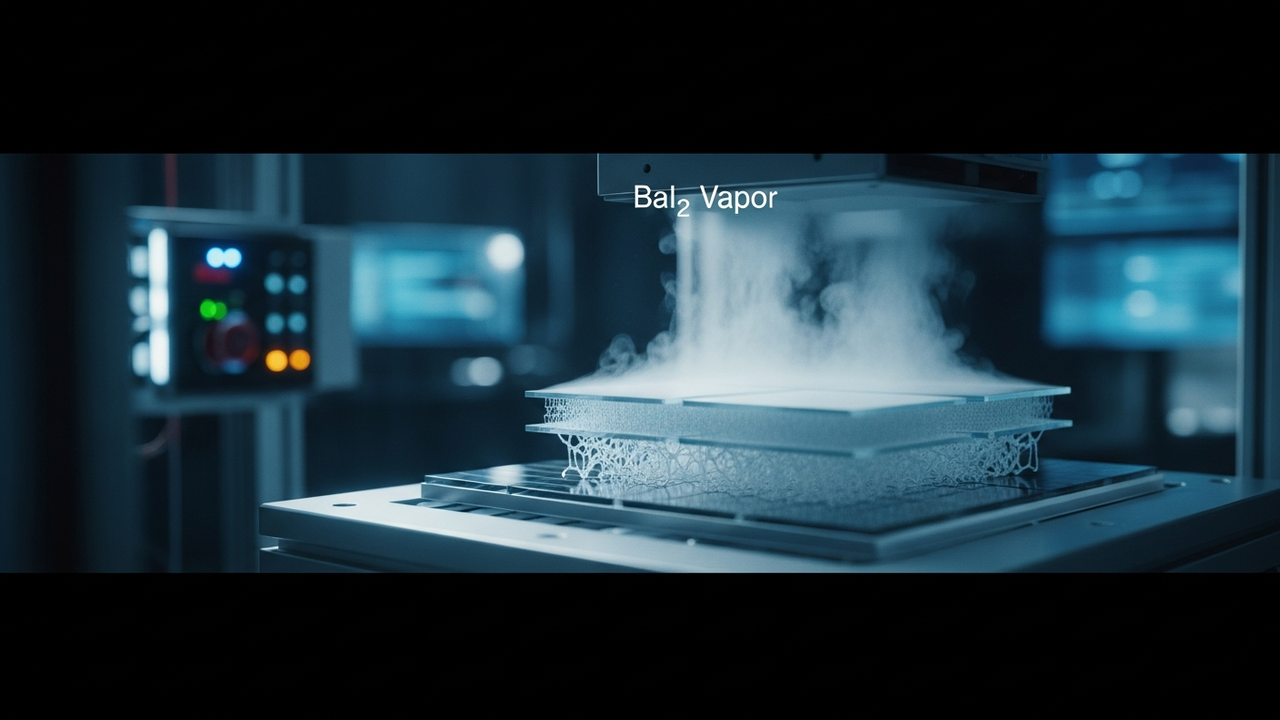
This research announces a record 18.15% power conversion efficiency for wide-bandgap perovskite solar cells fabricated via thermal co-evaporation. This significant advance was made possible by an innovative surface treatment utilizing BaI₂ vapor, offering substantial advantages in both efficiency and industrial compatibility, particularly for next-generation perovskite-silicon tandem photovoltaic applications.
Technical Innovation: BaI₂ Vapor Passivation and Manufacturing Scalability
Thermal co-evaporation is a highly desirable manufacturing technique due to its capacity for conformal deposition on textured silicon substrates and its excellent suitability for large-scale production. Historically, however, non-radiative recombination stemming from surface defects has been a major impediment to efficiency in wide-bandgap perovskites. The research team overcame this challenge by developing a non-destructive surface treatment using barium iodide (BaI₂) vapor to effectively passivate (deactivate) these surface defects within the perovskite film. This novel passivation layer significantly suppresses charge carrier losses, thereby enhancing overall photovoltaic performance. This led directly to the record 18.15% efficiency for perovskite solar cells with a bandgap exceeding 1.7 eV, a notable improvement over prior benchmarks. This innovation establishes a critical foundation for deploying highly efficient perovskite layers as the top cell in advanced tandem architectures.
The Promise and Challenges of Tandem Photovoltaics
Perovskite-silicon tandem solar cells are widely regarded as a pivotal next-generation technology, poised to extend the theoretical efficiency limits of photovoltaics beyond what single-junction cells can achieve. In this architecture, a perovskite top cell is designed to absorb short-wavelength light inefficiently captured by silicon, thus necessitating a high-bandgap perovskite. Traditionally, however, wide-bandgap perovskites have struggled with issues of lower stability and suboptimal efficiencies, while manufacturing scalability has presented an additional hurdle. This new approach, integrating thermal co-evaporation with BaI₂ vapor treatment, represents a groundbreaking solution that concurrently addresses these critical challenges by both boosting wide-bandgap perovskite efficiency and enabling their industrial-scale fabrication.
Strategic Outlook and Path to Commercialization
The achievement of 18.15% efficiency decisively demonstrates the high potential of thermally co-evaporated wide-bandgap perovskites as top cells for tandem solar applications. Continued refinement of this technology holds the promise of dramatically improving the overall efficiency of perovskite-silicon tandem solar cells, potentially transcending the inherent efficiency ceilings of conventional silicon photovoltaics. Given the inherent industrial compatibility of the manufacturing process, a relatively rapid path to commercialization is anticipated. Looking ahead, the research team plans to pursue further optimization of the BaI₂ vapor treatment, conduct comprehensive long-term stability evaluations of these devices, and focus on seamless integration into tandem structures, ultimately contributing to the widespread deployment of highly efficient and cost-effective solar power solutions globally.
Source: https://pubs.acs.org/doi/10.1021/acsenergylett.6c01161
Get our weekly technology intelligence — free
Receive an infographic that lets you judge at a glance whether each field’s analysis report is worth reading.
Subscribe Free — Weekly Tech Intelligence
By subscribing, you’ll receive Troy-Technical’s weekly technology intelligence newsletter.
- Your email and selected fields are used only to deliver the newsletter.
- We never share your information with third parties.
- You can unsubscribe anytime via the link in each email.
See our Privacy Policy for details.
Takes about a minute · Unsubscribe anytime






Comments