Key Findings
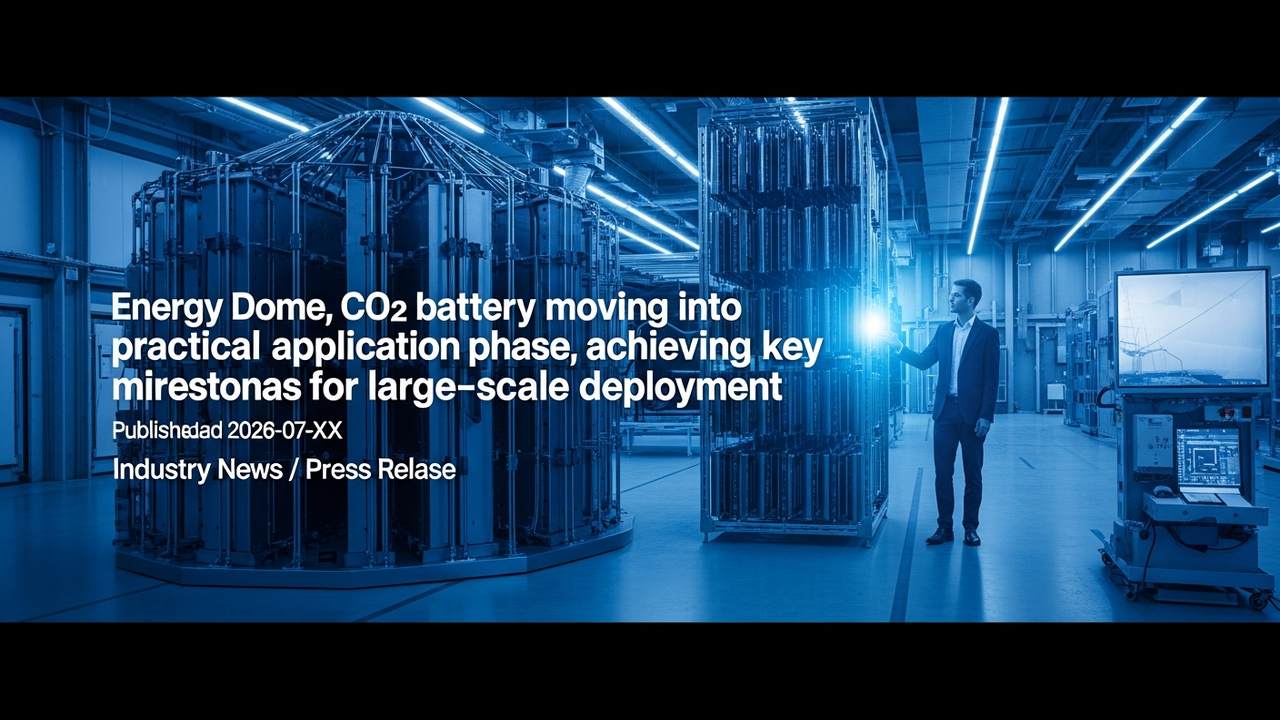
Energy Dome has announced the achievement of several critical milestones toward the commercialization and large-scale deployment of its innovative CO2 Battery technology. This progress indicates that the company’s CO2 Battery has moved beyond conceptual validation, reaching a practical level ready for integration into actual power grids. Notably, its capabilities as a long-duration energy storage (LDES) solution are being demonstrated through initial commercial projects.
Technical / Clinical Details
The CO2 Battery is a thermodynamic system that stores energy by utilizing the reversible liquefaction and gasification process of carbon dioxide (CO2). The system compresses CO2 for storage as a liquid, then vaporizes it to drive a turbine and generate electricity when needed. This closed-loop process ensures high efficiency and long-duration energy supply without external CO2 emissions. Unlike conventional lithium-ion batteries, which are specialized for short discharges of a few hours, the CO2 Battery can provide continuous discharge for over 10 hours, thereby contributing to the smoothing of variable renewable energy sources like solar and wind.
Background & Context
In the global energy transition, the expansion of renewable energy adoption is essential, yet its output variability poses challenges to grid stability. To address this, there is a strong demand for solutions capable of storing large amounts of energy for extended periods. Energy Dome’s CO2 Battery utilizes inexpensive and readily available CO2 as its primary storage medium, reducing reliance on scarce metals like lithium and cobalt. This offers a more sustainable and geographically unconstrained energy storage method. The achievement of these milestones demonstrates the potential for this technology to become a core component of future energy infrastructure.
Strategic Significance & Outlook
Following a pilot project in Italy, Energy Dome’s CO2 Battery technology is being deployed in large-scale commercial projects across the United States, Ireland, and Australia. For instance, a 19 MW system is planned in the U.S., a 23 MW/200 MWh system in Ireland, and a 20 MW/240 MWh system in Victoria, Australia. These projects will demonstrate the CO2 Battery’s capability to meet diverse geographical and grid requirements, contributing to renewable energy integration and grid stabilization. Looking ahead, further cost reductions and system optimization are expected to solidify its position as a leading option in the global energy storage market.
Source: #
Get our weekly technology intelligence — free
Receive an infographic that lets you judge at a glance whether each field’s analysis report is worth reading.
Subscribe Free — Weekly Tech Intelligence
By subscribing, you’ll receive Troy-Technical’s weekly technology intelligence newsletter.
- Your email and selected fields are used only to deliver the newsletter.
- We never share your information with third parties.
- You can unsubscribe anytime via the link in each email.
See our Privacy Policy for details.
Takes about a minute · Unsubscribe anytime







Comments