

Key Findings
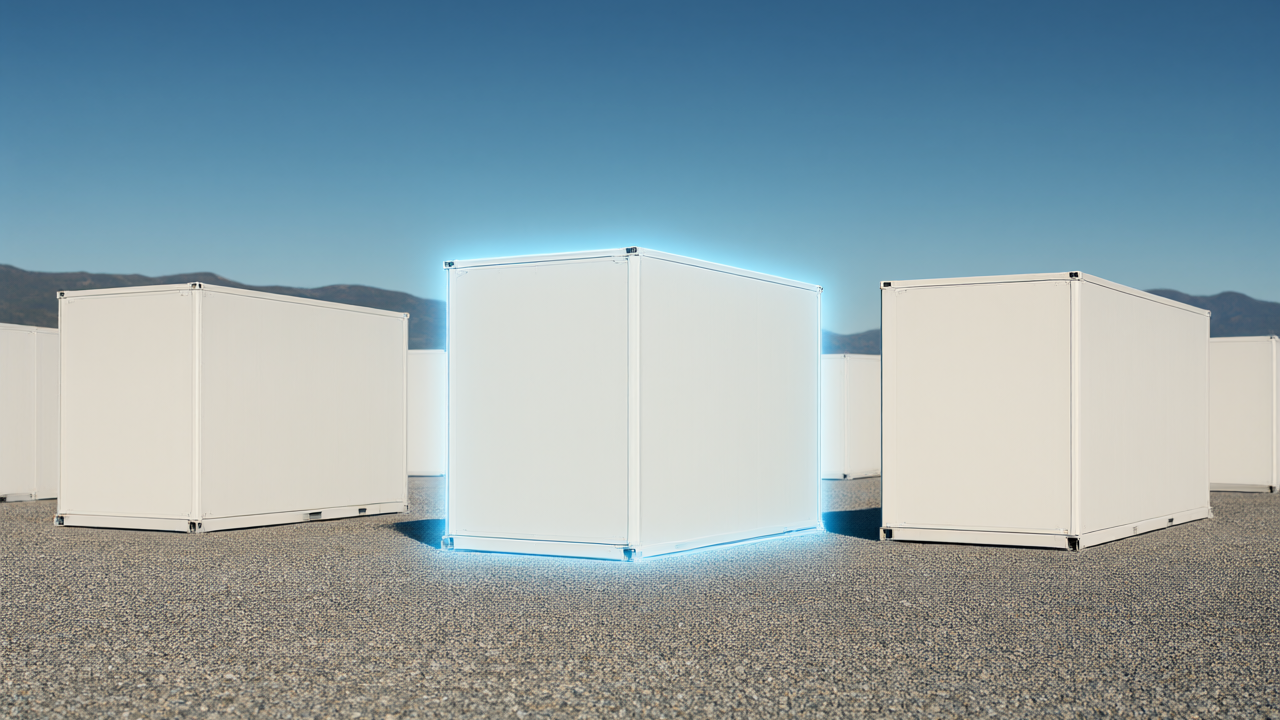
Sungrow has demonstrated that its PowerTitan 3.0 battery energy storage system (BESS) can contain thermal runaway within a single container, preventing fire spread to neighboring units or critical infrastructure. During a large-scale test, the internal temperature of the initiating container peaked at 1,259.8°C over a 7.5-hour period. Despite these temperatures, thermal runaway did not propagate to four adjacent battery containers or the medium-voltage substation, and the initiating container remained structurally intact.
Technical Details
The test configuration simulated a utility-scale installation consisting of 28.56 MWh of fully liquid-cooled PowerTitan 3.0 storage and a 7.4 MW medium-voltage substation. The PowerTitan 3.0 utilizes high-energy-density stacked cells and an integrated AC-block architecture, which houses both the battery system and the DC/AC power converter in a 20-foot container.
To challenge the system’s inherent containment capabilities, the following conditions were applied:
- Batteries were charged to 100% state of charge.
- Containers were positioned in a close, back-to-back arrangement.
- All active fire suppression and thermal management systems were disabled.
- Rooftop pressure-relief panels on the initiating container were opened to maximize oxygen availability.
The test was conducted by UL Solutions, witnessed by the Fire Risk Alliance, and observed by Jensen Hughes, adhering to UL 9540A: 2026 and CSA/ANSI C800-2025 standards.
Background and Significance
PowerTitan 3.0 is the first stacked-cell BESS with an integrated AC-block architecture to complete this specific type of test. Sungrow noted that the physical results aligned with previous simulation-based assessments that analyzed hundreds of potential fire scenarios and operating conditions.
This result marks the completion of large-scale fire tests for all three generations of the PowerTitan platform, with each passing on the first attempt. For utility-scale installations, these findings highlight the critical importance of system-level containment to prevent the spread of thermal runaway between containers, thereby reducing the potential scale of damage.
Get our weekly technology intelligence — free
Receive an infographic that lets you judge at a glance whether each field’s analysis report is worth reading.
Subscribe Free — Weekly Tech Intelligence
By subscribing, you’ll receive Troy-Technical’s weekly technology intelligence newsletter.
- Your email and selected fields are used only to deliver the newsletter.
- We never share your information with third parties.
- You can unsubscribe anytime via the link in each email.
See our Privacy Policy for details.
Takes about a minute · Unsubscribe anytime