
Key Findings
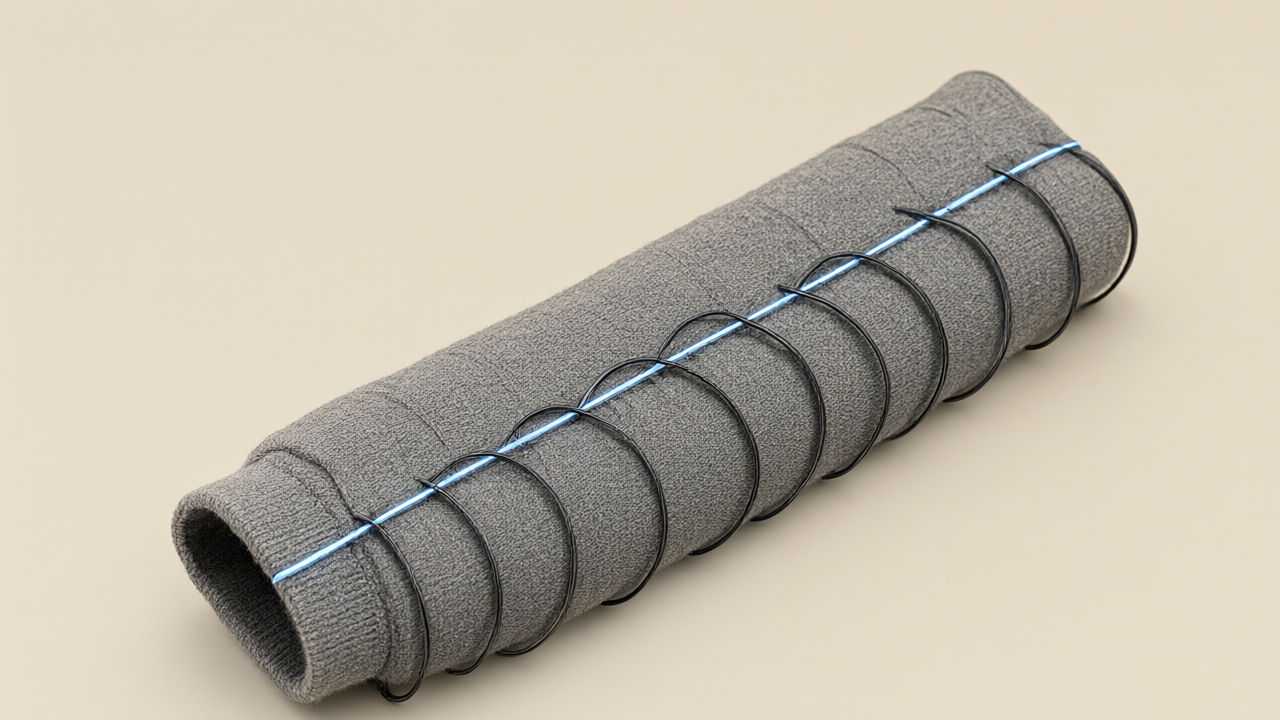
The Korea Institute of Science and Technology (KIST) has developed a fiber-type zinc battery capable of continuous production at meter-scale lengths. In durability tests, the battery retained 89.8% of its initial capacity after 10,000 repeated bending cycles. Additionally, full-cell tests demonstrated that the battery retained 85% of its initial capacity after 800 charge-discharge cycles.
Technical Details
To overcome the common issue of dendrite growth—branching crystals on the zinc anode that degrade performance—the research team introduced oxygen functional groups into carbon nanotubes. This modification densely aligns the nanotubes, guiding zinc ions to deposit evenly across the surface and reducing corrosion reactions and hydrogen evolution during cycling.
The team also implemented a continuous electroplating system to enable mass production. This automated process integrates several stages:
- Fiber feeding
- Zinc plating
- Washing
- Drying
- Winding
This system allowed the production of a 1-meter battery, a ten-fold increase over previous fiber-type zinc batteries which were typically limited to 10 centimeters.
Background and Context
Zinc batteries utilize a water-based electrolyte, offering a lower risk of fire or explosion compared to conventional batteries, making them suitable for wearable applications. Unlike prismatic or cylindrical forms, fiber-type batteries can be sewn into fabrics or wrapped around curved surfaces. The project was a collaboration between KIST’s Jeonbuk Branch Institute for Advanced Materials, Jeonbuk National University, KAIST, and Kangwon National University.
Significance and Outlook
The researchers verified the technology by integrating the fiber battery with a motion-detection sensor and a flexible solar cell into a combat uniform, allowing for daytime charging and nighttime operation. Future applications include distributed power sources for humanoid robot frames and electronic skin. For full commercialization, the team notes that further improvements are required regarding production speed, plating uniformity over long lengths, and stability during washing and exposure to sweat.
Source: https://biz.heraldcorp.com/article/10918971
Get our weekly technology intelligence — free
Receive an infographic that lets you judge at a glance whether each field’s analysis report is worth reading.
Subscribe Free — Weekly Tech Intelligence
By subscribing, you’ll receive Troy-Technical’s weekly technology intelligence newsletter.
- Your email and selected fields are used only to deliver the newsletter.
- We never share your information with third parties.
- You can unsubscribe anytime via the link in each email.
See our Privacy Policy for details.
Takes about a minute · Unsubscribe anytime