Background
The global imperative for sustainable energy solutions continues to drive innovation in renewable technologies, with solar power at the forefront. While incumbent silicon-based photovoltaics have seen widespread adoption, their manufacturing costs, weight, and efficiency still present avenues for improvement. Quantum dot (QD) solar cells have emerged as a promising alternative, offering potential for low-cost manufacturing, flexibility, and enhanced efficiency. Harnessing fundamental quantum mechanical phenomena like Multiple Exciton Generation (MEG) and Singlet Fission (SF) is expected to unlock efficiencies far beyond what conventional solar cells can achieve, thereby accelerating the transition to a cleaner energy future.
Key Findings
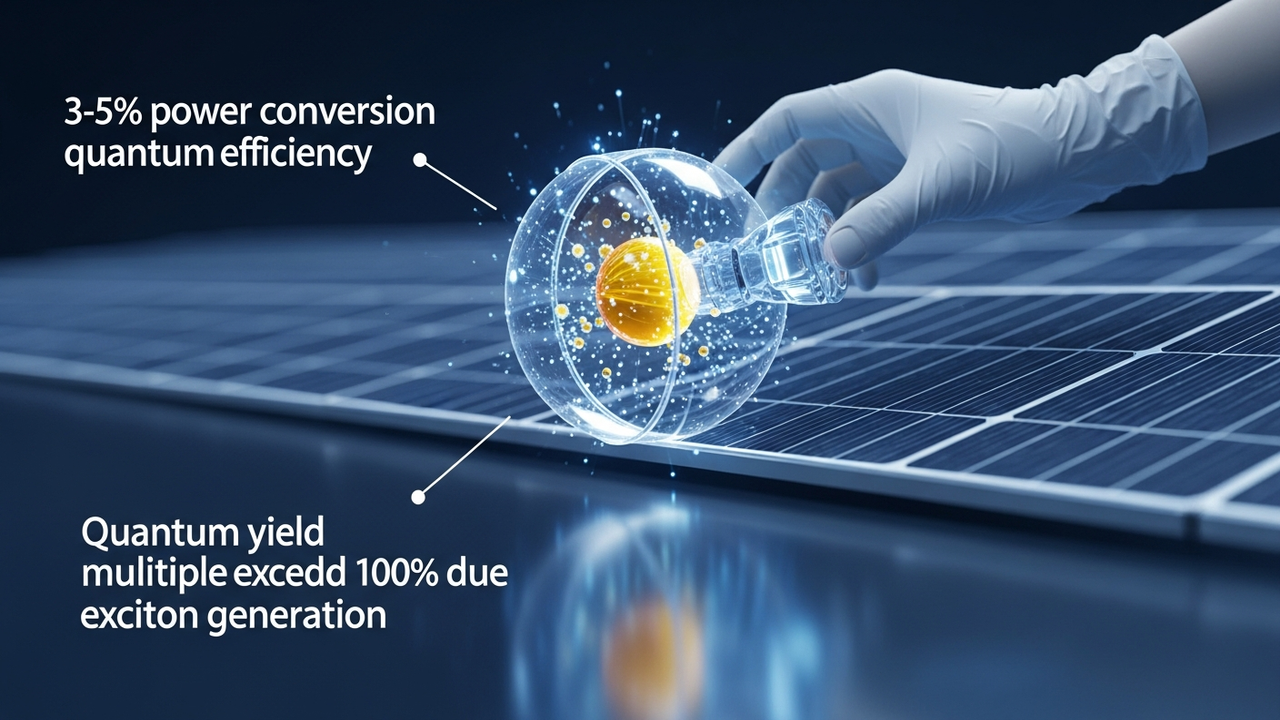
Significant advancements have been made in quantum dot solar cell technology, pushing them forward as a leading contender for next-generation solar energy conversion. Simple all-inorganic QD solar cells have achieved a power conversion efficiency (PCE) of 3-5%. More remarkably, in photon energy regions where high-energy photons induce Multiple Exciton Generation (MEG), a groundbreaking quantum yield (QY) exceeding 100% for photocurrent was recorded. This pivotal achievement holds profound implications, suggesting the potential to realize efficiencies that could surpass the theoretical Shockley-Queisser limit—a long-standing benchmark for single-junction solar cell efficiency.
Technical / Measurement Details
- Power Conversion Efficiency (PCE): Simple all-inorganic QD solar cells demonstrated PCEs of 3-5%.
- Quantum Yield (QY) for Photocurrent: Achieved over 100% in specific photon energy regions conducive to MEG.
- Multiple Exciton Generation (MEG): This critical phenomenon enables the creation of two or more electron-hole pairs from a single high-energy photon. Unlike conventional solar cells that typically generate only one electron-hole pair per photon, MEG directly contributes to quantum yields exceeding 100%, offering a significant boost to theoretical efficiency limits.
- Singlet Fission (SF): The research also explores novel device configurations leveraging Singlet Fission, where one high-energy excited state efficiently splits into two lower-energy excited states. This mechanism further enhances the utilization of absorbed light energy, contributing to overall efficiency improvements.
- Size-Tunable Bandgap: Quantum dots inherently possess a size-tunable bandgap, allowing for efficient absorption across a broad range of the solar spectrum, a key advantage for broadband solar energy harvesting.
These characteristics collectively underscore the exceptional capability of quantum dots to more efficiently harvest solar energy and convert it into electricity, paving the way for a new generation of high-performance photovoltaic devices.
Strategic Significance & Outlook
The demonstration of over 100% QY via MEG in quantum dot solar cells represents a transformative breakthrough for the future of solar energy. Future research and development will strategically focus on optimizing quantum dot materials, meticulously designing device structures to more effectively harness both MEG and SF phenomena, and rigorously verifying long-term stability and scalability. A crucial next step involves developing cost-effective processes for the large-scale manufacturing of these high-performance QD solar cells. Successful commercialization of this technology promises to accelerate the widespread adoption of low-cost, high-efficiency solar cells, significantly diversifying global energy supply, and making substantial contributions to climate change mitigation efforts. Ultimately, QD solar cells are envisioned for a broad spectrum of applications, ranging from residential and industrial power generation to specialized uses in space technologies and beyond.
Source: https://www.researchgate.net/publication/408319061_Quantum_Dot_Solar_Cells
Get our weekly technology intelligence — free
Receive an infographic that lets you judge at a glance whether each field’s analysis report is worth reading.
Subscribe Free — Weekly Tech Intelligence
By subscribing, you’ll receive Troy-Technical’s weekly technology intelligence newsletter.
- Your email and selected fields are used only to deliver the newsletter.
- We never share your information with third parties.
- You can unsubscribe anytime via the link in each email.
See our Privacy Policy for details.
Takes about a minute · Unsubscribe anytime







Comments