
Key Findings
A recent review paper in ACS Publications provides an in-depth examination of LLM-based autonomous agent systems for heterogeneous catalysis research, systematically presenting current challenges and future possibilities in tool integration and closed-loop interaction with robotic platforms. It particularly highlights the potential of hierarchical multi-agent LLM reasoning to dramatically improve catalyst space exploration efficiency.
Technical / Clinical Details
The review details how LLMs can automate various tasks in catalytic science, such as literature review, reaction pathway prediction, and molecular design. LLM-based agents, leveraging their natural language processing capabilities, can extract information from scientific literature, interpret experimental data, and generate new hypotheses. However, challenges remain in seamlessly integrating these agents with physical experimental tools and robotic platforms to realize autonomous ‘self-driving laboratories.’ The review identifies the following key advancements and challenges:
- Tool Integration Challenges: The lack of standardized interfaces and protocols for LLM agents to effectively interact with computational chemistry software (DFT packages, MD simulators) and experimental equipment (spectrometers, reactors).
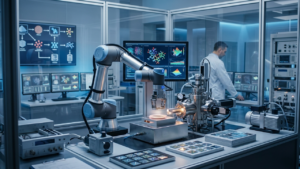
- Closed-Loop Interaction: The need for mechanisms that allow agents to autonomously complete human-like learning cycles, such as revising hypotheses based on experimental results and planning subsequent experiments.
- Hierarchical Multi-Agent Reasoning: An approach that significantly improves exploration efficiency by decomposing complex catalytic search tasks into sub-tasks (e.g., literature analysis, theoretical calculations, experimental planning) and coordinating specialized LLM agents for each.
This approach opens new avenues for more rapidly and efficiently discovering compositions and structures that maximize catalyst performance (activity, selectivity, stability).
Background & Context
Heterogeneous catalysis plays a crucial role in the chemical industry, energy conversion, and environmental protection. However, developing high-performance catalysts is a highly time-consuming and costly process due to the vast search space and complex structure-activity relationships. The advent of AI, particularly LLMs, holds the potential to break this bottleneck and transform the paradigm of catalyst discovery from ‘human-led trial-and-error’ to ‘AI-assisted rational design.’ Autonomous agents are expected to be central to this transformation.
Strategic Significance & Outlook
LLM-based autonomous agent systems will have a revolutionary impact on heterogeneous catalysis research. As tool interoperability and integration with robotic platforms advance, AI will be able to autonomously drive the entire catalyst discovery process. This is expected to dramatically shorten the time to discovery of new catalysts and lead to the development of more efficient and sustainable chemical processes. In the future, these systems could also be applied to autonomous scientific discovery in other areas of materials and life sciences, redefining the future of scientific research.
Source: https://pubs.acs.org/doi/10.1021/acscatal.6c02268
Get our weekly technology intelligence — free
Receive an infographic that lets you judge at a glance whether each field’s analysis report is worth reading.
Subscribe Free — Weekly Tech Intelligence
By subscribing, you’ll receive Troy-Technical’s weekly technology intelligence newsletter.
- Your email and selected fields are used only to deliver the newsletter.
- We never share your information with third parties.
- You can unsubscribe anytime via the link in each email.
See our Privacy Policy for details.
Takes about a minute · Unsubscribe anytime






Comments