Key Findings
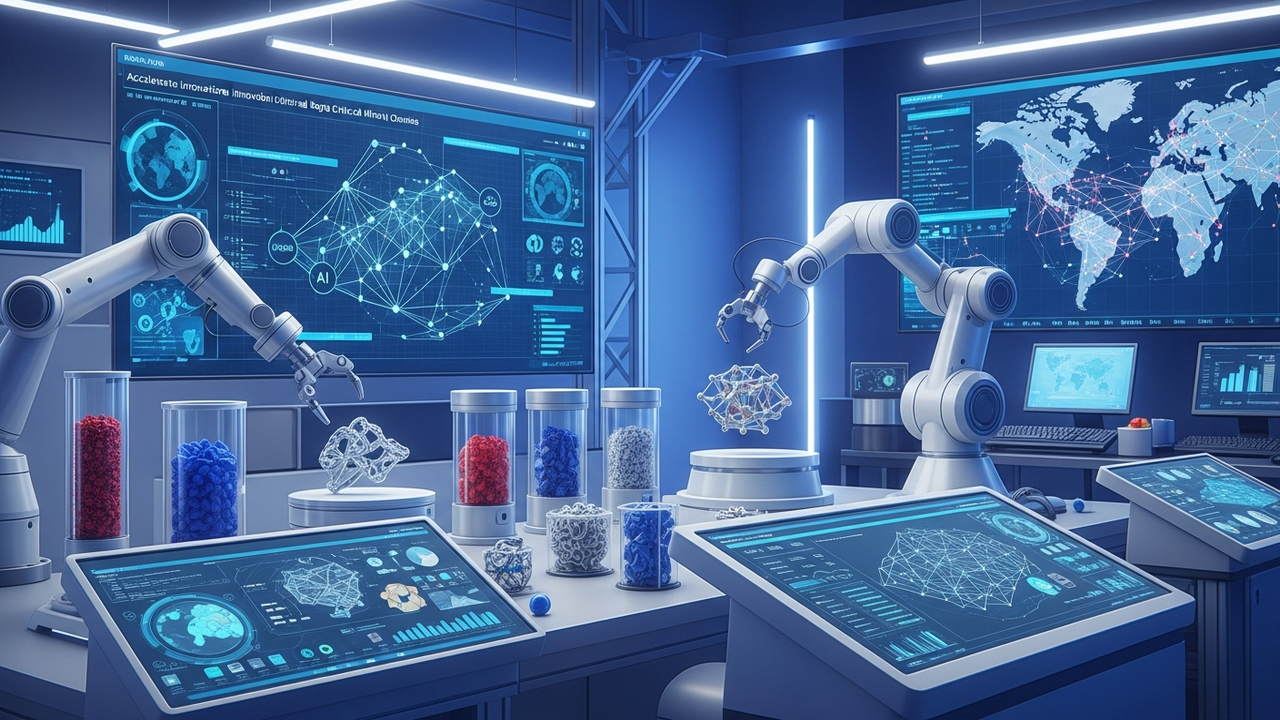
The U.S. Department of Energy (DOE) has announced the deployment of Artificial Intelligence (AI) solutions to strengthen the critical minerals supply chain, essential for the nation’s economy and security. This strategy aims to accelerate the rapid development of alternative materials and reduce supply chain vulnerabilities.
Technical / Clinical Details
Central to the DOE’s strategy is the utilization of physics-based AI models. These AI models are designed to elucidate the complex relationships between a material’s atomic-level structure and its macroscopic properties. Specifically, AI learns from known material databases and first-principles calculations to efficiently ‘inverse design’ alternative materials with new compositions that meet specific functional requirements (e.g., strength, electrical conductivity, corrosion resistance). This accelerates the discovery of materials that can reduce dependence on critical minerals like cobalt and lithium. For example, the ongoing FORESIGHT project at Idaho National Laboratory uses AI to analyze complex supply chain data, identifying bottlenecks, potential risks, and opportunities for diversification. This AI-driven analysis provides strategic insights to optimize the entire supply chain, from material design to procurement, manufacturing, and recycling.
Background & Context
Critical minerals are indispensable resources for modern industries, including renewable energy technologies, defense systems, and electronics. However, the supply of many of these minerals is concentrated in specific countries, making them vulnerable to geopolitical risks and market fluctuations. The U.S. considers addressing these supply chain challenges and increasing domestic resilience an urgent priority. AI is expected to be a powerful tool for solving this complex problem, offering new approaches to accelerate the pace of discovery in materials science and optimize supply chain management.Strategic Significance & Outlook
The DOE’s AI-driven critical minerals strategy will play a vital role in increasing U.S. material self-sufficiency and supporting the transition to a clean energy economy. The discovery of alternative materials through physics-based AI will also lead to the development of new manufacturing processes that are more cost-effective and environmentally friendly. In the future, AI is expected to enable real-time monitoring, risk prediction, and autonomous adjustments across the entire supply chain, building a more resilient and secure critical minerals supply chain. This will bring long-term benefits to both national security and economic prosperity.
Get our weekly technology intelligence — free
Receive an infographic that lets you judge at a glance whether each field’s analysis report is worth reading.
Subscribe Free — Weekly Tech Intelligence
By subscribing, you’ll receive Troy-Technical’s weekly technology intelligence newsletter.
- Your email and selected fields are used only to deliver the newsletter.
- We never share your information with third parties.
- You can unsubscribe anytime via the link in each email.
See our Privacy Policy for details.
Takes about a minute · Unsubscribe anytime







Comments