Key Findings
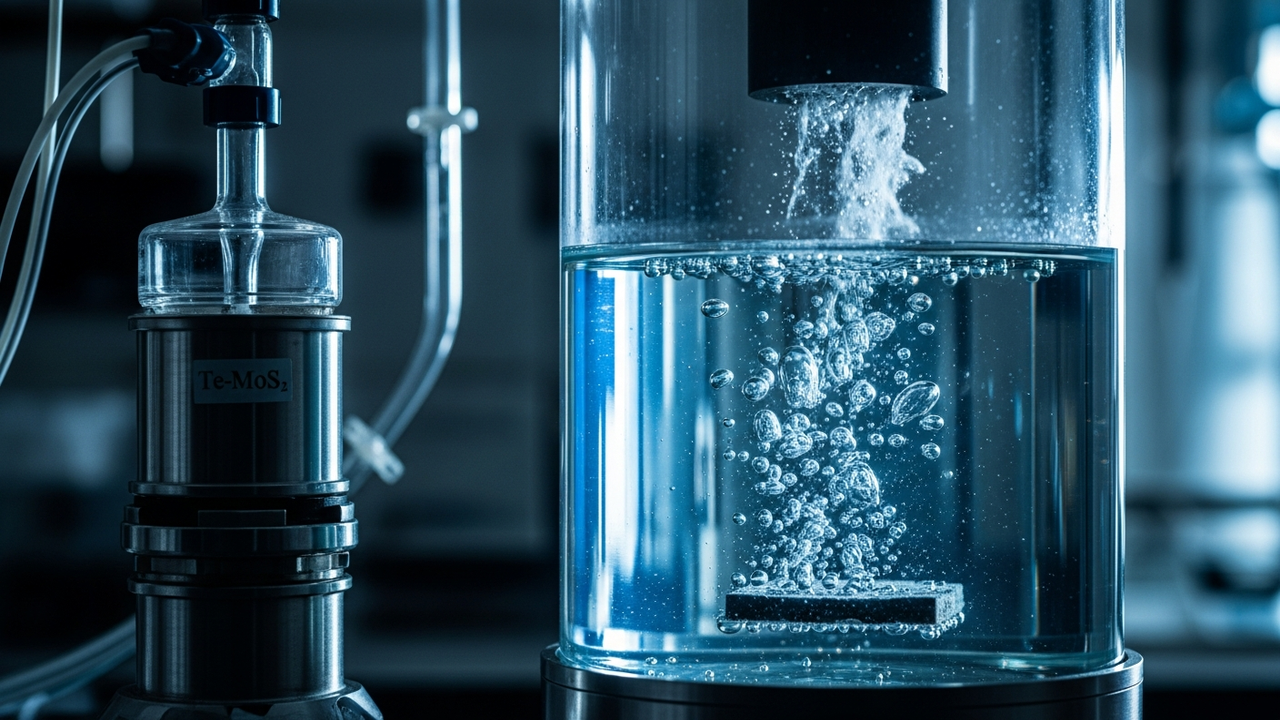
A research team led by Professor DENG Dehui at the Chinese Academy of Sciences has developed a highly efficient and exceptionally stable molybdenum disulfide (MoS₂) based hydrogen evolution catalyst, termed ‘Te-MoS₂,’ using an innovative single-element dual-site substitution strategy. This catalyst significantly expands the potential for green hydrogen production by offering a sustainable and economical alternative to expensive platinum-based catalysts.
Technical Details
The developed Te-MoS₂ catalyst requires a remarkably low overpotential of just 364 mV to achieve an industrially relevant current density of 1000 mA·cm⁻² in acidic electrolyte environments. This performance is outstanding even when compared to existing high-efficiency catalysts. Furthermore, the catalyst has demonstrated stable hydrogen evolution performance for over 200 hours, proving its long-term operational reliability. The dual-site substitution strategy involves introducing a single substituting element (tellurium: Te, in this case) into two distinct sites within the catalyst material to optimize its electronic structure and activity, successfully maximizing the intrinsic catalytic activity of MoS₂.
Background and Industry Context
PEM (Proton Exchange Membrane) water electrolysis is one of the most promising technologies for producing high-purity green hydrogen in conjunction with renewable energy sources. However, the efficiency and economics of this process are significantly bottlenecked by the reliance on expensive and scarce Platinum Group Metal (PGM) catalysts, particularly platinum used in the hydrogen evolution reaction (HER). The research by Professor DENG’s team presents a practical solution to the global challenge of developing PGM-free or PGM-reduced catalysts. High-performance, low-cost HER catalysts are essential for substantially reducing the cost of green hydrogen production and accelerating its widespread adoption.
Strategic Significance and Outlook
The development of this Te-MoS₂ catalyst marks a major step towards the commercialization of green hydrogen production via PEM water electrolysis. Its high efficiency, stability, and relatively low-cost material composition hold significant potential for adoption in future large-scale hydrogen production plants. The research team plans to further scale up this catalyst and advance its integration into actual electrolyzer systems. This breakthrough is poised to contribute to a future where hydrogen energy becomes a primary pillar of a sustainable energy mix.
Source: https://english.cas.cn/newsroom/research-news/202607/t20260715_1178420.shtml
Get our weekly technology intelligence — free
Receive an infographic that lets you judge at a glance whether each field’s analysis report is worth reading.
Subscribe Free — Weekly Tech Intelligence
By subscribing, you’ll receive Troy-Technical’s weekly technology intelligence newsletter.
- Your email and selected fields are used only to deliver the newsletter.
- We never share your information with third parties.
- You can unsubscribe anytime via the link in each email.
See our Privacy Policy for details.
Takes about a minute · Unsubscribe anytime








Comments