Key Findings
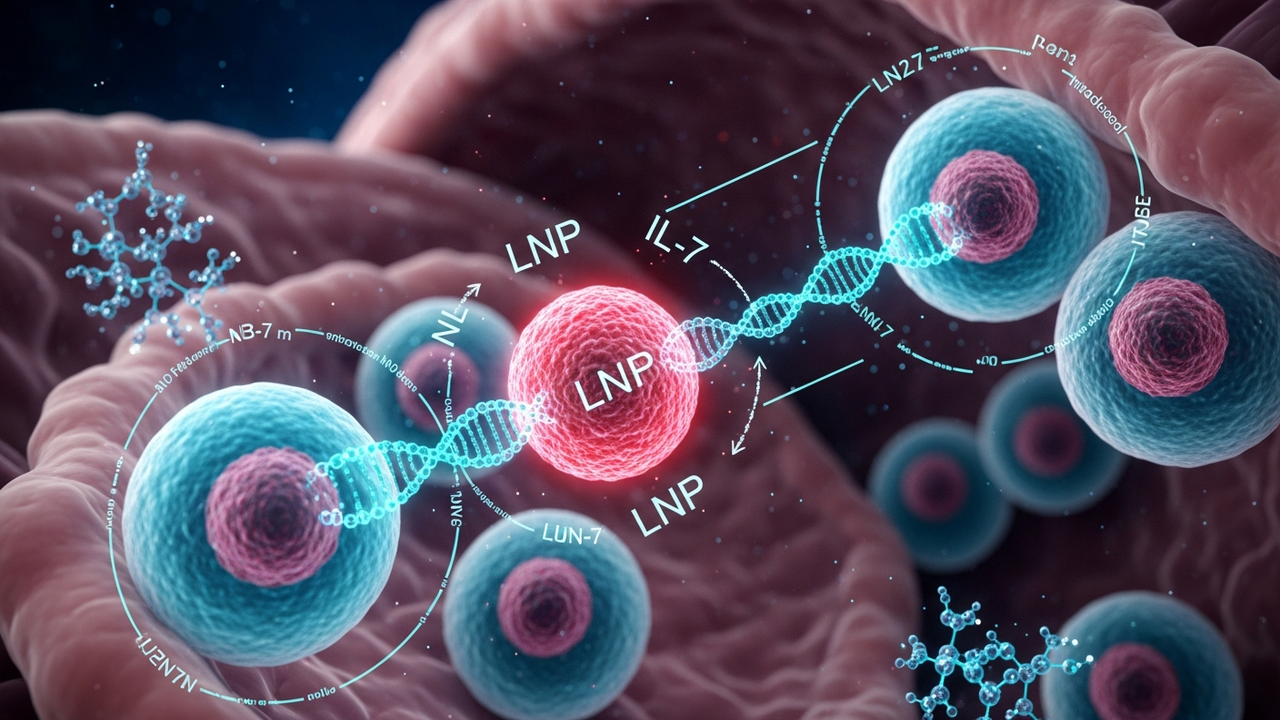
Recent research reports on an improved design for lipid nanoparticles (LNPs) that co-present the cytokine interleukin-7 (IL-7) along with anti-CD3 and anti-CD28 antibodies. This novel LNP design dramatically enhances both particle uptake and gene transfection efficiency in primary human T cells. It successfully delivers chimeric antigen receptor (CAR) mRNA in vivo to generate functional CAR-expressing T cells, marking a significant advancement in T cell-targeted mRNA LNP technology.
Technical & Clinical Details
The LNPs developed in this study achieve T cell-specific targeting and activation simultaneously by co-presenting IL-7, anti-CD3 antibodies, and anti-CD28 antibodies on their surface. IL-7, a cytokine known to promote T cell survival and proliferation, enhances the LNP’s affinity for T cells and improves intracellular uptake efficiency. Crucially, the IL-7-conjugated LNPs were found to selectively bias functional mRNA transfection towards splenic T cells. This is significant as it promotes T cell engineering in the spleen—a central immune organ—while reducing transfection in hepatic T cells, potentially minimizing off-target effects. The in vivo generation of CAR-T cells holds the potential to overcome the complexity, cost, and time constraints associated with traditional ex vivo CAR-T cell manufacturing processes.
Background & Context
CAR-T cell therapy has revolutionized the treatment of hematological cancers, but its manufacturing remains complex and costly, limiting patient access. In vivo CAR-T cell generation is attracting attention as a next-generation approach to address these challenges, enabling simpler and broader application to various cancer types and autoimmune diseases. However, technologies for specifically delivering mRNA to T cells in vivo are still in their nascent stages. This research breaks through this critical technological barrier by improving LNP design and employing the strategy of cytokine co-presentation.Strategic Significance & Outlook
This cytokine co-presenting LNP technology holds immense potential for the development of T cell-targeted mRNA therapeutics. Beyond streamlining in vivo CAR-T cell generation, it could be applied to other T cell-based immunotherapies and treatments for autoimmune diseases where modulation of T cell function is required. Selective delivery to splenic T cells offers a significant advantage in maximizing therapeutic efficacy while potentially reducing off-target side effects. Further preclinical and clinical development is anticipated, which could significantly contribute to the advancement of next-generation T cell immunotherapies and gene therapies.
Source: https://pubmed.ncbi.nlm.nih.gov/42442285
Get our weekly technology intelligence — free
Receive an infographic that lets you judge at a glance whether each field’s analysis report is worth reading.
Subscribe Free — Weekly Tech Intelligence
By subscribing, you’ll receive Troy-Technical’s weekly technology intelligence newsletter.
- Your email and selected fields are used only to deliver the newsletter.
- We never share your information with third parties.
- You can unsubscribe anytime via the link in each email.
See our Privacy Policy for details.
Takes about a minute · Unsubscribe anytime









Comments