Key Findings
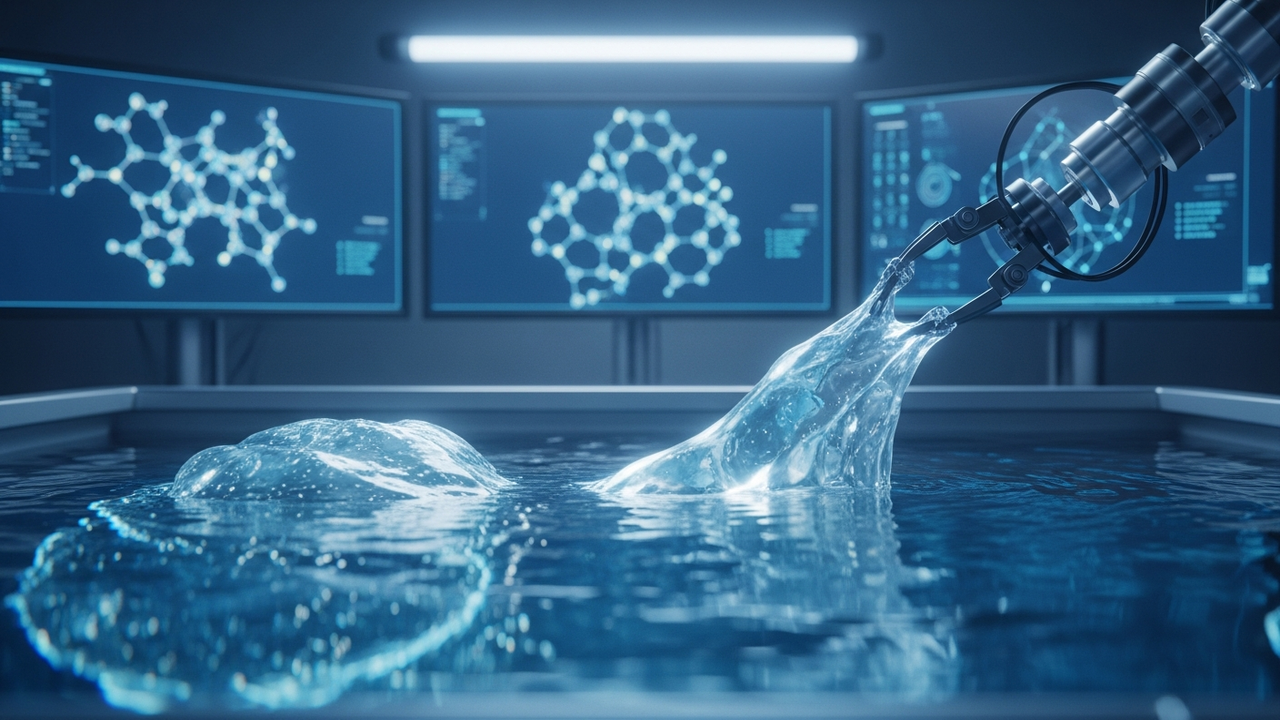
A team of researchers from Osaka University and other collaborating Japanese institutions has developed a groundbreaking super-adhesive hydrogel, designed with AI, that boasts exceptional underwater adhesion, robust self-healing abilities, and high mechanical strength. This achievement represents a significant leap beyond the limitations of conventional materials development processes.
Technical / Clinical Details
The discovery of this novel hydrogel was facilitated by an AI-driven framework that integrated machine learning with high-throughput experimentation. The research team trained AI models on vast datasets concerning material composition, structure, and intermolecular interactions. The AI then predicted candidate materials optimized simultaneously for multiple properties such as underwater adhesion, self-healing, and mechanical strength. This approach dramatically shortened the development time compared to conventional, empirical trial-and-error methods. Specifically, the hydrogel achieves strong adhesion to surfaces underwater through the formation of robust molecular-level interactions within its hydrophilic polymer network and specific crosslinking agents. Even when damaged, it can self-repair by utilizing ambient water to reform its molecular chains. Its high mechanical strength ensures resilience against various physical stresses.
Background & Context
Many traditional adhesives face a critical challenge: their performance significantly degrades in aqueous environments. However, there is a growing demand for materials with underwater adhesive and self-healing properties across various fields, including biomedical applications (for internal body use), soft robotics (for underwater manipulation), and marine engineering (for repairing underwater structures). Prior material development processes required extensive experimentation and prolonged trial-and-error, making it exceptionally difficult to simultaneously optimize multiple complex properties. AI-driven frameworks offer a powerful solution to this challenge, promising to dramatically accelerate the development process.
Strategic Significance & Outlook
This AI-designed super-adhesive hydrogel is expected to find applications in a wide array of fields, including medical adhesives (e.g., tissue adhesion during surgery), wearable electronics (e.g., underwater sensor attachment), soft robotics, underwater repair, and even biomimetic materials. Its biocompatibility also opens doors for contributions to next-generation medical devices and regenerative medicine. This technology stands as a potent example of innovation driven by the convergence of AI and materials science, poised to reshape the future of material development.
Get our weekly technology intelligence — free
Receive an infographic that lets you judge at a glance whether each field’s analysis report is worth reading.
Subscribe Free — Weekly Tech Intelligence
By subscribing, you’ll receive Troy-Technical’s weekly technology intelligence newsletter.
- Your email and selected fields are used only to deliver the newsletter.
- We never share your information with third parties.
- You can unsubscribe anytime via the link in each email.
See our Privacy Policy for details.
Takes about a minute · Unsubscribe anytime




Comments