Key Findings
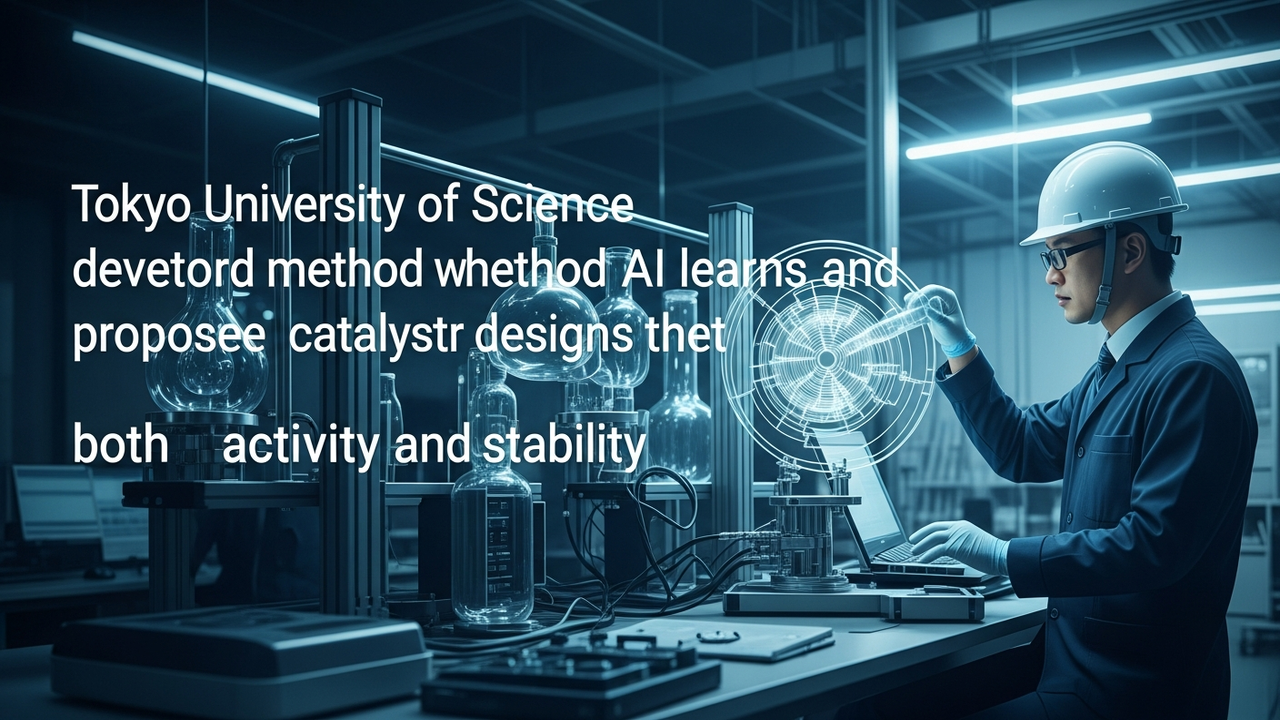
A research team at Tokyo University of Science has developed a novel AI-assisted method to design catalysts that successfully achieve both high activity and high stability, a critical challenge in catalyst development. The AI learned complex patterns and autonomously proposed promising catalyst structures that balance these two often-conflicting properties.
Technical / Clinical Details
The research team leveraged extensive datasets of existing catalysts and their physicochemical properties to train a machine learning model. The AI learned the intricate relationships between structural features, elemental composition, and electronic states that influence both catalyst activity and stability. As a result, the AI was able to propose novel structures that closely resembled previously identified promising catalysts or offered superior potential. This AI-assisted approach enables a dramatic reduction in the design cycle compared to traditional trial-and-error methods. Given that catalyst development typically requires extensive experimentation and prototyping, AI-driven filtering of design candidates significantly enhances research efficiency.
Background & Context
Catalysts are indispensable materials in the chemical and energy industries, contributing significantly to improved reaction efficiency and reduced environmental impact. However, the dual goals of high activity and high stability often present a trade-off, making the simultaneous achievement of both in catalyst design extremely difficult. Furthermore, many specialized catalysts rely on scarce precious metals, necessitating more efficient development methods from the perspectives of sustainability and cost reduction. This AI-assisted design method offers a powerful solution to these critical challenges.
Strategic Significance & Outlook
This AI-assisted catalyst design method holds significant promise for applications across a wide range of fields, including battery materials, fuel cells, and chemical synthesis processes. As a crucial step towards inverse design, the ability to ‘back-calculate’ material structures from desired functionalities can reduce dependence on scarce resources and foster more sustainable material development. In the future, this technology could serve as a foundational element for fully autonomous ‘self-driving labs’ capable of discovering and optimizing catalysts independently.
Source: https://www.scitech.tokyo/news/ai-catalyst-discovery/
Get our weekly technology intelligence — free
Receive an infographic that lets you judge at a glance whether each field’s analysis report is worth reading.
Subscribe Free — Weekly Tech Intelligence
By subscribing, you’ll receive Troy-Technical’s weekly technology intelligence newsletter.
- Your email and selected fields are used only to deliver the newsletter.
- We never share your information with third parties.
- You can unsubscribe anytime via the link in each email.
See our Privacy Policy for details.
Takes about a minute · Unsubscribe anytime







Comments