Key Findings
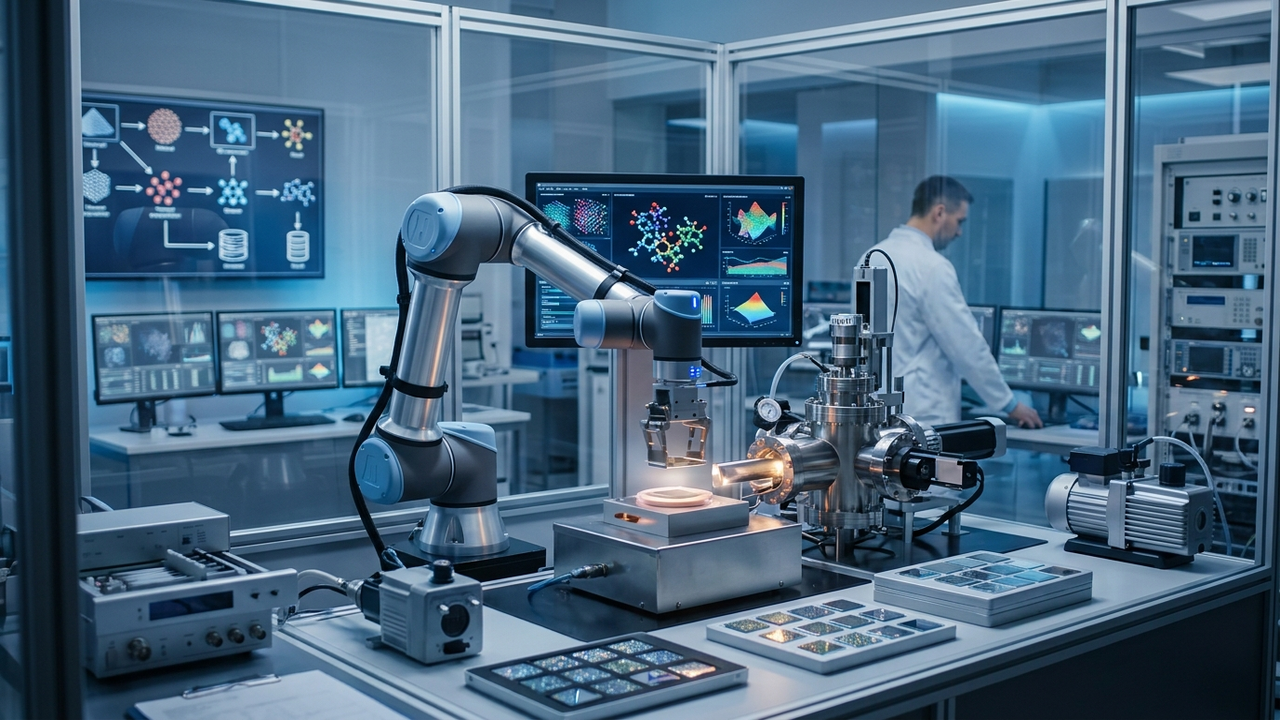
A research team in the U.S. has demonstrated that their multimodal LLM agent, ‘SynAgent,’ can autonomously synthesize highly crystalline LiCoO2 (001) thin films and comprehensively understand how substrate temperature governs crystallization, all within a mere 18 experiments. This efficiency marks a substantial leap forward, promising significant reductions in the time and cost typically associated with trial-and-error materials development.
Technical / Clinical Details
SynAgent is an agent powered by GPT-5.5, capable of multimodal reasoning using diverse experimental data, including X-ray diffraction patterns and electron micrographs. This capability allows it to maintain a clear understanding of the synthesis process and automatically evolve its hypotheses based on experimental outcomes. In the complex materials system of LiCoO2 (001) thin film deposition, SynAgent not only achieved the target of high crystallinity but also identified the precise impact of subtle substrate temperature variations on crystal growth. This approach showcases its ability to mimic and extend human expert intuition in optimizing chemical reaction pathways and exploring novel material synthesis conditions.
Background & Context
The field of materials science constantly seeks new functional materials, but the discovery and development process is traditionally resource-intensive, requiring extensive experimentation and specialized knowledge over long periods. While AI and machine learning have advanced materials design, SynAgent goes further by automating the entire cycle—from experiment execution and interpretation to designing subsequent experiments, achieving ‘autonomous synthesis.’ This advancement is particularly critical for areas like lithium-ion battery material development, where accelerating the research cycle can yield transformative impacts.
Strategic Significance & Outlook
Autonomous materials synthesis platforms like SynAgent are poised to accelerate material discovery and optimization across a broad spectrum of fields, including battery technologies, catalysts, and pharmaceuticals. Future work aims to expand its application to more complex synthesis routes and multicomponent material systems. This technology has the potential to fundamentally transform the paradigm of materials science research, overcoming the ‘discovery bottleneck’ by integrating high-precision data analysis with logical reasoning, thereby contributing significantly to the realization of a sustainable society.
Source: https://arxiv.org/html/2609.18598v1
Get our weekly technology intelligence — free
Receive an infographic that lets you judge at a glance whether each field’s analysis report is worth reading.
Subscribe Free — Weekly Tech Intelligence
By subscribing, you’ll receive Troy-Technical’s weekly technology intelligence newsletter.
- Your email and selected fields are used only to deliver the newsletter.
- We never share your information with third parties.
- You can unsubscribe anytime via the link in each email.
See our Privacy Policy for details.
Takes about a minute · Unsubscribe anytime





Comments