Key Findings
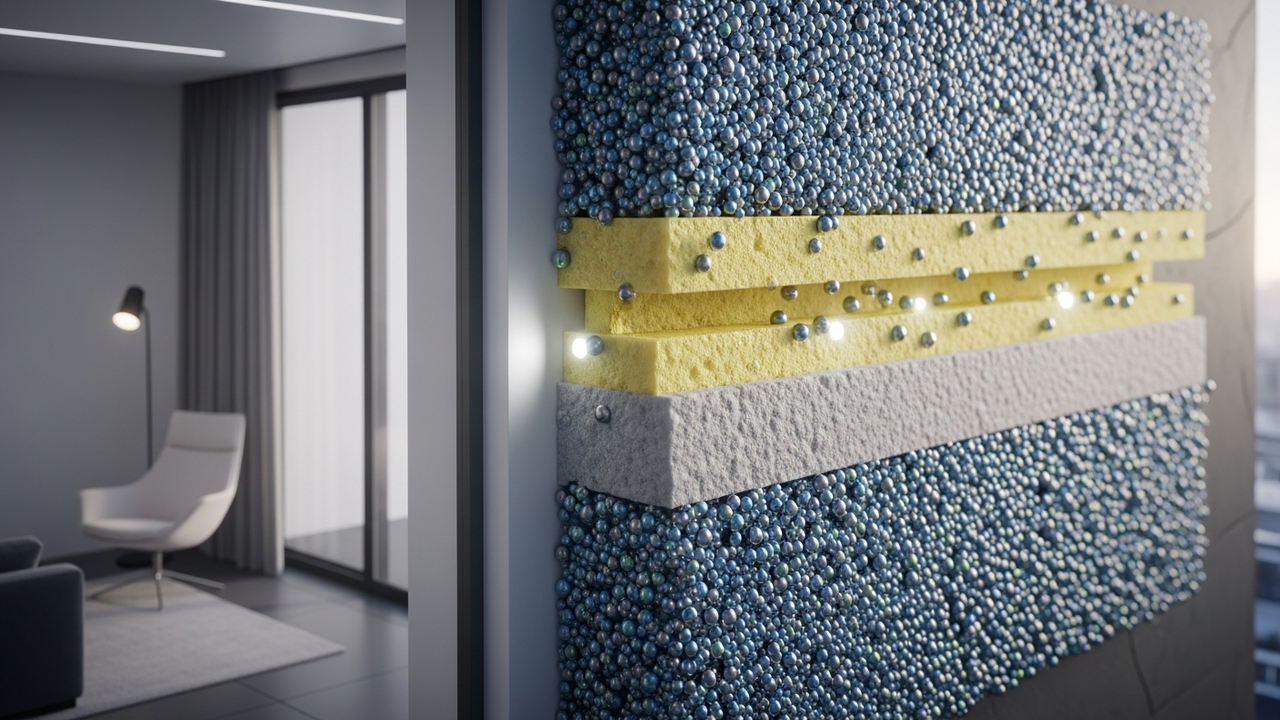
In recent research, an innovative material with dual thermal and acoustic insulation capabilities has been developed by integrating phase change material (PCM) microcapsules into polyurethane foam. This ‘dual-purpose’ foam, when applied to building envelopes, efficiently moderates diurnal temperature fluctuations and significantly cuts heating energy consumption. Notably, the PCM microcapsules demonstrate a high heat storage capacity of 40-60 J/m² while preserving the excellent acoustic insulation properties inherent to polyurethane foam. This marks a significant technological advancement that simultaneously addresses building energy efficiency and living environment comfort.
Technical / Clinical Details
In this study, PCM microcapsules with an n-tetradecane core were synthesized and then uniformly dispersed during the polyurethane foam manufacturing process. N-tetradecane, with a phase change temperature of approximately 6°C, is ideally suited for diurnal temperature management in buildings in cold regions. The PCM microcapsules exert a ‘thermal buffering’ effect, stabilizing indoor temperatures by absorbing heat and liquefying when ambient temperatures reach their melting point, and releasing latent heat when temperatures drop. Experimental results show that the PCM-integrated foam reduced peak heat flux by up to 30% and suppressed internal temperature fluctuations by 5°C compared to foam without PCM. Simultaneously, acoustic transmission loss tests demonstrated that the PCM composite foam maintained acoustic insulation performance comparable to or superior to conventional polyurethane foam, exhibiting excellent sound blocking across a wide frequency range. This proves the potential to solve two critical problems—energy efficiency and noise reduction—with a single material.
Background & Context
In modern architecture, energy efficiency and occupant comfort are paramount design considerations. Especially in cold climates, heating energy consumption is high, and in urban areas, blocking external noise is crucial. Traditional insulation materials primarily focus on increasing thermal resistance, and achieving both temperature moderation and acoustic performance has not always been straightforward. Phase change materials are attracting attention as a promising technology to level out heating and cooling loads and reduce energy consumption by increasing a building’s ‘thermal mass’ through their heat storage capabilities. This integration of PCM with polyurethane foam aligns with the trend towards multifunctional building materials, offering more high-performance and sustainable architectural solutions.
Strategic Significance & Outlook
This dual-purpose insulating foam is expected to find applications in a wide range of buildings, including residential, commercial, and industrial facilities. Future research will focus on improving the long-term thermal and mechanical stability of PCM microcapsules, developing cost-effective manufacturing processes, and evaluating fire safety. Furthermore, the combination of PCMs with different phase change temperatures and the introduction of nanocomposite material technologies could lead to the development of products tailored to diverse climatic conditions and specific needs. The widespread adoption of this innovative material technology will represent a significant step for the construction industry in providing more sustainable and comfortable living spaces and contributing to global energy consumption reduction.
Source: https://pubs.acs.org/doi/10.1021/acsapm.6c01415
Get our weekly technology intelligence — free
Receive an infographic that lets you judge at a glance whether each field’s analysis report is worth reading.
Subscribe Free — Weekly Tech Intelligence
By subscribing, you’ll receive Troy-Technical’s weekly technology intelligence newsletter.
- Your email and selected fields are used only to deliver the newsletter.
- We never share your information with third parties.
- You can unsubscribe anytime via the link in each email.
See our Privacy Policy for details.
Takes about a minute · Unsubscribe anytime



Comments