Key Findings
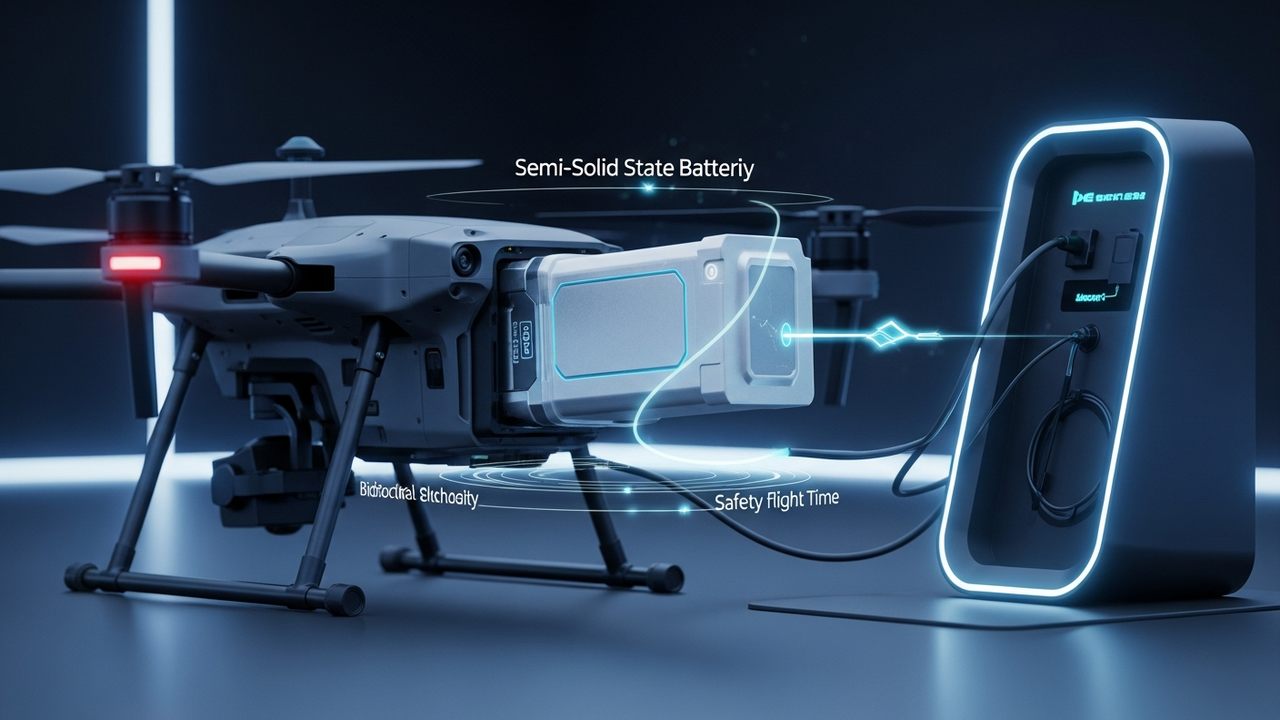
Tattu has unveiled a groundbreaking semi-solid-state battery specifically designed for the commercial drone market. This new battery boasts an impressive energy density of 350 Wh/Kg and an extended lifespan exceeding 1,200 charge cycles. These performance metrics are achieved through innovative “dual electrolyte innovations,” which include solid-state electrolyte coatings and in-situ gel electrolyte solidification. This technology minimizes the use of liquid electrolyte and effectively suppresses dendrite growth, thereby extending drone flight durations and substantially enhancing both safety and reliability.
Technical Details
Commercial drones demand long flight times, high power output, and reliable operation in diverse and often harsh environments. Conventional liquid-electrolyte lithium-ion batteries have inherent limitations in safety (fire risk) and energy density. Tattu’s semi-solid-state battery addresses these challenges by employing a “dual electrolyte innovation.” Firstly, a thin solid-state electrolyte coating is applied to electrode surfaces, suppressing parasitic side reactions at the interface and preventing dendrite nucleation. Secondly, a small amount of liquid electrolyte within the cell is solidified in-situ into a gel, maintaining flexibility while ensuring high ionic conductivity. This dual approach minimizes liquid electrolyte content, dramatically improving thermal stability and significantly reducing the risk of leakage and fire. The result is a high energy density of 350 Wh/Kg and a lifespan of over 1,200 cycles, which drastically improves drone operational efficiency and safety.
Background & Context
The commercial drone market is rapidly expanding across various sectors, including logistics, inspection, agriculture, and disaster response. These applications require longer flight times, greater payload capacities, and stable operation under extreme temperatures, which existing battery technologies have struggled to fully meet. Semi-solid-state batteries are emerging as a pragmatic solution to significantly surpass current lithium-ion battery performance, particularly as all-solid-state batteries still face challenges in large-scale production. Tattu’s announcement is a significant example of how advancements in battery technology are broadening the possibilities within the drone industry.
Strategic Significance & Outlook
The semi-solid-state battery unveiled by Tattu is poised to bring a significant transformation to the commercial drone market. Its 350 Wh/Kg energy density and 1,200+ cycle life will substantially extend drone flight ranges and reduce operational costs by decreasing the need for frequent battery replacements. Enhanced safety could also contribute to more relaxed regulations for drone operations in urban and hazardous areas. Moving forward, Tattu is expected to further evolve this technology and integrate it into a diverse range of industrial drone platforms, accelerating the creation of new services and business models powered by drones. This will significantly contribute to the growth and development of the entire commercial drone industry.
Get our weekly technology intelligence — free
Receive an infographic that lets you judge at a glance whether each field’s analysis report is worth reading.
Subscribe Free — Weekly Tech Intelligence
By subscribing, you’ll receive Troy-Technical’s weekly technology intelligence newsletter.
- Your email and selected fields are used only to deliver the newsletter.
- We never share your information with third parties.
- You can unsubscribe anytime via the link in each email.
See our Privacy Policy for details.
Takes about a minute · Unsubscribe anytime









Comments