Key Findings
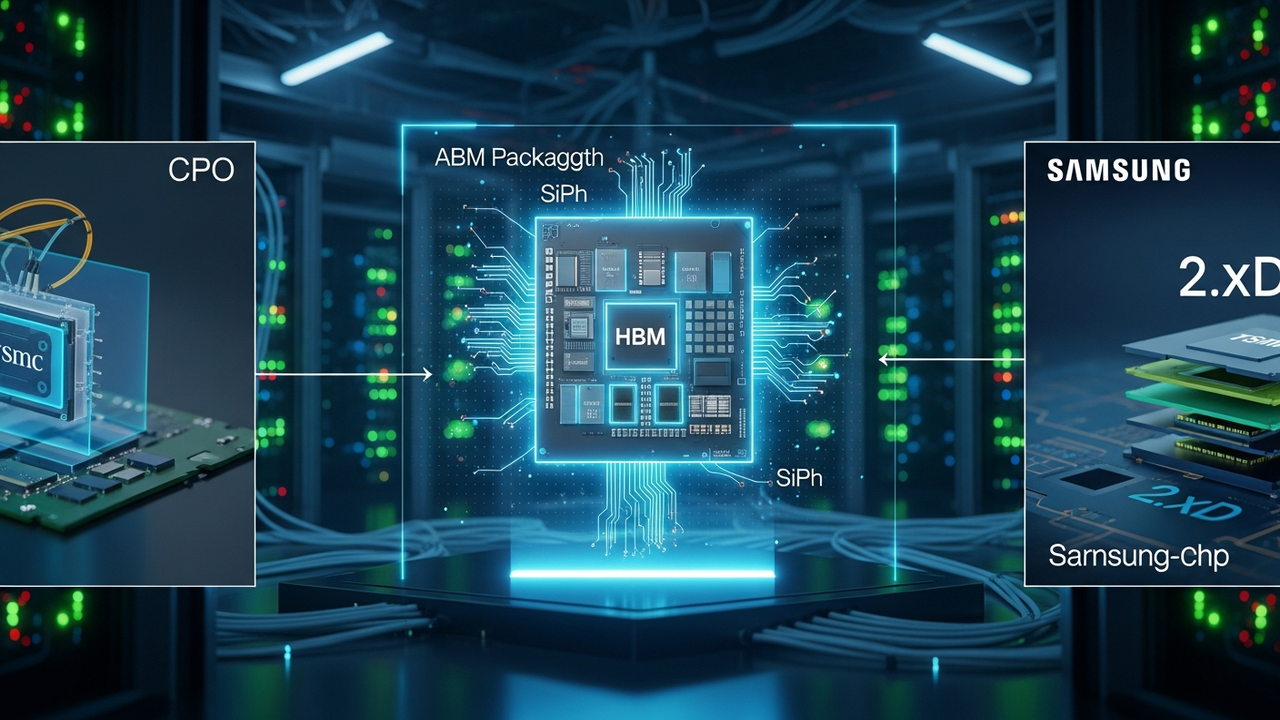
TSMC has established a leading position in the data center co-packaged optics (CPO) switch market, having already commenced sampling or shipping products in collaboration with Broadcom and NVIDIA. Simultaneously, Samsung is actively developing ‘2.xD’ advanced packaging technology that integrates high-bandwidth memory (HBM), logic chips, and silicon photonic (SiPh) chips into a single package, focusing on resolving future optical I/O challenges in AI computing.
Technical and Clinical Details
TSMC’s CPO technology dramatically shortens data transmission distances by physically packaging optical engines and electrical chips in close proximity, thereby improving power efficiency and bandwidth. This directly addresses network bottlenecks and power consumption issues in data centers. Samsung’s ‘2.xD’ packaging, on the other hand, integrates SiPh chips alongside HBM and logic chips, enabling optical signal data transmission within and between chips. This technology specifically targets the enormous data transfer volumes and power consumption challenges of AI data centers. Samsung leverages its unique ‘triple-play’ portfolio, which includes DRAM (HBM), logic foundry, and silicon photonics, providing a distinct advantage in co-designing and optimizing these components internally. This internal capability holds the potential for system-level performance optimization and cost efficiency.
Background and Industry Context
The evolution of AI has significantly increased demands not only for semiconductor chip computational power but also for inter-chip and inter-system data transmission bandwidth. Traditional electrical signal transmission faces physical limitations and power consumption challenges. Advanced packaging technologies like CPO and ‘2.xD’ aim to overcome these hurdles by enabling optical signal transmission at the chip level, thus laying the groundwork for next-generation AI infrastructure. TSMC, as a leading foundry, is pioneering CPO technology in collaboration with key customers. Meanwhile, Samsung leverages its vertically integrated strengths, from memory to foundry, to differentiate itself with comprehensive, proprietary solutions.
Strategic Significance and Outlook
The widespread adoption of TSMC’s CPO technology will bring about a major transformation in data center architectures, improving the efficiency of AI workloads. Samsung’s ‘2.xD’ packaging technology has the potential to establish new standards in future AI chip design, offering a comprehensive solution to power and performance challenges. The technological rivalry between these two giants is critically important for shaping the future of AI computing, indicating the advent of an era where optical I/O technology becomes mainstream in semiconductor packaging. Researchers, engineers, and investors must closely monitor the advancements in these advanced packaging technologies and their implications for AI infrastructure.
Source: https://www.kucoin.com/news/flash/tsmc-leads-in-switch-cpo-samsung-bets-on-future-ai-packaging
Get our weekly technology intelligence — free
Receive an infographic that lets you judge at a glance whether each field’s analysis report is worth reading.
Subscribe Free — Weekly Tech Intelligence
By subscribing, you’ll receive Troy-Technical’s weekly technology intelligence newsletter.
- Your email and selected fields are used only to deliver the newsletter.
- We never share your information with third parties.
- You can unsubscribe anytime via the link in each email.
See our Privacy Policy for details.
Takes about a minute · Unsubscribe anytime





Comments