Key Findings
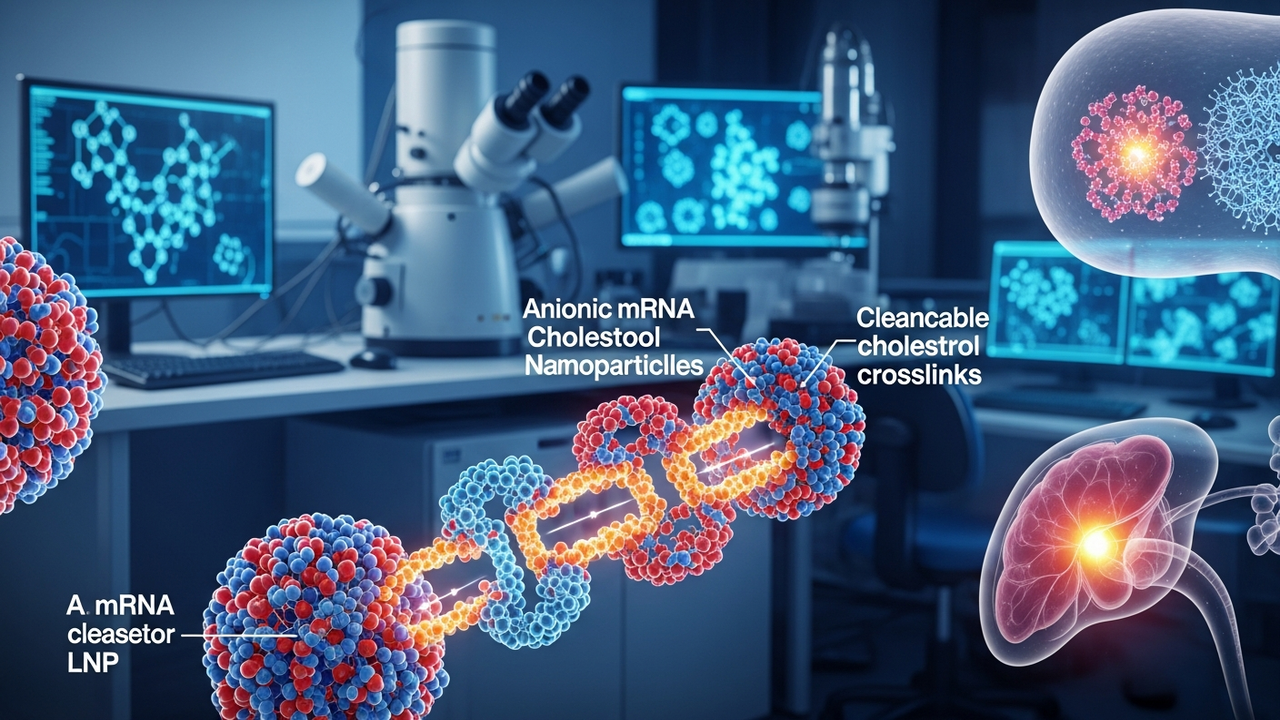
This research successfully developed a novel approach to enhance the stability of anionic mRNA lipid nanoparticles (LNPs) through cleavable crosslinking of cholesterol. This innovative method overcomes conventional stability challenges, significantly broadening the design flexibility for targeted mRNA delivery to specific tissues and cells.
Technical / Clinical Details
The research team successfully crosslinked cholesterol using pH-responsive linkers, which effectively inhibited LNP aggregation and improved stability under near-neutral physiological pH conditions, thus reducing the risk of premature degradation and off-target delivery in vivo. When the optimized crosslinked formulation was administered intravenously in a mouse model, it resulted in approximately a twofold increase in splenic mRNA expression and markedly improved transfection efficiency compared to non-crosslinked LNPs. This selective delivery to the spleen is critically important for vaccines and immunotherapies targeting specific immune cells. Furthermore, the incorporation of cleavable linkers ensures efficient mRNA release intracellularly, which is expected to maximize therapeutic efficacy. This technology is adaptable to various mRNA payloads and lipid chemistries, positioning it as a versatile platform for future mRNA drug development.
Background & Context
mRNA therapeutics have garnered immense attention across diverse fields, including cancer treatment, gene therapy, and regenerative medicine, since their efficacy was demonstrated in COVID-19 vaccines. However, mRNA’s inherent instability in vivo and the necessity for efficient intracellular delivery make lipid nanoparticles indispensable. Traditional LNPs, especially when encapsulating anionic mRNA, have faced challenges in stability and tissue-specific delivery efficiency. The crosslinked cholesterol-based LNPs developed in this study offer a promising solution to these issues, potentially accelerating the development of enhanced mRNA vaccines and tailor-made mRNA therapies for specific diseases.
Strategic Significance & Outlook
This cleavable cholesterol crosslinking technology opens new frontiers for mRNA-LNP design and application. The enhanced splenic delivery is particularly advantageous for inducing immune responses targeting B and T cells, potentially leading to groundbreaking advancements not only in infectious disease vaccines but also in cancer immunotherapy. Future steps will involve combining this technology with surface modification techniques to enable specific delivery to other tissues and cell types, as well as conducting human clinical trials to validate safety and efficacy. This innovation is poised to become a cornerstone technology for realizing personalized medicine, offering precise and potent therapeutic interventions.
Source: https://pubmed.ncbi.nlm.nih.gov/42461776
Get our weekly technology intelligence — free
Receive an infographic that lets you judge at a glance whether each field’s analysis report is worth reading.
Subscribe Free — Weekly Tech Intelligence
By subscribing, you’ll receive Troy-Technical’s weekly technology intelligence newsletter.
- Your email and selected fields are used only to deliver the newsletter.
- We never share your information with third parties.
- You can unsubscribe anytime via the link in each email.
See our Privacy Policy for details.
Takes about a minute · Unsubscribe anytime








Comments