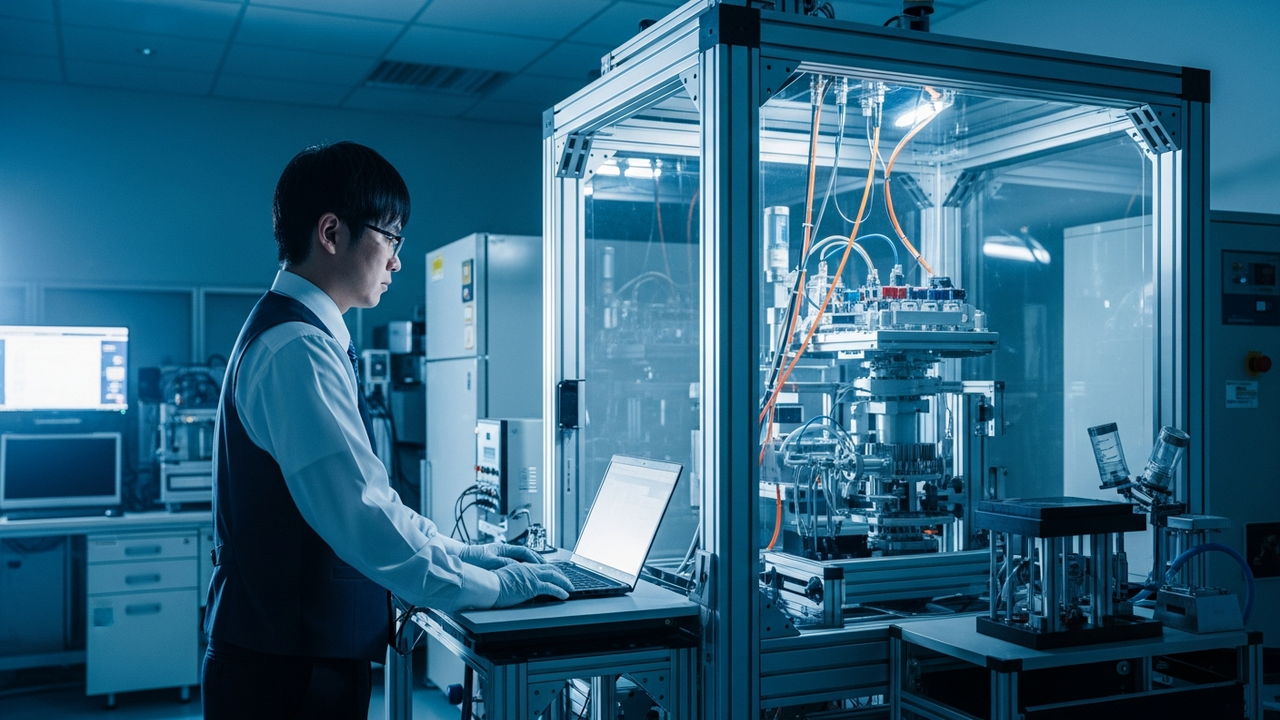
Background: Addressing Material Development Bottlenecks with AI
Traditional material development has historically relied heavily on trial-and-error experimentation, a process that is both time-consuming and prohibitively expensive. In the critical clean energy sector, the rapid development of high-performance, cost-effective new materials is directly linked to addressing global energy challenges, creating an urgent demand for increased efficiency in discovery. Artificial intelligence (AI) and materials informatics are emerging as pivotal solutions to overcome these bottlenecks, delivering accelerated development timelines and improved success rates through data-driven approaches. The integration of advanced computational methods with robotic experimentation represents a paradigm shift from traditional, sequential R&D models.
Key Innovation: An AI-Powered Closed-Loop System for Accelerated Material Discovery
Researchers at Tohoku University have pioneered a “closed-loop” system that seamlessly integrates AI models, autonomous experimentation, and continuous feedback mechanisms into a unified research platform. This cutting-edge framework is designed to encompass all stages of material exploration, poised to dramatically accelerate the discovery process for next-generation materials critical for clean energy technologies such as batteries and hydrogen storage, while substantially reducing associated development costs.
Technical Details: Autonomous Discovery via MLIPs, LLMs, and AI Agents
The system harnesses its powerful capabilities by combining several advanced technologies. It leverages extensive material databases and employs high-precision machine learning interatomic potentials (MLIPs) to predict atomic-level behaviors with high fidelity. Furthermore, large language models (LLMs) and intelligent AI agents collaborate to autonomously manage tasks ranging from complex scientific literature analysis and experimental design to the execution of automated laboratory workflows. This holistic automation of the entire materials discovery pipeline—from data collection and AI modeling to autonomous experimentation and potential industrial deployment—enables efficient exploration and development of optimized materials with minimal human intervention.
Strategic Impact and Outlook: Accelerating Sustainable Solutions
Tohoku University’s proposed closed-loop system holds significant potential to contribute to the realization of a sustainable society by accelerating the discovery and development of advanced clean energy materials. Innovations in battery performance, improvements in hydrogen storage efficiency, and advancements in CO2 separation membranes will directly enhance energy conversion efficiency and reduce greenhouse gas emissions. Beyond academic research, this technology is expected to drive the adoption of new material technologies across diverse industrial sectors, including manufacturing, energy, and automotive industries, thereby fostering competitive advantages and catalyzing further innovation. Its impact could redefine industrial R&D methodologies globally, setting new benchmarks for efficiency and effectiveness in material science.
Get our weekly technology intelligence — free
Receive an infographic that lets you judge at a glance whether each field’s analysis report is worth reading.
Subscribe Free — Weekly Tech Intelligence
By subscribing, you’ll receive Troy-Technical’s weekly technology intelligence newsletter.
- Your email and selected fields are used only to deliver the newsletter.
- We never share your information with third parties.
- You can unsubscribe anytime via the link in each email.
See our Privacy Policy for details.
Takes about a minute · Unsubscribe anytime








Comments