Key Findings
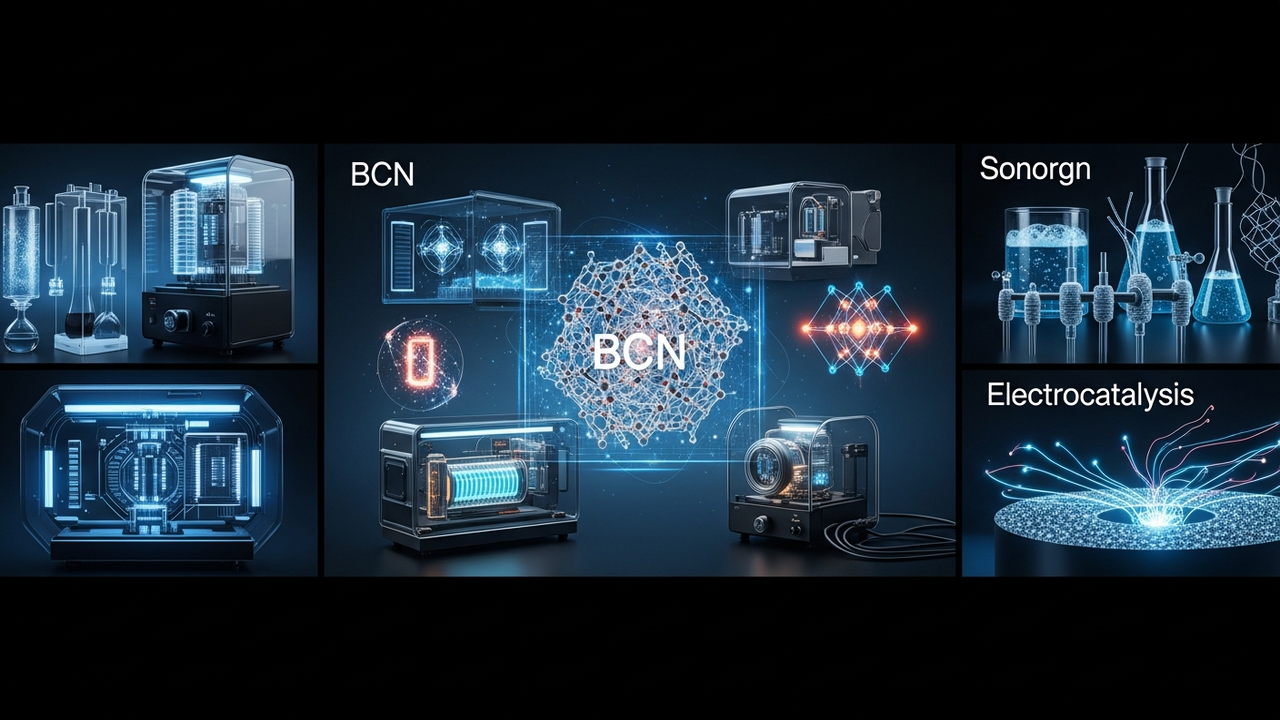
A perspective article published in “Accounts of Materials Research” posits Boron Carbon Nitride (BCN) as an extremely promising “metal-free” two-dimensional (2D) material, potentially replacing existing MXene materials. This concept represents a significant breakthrough in 2D materials science, enabling the design of novel functional materials independent of metal elements. The article elaborates on how BCN’s unique structural and electronic characteristics could lead to innovative applications in fields such as energy storage and electrocatalysis.
Technical / Clinical Details
- Concept of Metal-Free MXene: While conventional MXenes contain transition metals (e.g., Ti, Nb), BCN is composed solely of boron, carbon, and nitrogen, forming a metal-free 2D layered structure. This characteristic reduces the risk of metal contamination and opens pathways for more sustainable and environmentally friendly material development.
- Synthesis Strategies: BCN synthesis primarily employs chemical vapor deposition (CVD) and pyrolysis methods. These techniques are crucial for precisely controlling BCN’s composition, layer thickness, and crystallinity to tailor materials for specific application requirements. For instance, adjusting carbon content could allow for tuning electrical conductivity or semiconducting properties.
- Similarities and Differences with MXene: BCN shares many similarities with MXenes, including a layered structure, high specific surface area, and the potential for surface functionalization. However, being metal-free, BCN exhibits distinct electronegativity and bandgap characteristics compared to MXenes, which could lead to unique chemical stability and catalytic activity. BCN is gaining particular interest as a potential replacement for noble metal catalysts in electrocatalysis.
Background & Context
MXenes have garnered significant attention in energy storage and catalysis due to their excellent electrical conductivity, mechanical strength, and hydrophilicity. However, challenges exist regarding the cost of metal elements, supply uncertainties, and metal ion leaching in certain applications. As a metal-free 2D material, BCN holds the potential to overcome these issues, generating considerable expectations for applications in clean energy technologies such as electric vehicle batteries and fuel cells, water-splitting catalysts. With global emphasis on sustainability, the development of metal-free materials has become a top research and development priority.
Strategic Significance & Outlook
This perspective article provides a roadmap for BCN to establish its position as a next-generation high-performance material. Future research is expected to accelerate on further optimizing synthesis processes, enhancing BCN stability, and integrating it into diverse functional devices. Particularly, leveraging AI-driven materials design and high-throughput screening technologies will be crucial for more efficiently exploring BCN’s properties and accelerating its practical application in energy storage and electrocatalysis. This novel material holds the potential to make significant contributions towards achieving a sustainable society.
Source: https://pubs.acs.org/doi/10.1021/accountsmr.6c00144
Get our weekly technology intelligence — free
Receive an infographic that lets you judge at a glance whether each field’s analysis report is worth reading.
Subscribe Free — Weekly Tech Intelligence
By subscribing, you’ll receive Troy-Technical’s weekly technology intelligence newsletter.
- Your email and selected fields are used only to deliver the newsletter.
- We never share your information with third parties.
- You can unsubscribe anytime via the link in each email.
See our Privacy Policy for details.
Takes about a minute · Unsubscribe anytime