Key Findings
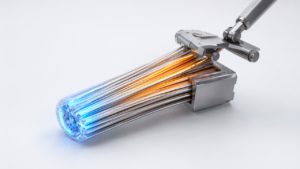
An engineering team at Purdue University has successfully developed a novel cobalt-aluminum intermetallic alloy that astonishingly combines superior yield strength, reaching 6 to 10 times that of conventional high-strength structural steel, with remarkable ductility at room temperature. This innovative material’s properties are realized through precise nanoscale microstructural design, holding the potential to dramatically enhance the performance of components used in demanding environments across aerospace, energy systems, and defense technologies. This discovery represents a crucial breakthrough in overcoming the long-standing trade-off between strength and ductility.
Technical / Clinical Details
- Unprecedented Strength-Ductility Combination: The developed cobalt-aluminum alloy boasts a yield strength (the point at which material begins to deform permanently) up to 10 times greater than typical structural steel. Simultaneously, this material exhibits significant plastic deformability—ductility—at room temperature, reducing the risk of brittle fracture. Achieving both high strength and high ductility has historically been extremely challenging for advanced metallic materials.
- Secret of Nanoscale Design: This unique property is achieved by precisely controlling the alloy’s microstructure at the nanoscale. Researchers formed uniform nanometer-sized grains and specific interface structures within the material through precise compositional ratios and thermal treatment processes. This design effectively suppresses dislocation movement under stress while simultaneously retarding crack propagation, enabling its exceptional mechanical performance.
- Cobalt-Aluminum Intermetallic Compound: The material is not a single element but an intermetallic compound where cobalt and aluminum are bonded in specific ratios, characterized by a regular atomic arrangement. This regularity contributes to high elastic modulus and hardness, which, combined with the nanostructure, allows for superior mechanical properties.
Background & Context
The aerospace, energy, and defense industries constantly require materials that are lightweight, possess extremely high strength, excellent heat resistance, and superior fatigue properties. For example, turbine blades in jet engines, structural components in spacecraft, and high-temperature parts in power plants operate under extreme conditions, where material limits directly dictate system performance. Conventional materials face a challenge: gaining high strength often comes at the cost of brittleness, imposing design constraints. This new alloy offers a groundbreaking solution to this long-standing problem, enabling the development of higher-performance, safer, and longer-lasting components.
Strategic Significance & Outlook
This novel cobalt-aluminum alloy is expected to find diverse applications in next-generation engines and space structures for the aerospace sector, efficient power generation turbines in the energy industry, and lightweight, high-durability components in defense technologies. Future efforts will focus on scaling up manufacturing processes, evaluating long-term reliability, and optimizing cost-effectiveness. If commercialized, this material could significantly shift the paradigm of material selection across industries, enabling the development of higher-performance products and delivering widespread economic and technological benefits globally.
Source: https://www.sciencedaily.com/releases/2026/07/260731034131.htm
Get our weekly technology intelligence — free
Receive an infographic that lets you judge at a glance whether each field’s analysis report is worth reading.
Subscribe Free — Weekly Tech Intelligence
By subscribing, you’ll receive Troy-Technical’s weekly technology intelligence newsletter.
- Your email and selected fields are used only to deliver the newsletter.
- We never share your information with third parties.
- You can unsubscribe anytime via the link in each email.
See our Privacy Policy for details.
Takes about a minute · Unsubscribe anytime