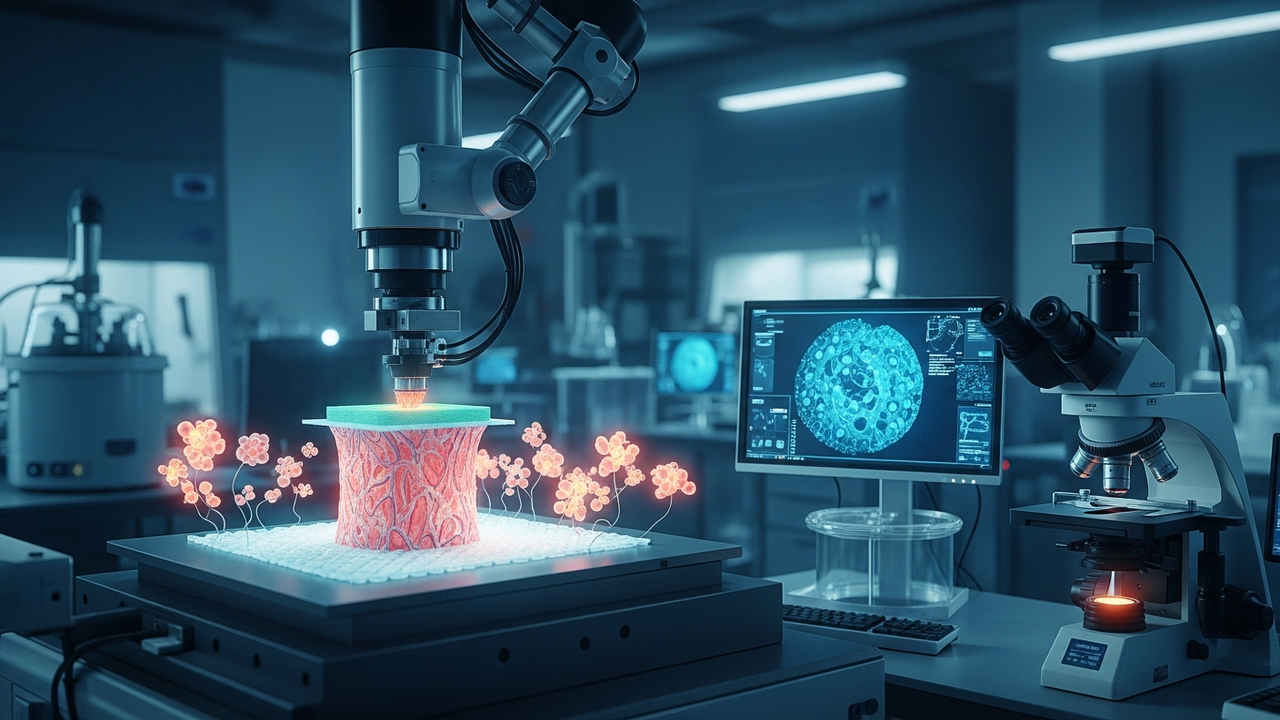
Key Findings: 3D Bioprinting and Organoid Fusion Opens New Horizons in Disease Modeling and Regenerative Medicine
The innovative convergence of 3D bioprinting and organoid technology is bringing forth a new paradigm in the fields of disease modeling, drug screening, and regenerative medicine. 3D bioprinting offers the capability to precisely position living cells, biomaterials, and bioactive factors in space, allowing for the reproducible creation of complex tissue structures. In parallel, organoids are self-organizing 3D cellular structures derived from stem cells that replicate key structural and functional features of specific organs in vitro. By combining these two technologies, it becomes possible to create more physiologically relevant, patient-specific tissue models and transplantable grafts, promising significant breakthroughs in biomedical research and clinical application.
Technical and Application Details: Prospects for Personalized Medicine and Organ Regeneration
- Enhanced Disease Modeling: Organoids are being developed as models for a wide range of organs, including the brain, liver, kidney, lung, heart, and pancreas. These organoids provide excellent in vitro models for studying complex disease mechanisms, such as genetic disorders, infectious diseases, and cancer. 3D bioprinting allows for precise control over the internal structure of organoids and their surrounding microenvironment, enabling the development of more sophisticated disease models.
- Efficient Drug Screening: Organoids can predict human drug responses more accurately than traditional 2D cell cultures or animal models, which often fail to replicate complex human physiology. Patient-derived tumor organoids, in particular, are being applied in drug sensitivity testing as personalized cancer models, holding the potential to guide optimal treatment selection for individual patients.
- Applications in Regenerative Medicine: Bioprinted organoids are being developed as transplantable tissue constructs for repairing or replacing damaged organs. For instance, research on liver regeneration using iPSC-derived organoids shows promise as a new treatment option for patients with liver failure. Active research is also focused on creating more complex, functional tissues, including the development of vascular networks.
Background and Industry Context: Technologies Driving Next-Generation Drug Discovery and Therapy
3D bioprinting and organoid technology are recognized as next-generation tools in regenerative medicine and drug discovery, overcoming previous limitations. These technologies have the potential to complement and ultimately replace traditional animal experimentation, contributing to cost reduction and increased efficiency in R&D. Especially in today’s demand for advancements in personalized medicine, high-fidelity in vitro models derived from patient cells have the potential to fundamentally transform the drug development process. Research institutions in Europe, North America, and Asia are leading these efforts, with active international collaborations.
Future Outlook: Functionality, Stability, and the Path to Clinical Application
For bioprinted organoids to achieve clinical application, further research on their functionality, long-term in vivo stability, and integration with host tissues is essential. In particular, advances in vascularized organoid fabrication technology will be key to enabling thicker, more functional tissue constructs. Additionally, standardization and scale-up of GMP-compliant manufacturing processes, along with the establishment of regulatory evaluation criteria, are critical challenges. If these hurdles are overcome, the fused technology of 3D bioprinting and organoids holds the potential to become a leading force in future medicine as true organ regenerative therapy, offering hope to patients with intractable diseases.
Source: https://academic.oup.com/rb/article/doi/10.1093/rb/rbag142/8722305
Get our weekly technology intelligence — free
Receive an infographic that lets you judge at a glance whether each field’s analysis report is worth reading.
Subscribe Free — Weekly Tech Intelligence
By subscribing, you’ll receive Troy-Technical’s weekly technology intelligence newsletter.
- Your email and selected fields are used only to deliver the newsletter.
- We never share your information with third parties.
- You can unsubscribe anytime via the link in each email.
See our Privacy Policy for details.
Takes about a minute · Unsubscribe anytime