Key Findings
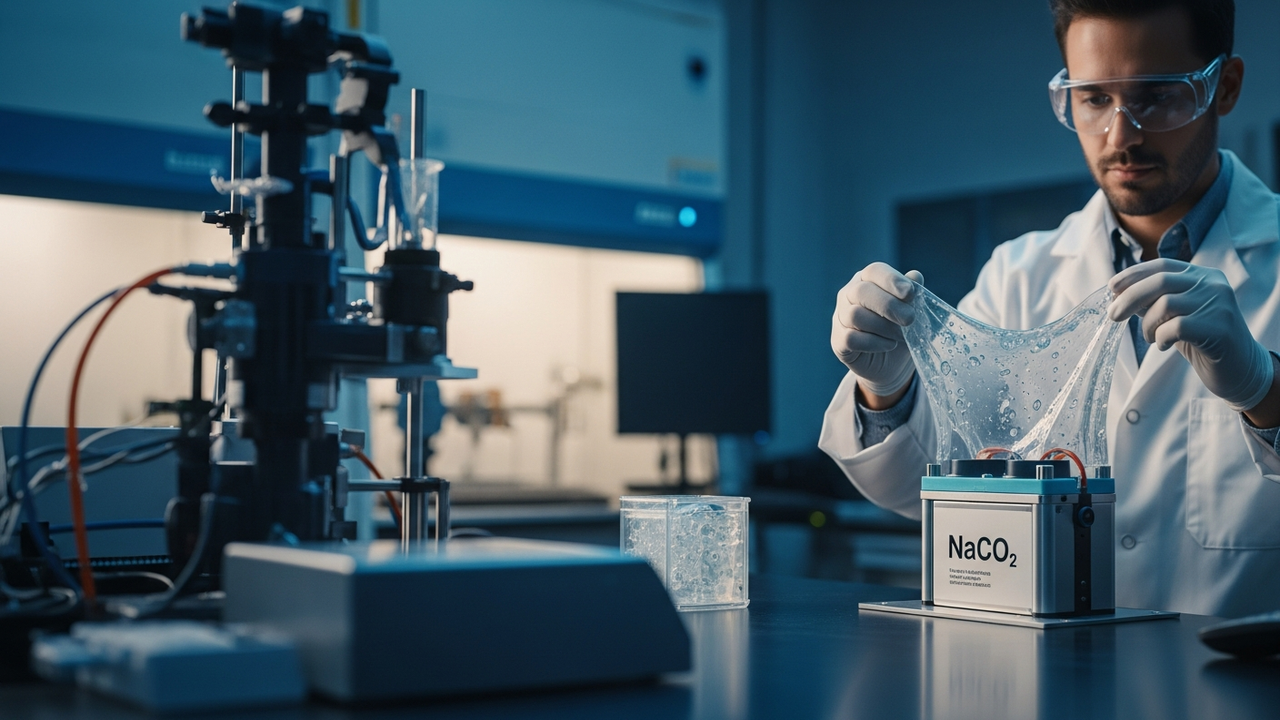
Research published by OAE Publishing Inc. on hybrid Na-CO2 batteries has clearly demonstrated that gel electrolytes effectively suppress liquid electrolyte leakage, imparting high safety and excellent mechanical flexibility to the battery system. This innovative approach integrates the benefits of liquid batteries and the morphological stability of solid batteries by effectively mitigating electrode volume changes and inhibiting the growth of sodium dendrites. This holds significant potential to greatly contribute to the development of safer and higher-performing sodium-based batteries.
Technical / Clinical Details
Hybrid Na-CO2 batteries are garnering attention as next-generation energy storage systems that leverage environmentally friendly CO2 utilization and abundant, inexpensive sodium. In such systems, the electrolyte is a critical component influencing both safety and performance. The gel electrolyte adopted in this study features a structure where liquid electrolyte is held within a polymer matrix, thereby suppressing the fluidity of the liquid electrolyte and significantly reducing the risk of leakage. While conventional liquid electrolytes struggle to accommodate electrode volume changes, leading to unstable electrode-electrolyte interfaces, the gel electrolyte’s superior flexibility effectively mitigates these volume changes. Furthermore, the viscous nature of the gel physically impedes the growth of sodium dendrites (tree-like crystals), preventing internal short circuits and extending cycle life. Thus, it has been shown that the gel electrolyte improves the overall performance and reliability of hybrid Na-CO2 batteries by combining the good interfacial wettability (contact with electrodes) of liquid electrolytes with the morphological stability and safety of solid electrolytes.
Background & Context
In the context of reducing CO2 emissions and enhancing energy security, the development of CO2 batteries that directly utilize carbon dioxide and sodium-ion batteries (NIBs) that use abundant sodium has become an urgent priority. Particularly, Na-CO2 batteries, which can use CO2 captured from emission sources as fuel, hold promise for realizing a carbon-neutral society. However, in these battery systems, the safety of liquid electrolytes and the dendrite problem associated with sodium metal anodes have been significant barriers to commercialization. Gel electrolytes are attracting attention from researchers and companies worldwide as a promising approach to solve these issues and accelerate the commercialization of sodium-based batteries.
Strategic Significance & Outlook
The adoption of gel electrolytes represents a groundbreaking step in significantly improving the safety and performance of hybrid Na-CO2 batteries. Future research will focus on further increasing energy density, extending cycle life, and reducing manufacturing costs. If this technology matures, the practical application of Na-CO2 batteries is expected to accelerate across a wide range of uses, including stationary energy storage, electric vehicles (EVs), and even large-scale grid storage systems. Notably, combined with CO2 capture and utilization technologies, it has the potential to play a crucial role in achieving a sustainable energy cycle.
Source: https://www.oaepublish.com/articles/energymater.2026.115
Get our weekly technology intelligence — free
Receive an infographic that lets you judge at a glance whether each field’s analysis report is worth reading.
Subscribe Free — Weekly Tech Intelligence
By subscribing, you’ll receive Troy-Technical’s weekly technology intelligence newsletter.
- Your email and selected fields are used only to deliver the newsletter.
- We never share your information with third parties.
- You can unsubscribe anytime via the link in each email.
See our Privacy Policy for details.
Takes about a minute · Unsubscribe anytime