Key Findings
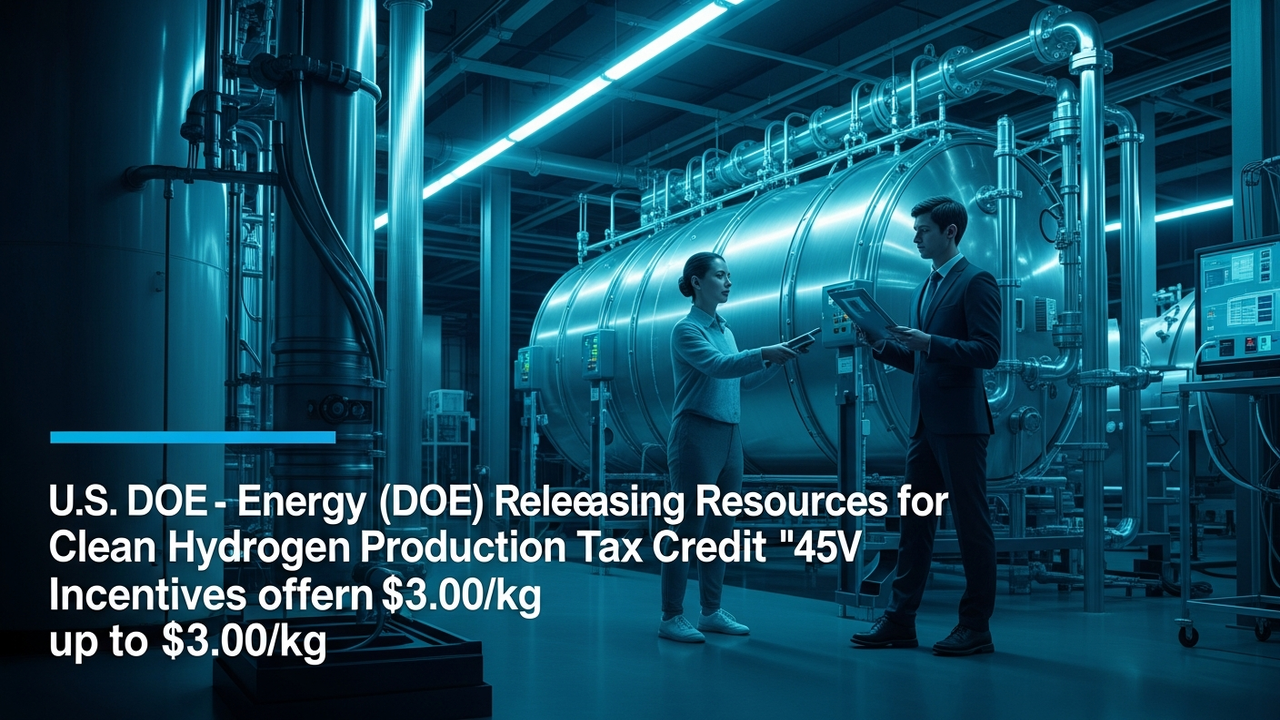
The U.S. Department of Energy (DOE) has released comprehensive resources pertaining to the Clean Hydrogen Production Tax Credit (45V), a pivotal incentive established under the Inflation Reduction Act (IRA). This tax credit is designed to significantly stimulate domestic clean hydrogen production by offering a generous 10-year incentive of up to $3.00 per kilogram of hydrogen produced.
Technical & Industrial Details
The 45V tax credit is structured into four tiers, with the incentive amount varying based on the lifecycle carbon intensity of the hydrogen production process. This tiered approach ensures that the cleanest hydrogen production receives the highest level of support. Specifically, projects emitting less than 0.45 kg CO2e/kg H2 qualify for the full $3.00/kg credit, with reduced credits for higher emission levels, and no credit for emissions above 4 kg CO2e/kg H2. The DOE’s 45VH2-GREET model will be utilized for emissions measurement. Furthermore, the use of Energy Attribute Certificates (EACs) is a critical consideration for evaluating lifecycle greenhouse gas (GHG) emissions associated with electricity consumption, and specific guidelines are under development. This mechanism is designed to precisely assess the carbon footprint of produced hydrogen and rigorously encourage truly clean production.
Background & Context
The Inflation Reduction Act (IRA) represents landmark legislation aimed at accelerating U.S. climate action and investment in clean energy. Among its provisions, the 45V tax credit is expected to dramatically improve the economic viability of clean hydrogen production, significantly shortening project payback periods and thus powerfully attracting private investment. This policy aims to foster the development of domestic electrolyzer manufacturing, renewable energy projects, and hydrogen infrastructure, thereby strengthening the U.S.’s competitive position in the global clean energy supply chain. The provision of clear guidelines and measurement methodologies for the tax credit reduces uncertainty for investors and developers, facilitating project planning.
Strategic Significance & Outlook
The implementation of the 45V tax credit is poised to dramatically accelerate the growth of the clean hydrogen industry in the United States. This will enable a greater number of green and low-carbon hydrogen projects to become economically feasible, thereby speeding up the decarbonization of industrial sectors such as steel, chemicals, and transportation. As EAC guidelines are finalized and the market matures, investors will be better equipped to accurately assess the long-term profitability and emission reduction impact of projects. This policy is expected to be a key driver for the U.S. to establish itself as a global leader in clean hydrogen production, exerting a significant influence on the worldwide energy transition and industrial decarbonization efforts.
Source: https://www.energy.gov/articles/clean-hydrogen-production-tax-credit-45v-resources
Get our weekly technology intelligence — free
Receive an infographic that lets you judge at a glance whether each field’s analysis report is worth reading.
Subscribe Free — Weekly Tech Intelligence
By subscribing, you’ll receive Troy-Technical’s weekly technology intelligence newsletter.
- Your email and selected fields are used only to deliver the newsletter.
- We never share your information with third parties.
- You can unsubscribe anytime via the link in each email.
See our Privacy Policy for details.
Takes about a minute · Unsubscribe anytime