Key Findings
A research team at Louisiana State University (LSU) has developed a revolutionary fuel-free method for generating electricity. This system harnesses temperature differences between two phase-changing materials (PCMs) with distinct electrical conductivities. Remarkably, it achieved an energy conversion efficiency of 50% with a minimal 10-degree Celsius temperature differential, a performance level comparable to existing natural gas power plants. This discovery sets a new benchmark for the efficiency of converting thermal energy into electrical power.
Technical / Clinical Details
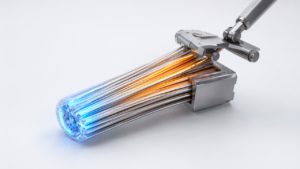
The core of this fuel-free power generation system lies in the property of certain phase-change materials to exhibit significantly different electrical conductivities in their solid and liquid phases. The researchers ingeniously arranged these two PCMs such that the heat generated when one material undergoes a phase change is transferred to the other, creating a temperature differential that is then exploited to generate electricity. For example, as one PCM melts and its electrical conductivity changes, and the other solidifies exhibiting a different conductivity, an electrical potential difference is created within the system. This potential difference drives a current, supplying power to an external circuit. The 50% conversion efficiency from a small 10°C temperature difference is a substantial improvement over existing thermoelectric technologies (typically a few percent), achieved through optimized material combinations and device architecture. Considering that natural gas power plants typically operate at around 40-60% efficiency, this is an exceptionally high performance level.
Background & Context
As global energy demand escalates and climate change mitigation becomes an urgent imperative, there is a strong need for clean, fuel-free, and highly efficient power generation technologies. In particular, technologies that recover electricity from unused waste heat or subtle ambient temperature gradients hold significant potential as sustainable energy solutions. Existing thermoelectric conversion technologies have suffered from low conversion efficiencies, preventing widespread commercialization. LSU’s breakthrough overcomes this technological barrier, offering a promising, environmentally friendly alternative to conventional fossil fuel power generation. This innovation has the potential to foster decentralized energy infrastructure and promote local energy self-sufficiency.
Strategic Significance & Outlook
This fuel-free power generation system is expected to have diverse applications, including:
- **Decentralized Power Generation**: On-site power generation for local communities and industrial facilities by directly converting unused heat sources like industrial waste heat, geothermal heat, or solar thermal energy.
- **Integration with Renewable Energy**: Complementing solar and wind power generation by utilizing diurnal or seasonal temperature differences for continuous power supply.
- **Self-Powered IoT Devices**: Continuously powering sensor networks and wearable devices using minute ambient temperature differences.
- **Remote Area Electrification**: Providing reliable, off-grid power sources for isolated regions.
For commercialization, future focus areas will include the long-term stability of the materials, reduction of manufacturing costs, scalability considerations, and performance evaluation under various operating conditions. However, its fuel-free and high-efficiency characteristics offer a powerful solution to global energy challenges, making it an extremely attractive technology for researchers, engineers, and investors. This technology holds the potential to drive a new paradigm shift in the energy industry worldwide.
Source: #
Get our weekly technology intelligence — free
Receive an infographic that lets you judge at a glance whether each field’s analysis report is worth reading.
Subscribe Free — Weekly Tech Intelligence
By subscribing, you’ll receive Troy-Technical’s weekly technology intelligence newsletter.
- Your email and selected fields are used only to deliver the newsletter.
- We never share your information with third parties.
- You can unsubscribe anytime via the link in each email.
See our Privacy Policy for details.
Takes about a minute · Unsubscribe anytime