Background & Context
The relentless demand for faster and higher-capacity data transmission continues to drive the evolution of information and communication technology. As conventional electronic circuits approach their fundamental physical speed limits, the industry increasingly looks to optical technologies, which utilize light as an information carrier, for future advancements. While spatially periodic photonic crystals revolutionized light control, their static nature imposed limitations on dynamic optical signal manipulation. Photonic Time Crystals, however, introduce a novel paradigm for controlling light’s properties dynamically along the temporal axis. This advancement is particularly crucial for terahertz wave modulation—a key technology with applications spanning 5G/6G communications, advanced security scanning, and high-resolution spectroscopic analysis. The groundbreaking work by an international research consortium, including researchers from École Polytechnique, Collège de France, and Helmholtz-Zentrum Dresden-Rossendorf (HZDR), significantly pushes the boundaries of physics and engineering.
Key Breakthrough
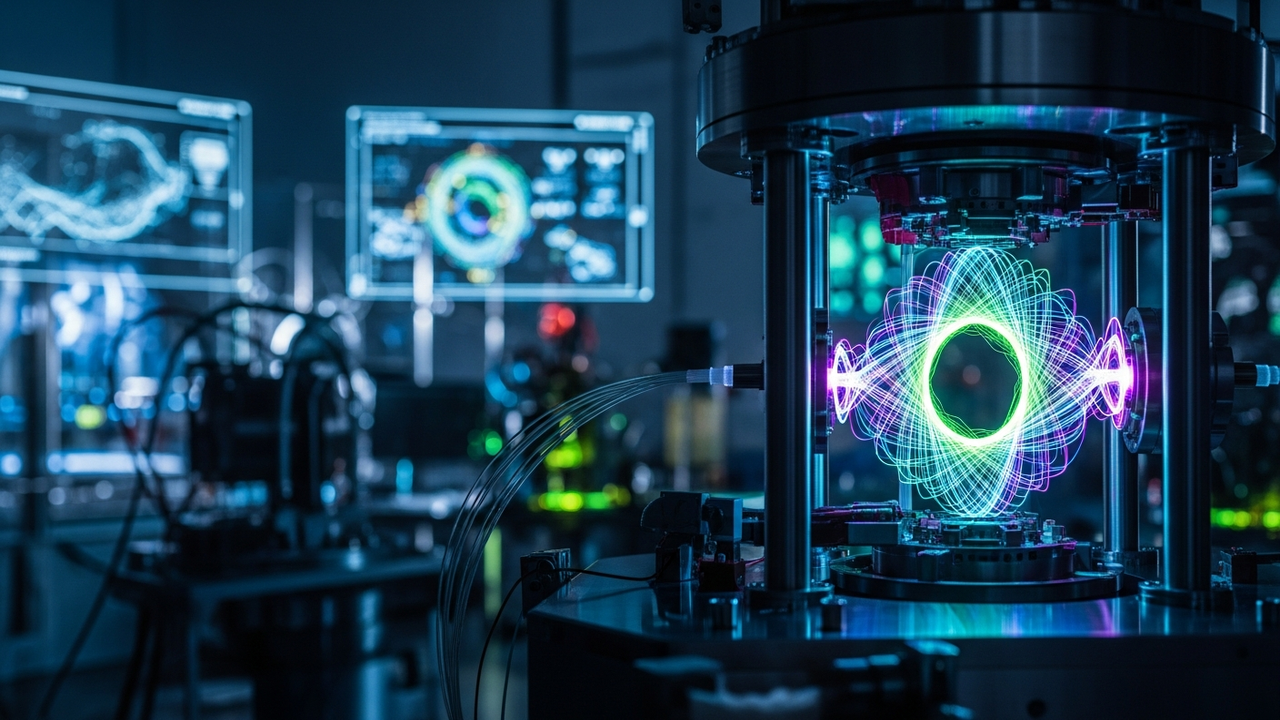
An international research team has experimentally demonstrated the world’s first all-optical photonic time crystal (PTC), with their seminal findings published in the prestigious journal Nature. This innovative material possesses the remarkable ability to strongly and repeatedly modulate its optical properties over extraordinarily brief timescales—specifically, in the order of picoseconds to femtoseconds. This unprecedented capability enables ultrafast terahertz modulation, representing a critical leap towards the realization of ultrafast optical computing and advanced telecommunications technologies.
Technical Deep Dive
Photonic Time Crystals (PTCs) are engineered materials whose optical properties vary periodically in time, conceptually mirroring conventional photonic crystals which feature spatially periodic structures. The PTC developed in this research is achieved by rapidly and reversibly altering a material’s dielectric constant through the application of powerful laser pulses. More specifically, laser-induced nonlinear optical effects periodically modulate the material’s refractive index, effectively creating a ‘temporal lattice’ through which light waves propagate. Within this dynamic temporal periodicity, light exhibits unconventional behaviors, enabling the active ‘reshaping’ of its frequency or waveform. The experimental demonstrations successfully showcased exceptionally fast and efficient modulation capabilities for optical signals within the terahertz frequency range. This translates to precise control over the amplitude, phase, and frequency of light signals on the picosecond order, holding immense promise for dramatically increasing information processing speeds.
Strategic Impact & Future Outlook
The successful realization of this world’s first all-optical photonic time crystal is set to unlock a range of revolutionary applications:
- Ultrafast Optical Computing: Paving the way for next-generation computer architectures that process information at the fundamental speed of light.
- Advanced Optical Communications: Enabling novel communication technologies in the terahertz band, critical for ultra-high-capacity and ultra-low-latency data transmission.
- Quantum Optical Devices: Providing new platforms for the generation and precise manipulation of entangled photons.
- High-Sensitivity Sensors: Facilitating the development of new classes of spectrometers and sensors that harness time-modulated light for enhanced performance.
Translating this breakthrough into commercial products will involve addressing challenges such as ensuring material stability, achieving manufacturing reproducibility, and developing scalable integration technologies. Nonetheless, the substantial improvements in information processing and communication speed and efficiency offered by this technology promise immeasurable socio-economic impacts. Researchers, engineers, and investors alike are urged to recognize the profound potential of photonic time crystals to redefine the future of global digital infrastructure.
Source: #
Get our weekly technology intelligence — free
Receive an infographic that lets you judge at a glance whether each field’s analysis report is worth reading.
Subscribe Free — Weekly Tech Intelligence
By subscribing, you’ll receive Troy-Technical’s weekly technology intelligence newsletter.
- Your email and selected fields are used only to deliver the newsletter.
- We never share your information with third parties.
- You can unsubscribe anytime via the link in each email.
See our Privacy Policy for details.
Takes about a minute · Unsubscribe anytime