Key Findings
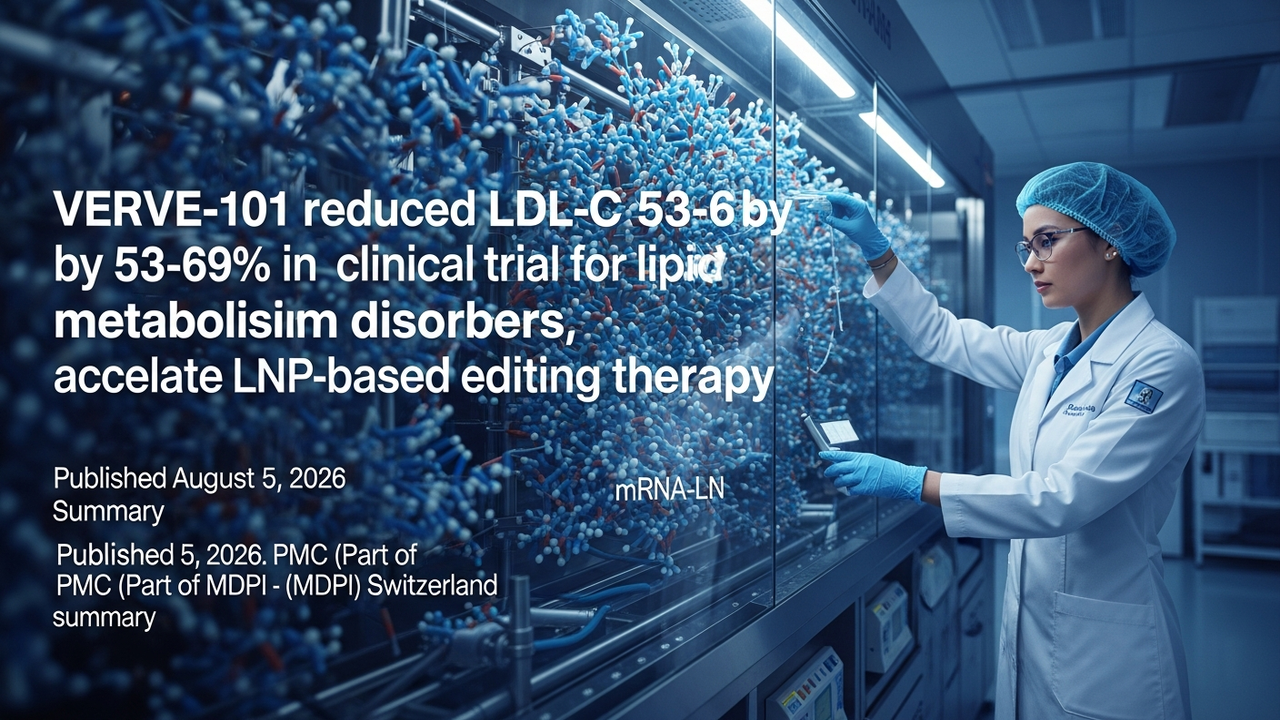
The field of lipid metabolic disorder treatment is witnessing a major advancement with the clinical progression of in vivo base editing via mRNA-lipid nanoparticle (LNP) delivery. Specifically, VERVE-101, an investigational base editing therapeutic targeting the PCSK9 gene, has demonstrated remarkable efficacy in its ongoing clinical trials (NCT05398029), showing substantial reductions in LDL-C (low-density lipoprotein cholesterol) levels, ranging from 53% to 69%. These results validate LNP-delivered gene editing as a powerful therapeutic modality that complements and potentially surpasses traditional RNA-targeted silencing approaches.
Technical / Clinical Details
VERVE-101 employs an LNP platform engineered for efficient hepatocyte-selective delivery of mRNA encoding a base editor. The base editor induces a precise, irreversible change in the PCSK9 gene within liver cells, effectively ‘turning off’ the production of the PCSK9 protein. PCSK9 normally degrades LDL receptors, thus inhibiting its function leads to increased expression of LDL receptors on liver cells, which then efficiently clear LDL-C from the bloodstream. Clinical trial NCT05398029 evaluates the safety, tolerability, and efficacy of VERVE-101. The interim data reported, highlighting LDL-C reductions between 53% and 69%, are highly encouraging, suggesting a durable effect from a single infusion. This level of LDL-C reduction is comparable to, or even exceeds, that achieved by existing PCSK9 inhibitor therapies, but with the potential benefit of a one-time treatment. The platform’s systematic formulation screening ensures over 90% liver tropism, minimizing extrahepatic editing risks and maximizing safety.
Background & Context
Hypercholesterolemia, particularly elevated LDL-C, is a primary risk factor for cardiovascular disease globally. While statins and PCSK9 inhibitors have revolutionized treatment, challenges remain, including patient adherence for chronic injectable therapies and unmet needs in specific patient populations. In vivo gene editing offers a paradigm-shifting approach, providing the potential for a permanent therapeutic effect after a single administration. The recognition of VERVE-102 (a related base editing program) in the 2026 ACC Scientific Statement as a leading example highlights the growing scientific and clinical community’s confidence in this technology. This development positions LNP-mediated base editing as a disruptive innovation, moving from bench research to bedside applications, and potentially offering a ‘cure’ for genetic predispositions to high cholesterol.
Strategic Significance & Outlook
The success of VERVE-101 in achieving significant and durable LDL-C reductions marks a pivotal moment for LNP-delivered gene editing. This platform holds immense promise not only for lipid metabolic disorders but also for a broader spectrum of genetic diseases that can be addressed by hepatic gene targeting. Future developments will focus on further optimizing the LNP formulations for enhanced tissue specificity and evaluating long-term safety and efficacy in larger patient cohorts. If successful, this technology could offer a ‘one-shot’ therapeutic solution, significantly improving patient quality of life by eliminating the need for chronic medication. For the pharmaceutical industry, this breakthrough accelerates investment in in vivo gene editing, fostering the development of new, potentially curative therapies for numerous conditions and solidifying the role of LNP-based platforms as a cornerstone of next-generation precision medicine.
Source: https://pmc.ncbi.nlm.nih.gov/articles/PMC13184955/
Get our weekly technology intelligence — free
Receive an infographic that lets you judge at a glance whether each field’s analysis report is worth reading.
Subscribe Free — Weekly Tech Intelligence
By subscribing, you’ll receive Troy-Technical’s weekly technology intelligence newsletter.
- Your email and selected fields are used only to deliver the newsletter.
- We never share your information with third parties.
- You can unsubscribe anytime via the link in each email.
See our Privacy Policy for details.
Takes about a minute · Unsubscribe anytime