Key Findings
A team of physicists at the Massachusetts Institute of Technology (MIT) has successfully observed, in real-time, the complex electronic phases formed and rearranged by the coexistence and interaction of two distinct charge density waves (CDWs) within the crystal of erbium tritelluride (ErTe3), a quantum material. This groundbreaking discovery deepens the understanding of the emergence mechanisms of many-body electronic phases in quantum materials, such as superconductivity and magnetism, providing new guidance for the design of future high-performance quantum devices.
Technical / Clinical Details
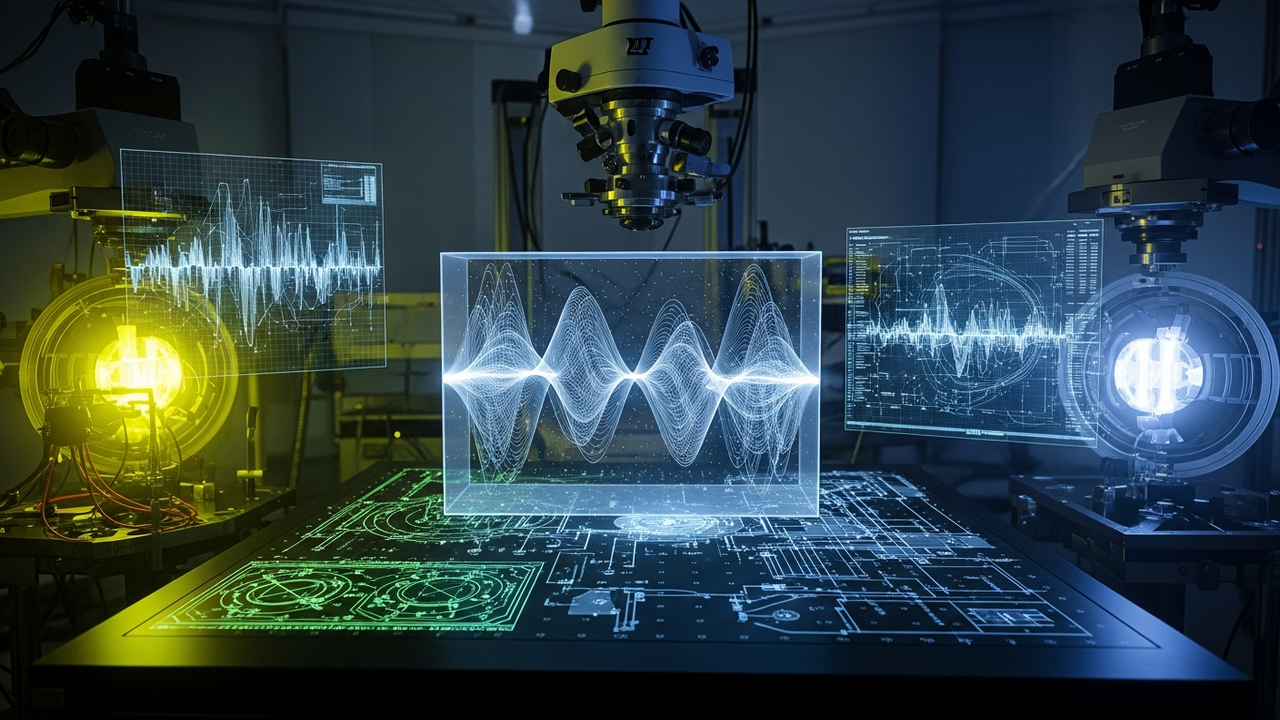
A charge density wave (CDW) is a state where the spatial charge distribution of electrons is periodically modulated, simultaneously deforming the crystal lattice. ErTe3 is a type of ‘topological material’ known for exhibiting multiple CDWs despite its relatively simple structure. The MIT research team utilized a combination of ultra-high-resolution scanning tunneling microscopy (STM) and angle-resolved photoemission spectroscopy (ARPES) to directly observe the atomic-scale behavior of electrons on the surface of ErTe3. This allowed for dynamically capturing how the two CDWs independently form, or interact to maintain a coexistence state, and subsequently rearrange in response to changes in temperature or external stimuli. Specifically, it was revealed that both CDWs have different orientations and ‘compete’ or ‘cooperate’ to determine the overall electronic structure of the material. This detailed observation provides experimental evidence for long-standing theoretical challenges regarding the electronic structure and phase transition mechanisms of quantum materials.
Background & Context
Quantum materials exhibit unique physical phenomena not found in conventional materials, such as superconductivity, colossal magnetoresistance, and topological properties, and are anticipated as the foundation for next-generation technologies (quantum computing, energy-efficient devices). The performance of these materials is determined by a wide variety of electronic phases arising from complex electron interactions. However, the question of how different electronic phases coexist and interact has been one of the deepest unresolved challenges in quantum materials science. CDWs, in particular, are known to be closely related to superconductivity and magnetism, and understanding their behavior is believed to lead to the elucidation of more advanced quantum phenomena, such as room-temperature superconductivity. This research at MIT enables direct ‘visualization’ of such complex quantum phenomena, bridging the gap between theory and experiment in materials design.
Strategic Significance & Outlook
The elucidation of the coexistence and dynamic behavior of two CDWs in ErTe3 is a groundbreaking advance in quantum materials science and will directly impact the design of future high-performance quantum devices. By applying this knowledge, researchers and engineers may be able to intentionally control multiple electronic phases to design, for example, room-temperature superconductors, more efficient spintronic devices, or new types of magnetic memory elements. Furthermore, this research provides a foundation for realizing ‘phase transition engineering’ where the electronic phases of quantum materials can be dynamically switched by external stimuli (e.g., light, electric fields, strain). This is expected to accelerate the practical application of quantum technologies, bringing revolutionary changes to various fields such as information processing, energy conversion, and sensor technology.
Get our weekly technology intelligence — free
Receive an infographic that lets you judge at a glance whether each field’s analysis report is worth reading.
Subscribe Free — Weekly Tech Intelligence
By subscribing, you’ll receive Troy-Technical’s weekly technology intelligence newsletter.
- Your email and selected fields are used only to deliver the newsletter.
- We never share your information with third parties.
- You can unsubscribe anytime via the link in each email.
See our Privacy Policy for details.
Takes about a minute · Unsubscribe anytime