Key Findings
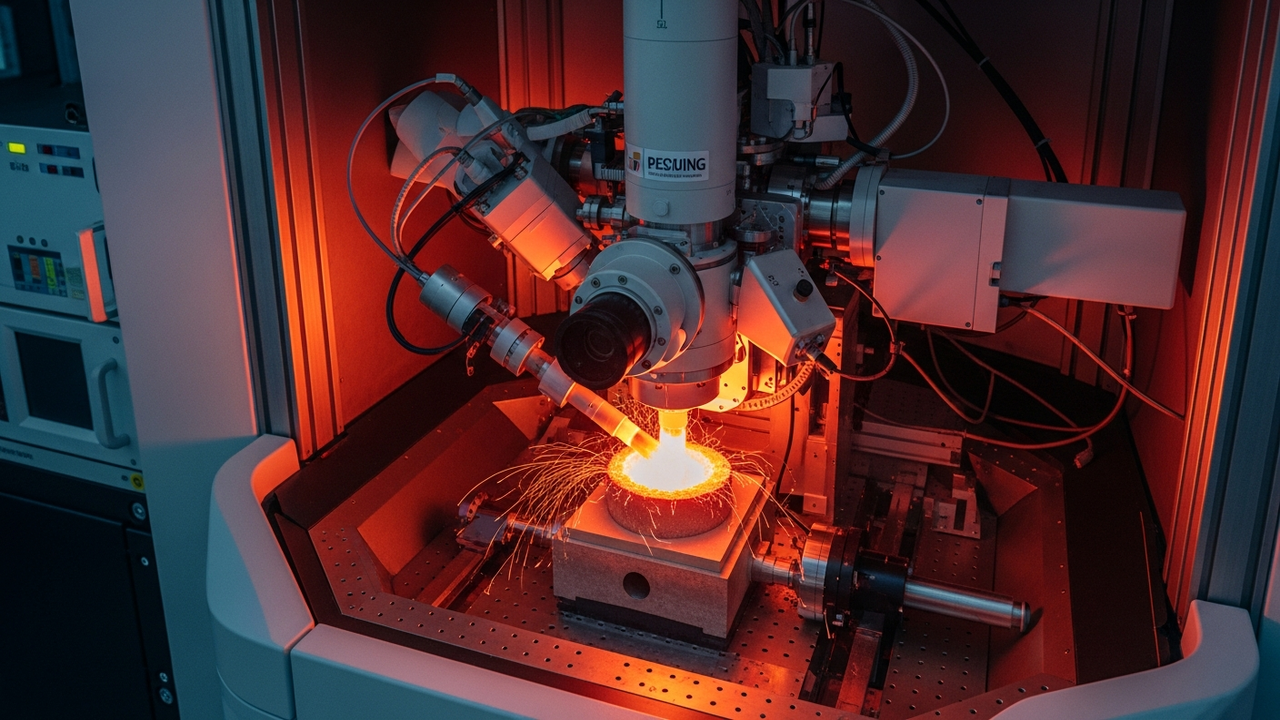
A team of researchers at SLAC National Accelerator Laboratory has successfully observed the melting behavior of copper atoms in real-time under extremely high-temperature environments using an electron camera. This study identified new crucial parameters that govern the gradual degradation of the crystal lattice as it transitions to a liquid state. This groundbreaking insight, combined with artificial intelligence (AI) simulations, holds significant potential to contribute to the development of new highly resistant materials capable of withstanding even more severe conditions, such as those required for fusion energy reactors.
Technical / Clinical Details
This research leveraged the capabilities of SLAC’s state-of-the-art Linac Coherent Light Source (LCLS), combining ultra-short X-ray pulses with ultrafast electron cameras to capture instantaneous temperature rises and subsequent atomic movements on a picosecond scale. Copper samples were heated to thousands of degrees using powerful lasers, and the subsequent melting process was directly observed as changes in crystal structure. While traditional melting theories assumed a relatively uniform and rapid collapse of the solid crystal lattice upon reaching a specific melting point, this real-time observation revealed that copper’s crystal lattice degrades gradually and in a non-uniform pattern. Specifically, it was suggested that the amplitude of atomic vibrational motion and the generation/propagation of defects on specific crystal planes are deeply involved in the melting process. This detailed data on atomic-level dynamics will dramatically improve the accuracy of AI-based material simulation models, enabling more precise prediction of melting behavior and optimization of heat-resistant material design.
Background & Context
Fusion energy is anticipated as a clean and virtually inexhaustible energy source, but its realization faces a significant challenge: the durability of reactor wall materials directly exposed to ultra-high-temperature plasma. These materials must withstand complex stresses—including extreme heat loads, high-energy particle irradiation, and interaction with hydrogen isotopes—that are difficult to address with existing materials science. Copper, due to its high thermal conductivity, is considered a candidate material for heat sinks and divertor components in fusion reactors, but there are still many challenges regarding its long-term stability under extreme conditions. SLAC’s research deepens the fundamental understanding necessary to develop new materials capable of withstanding such harsh environments, making an indispensable contribution to the progress of fusion research.
Strategic Significance & Outlook
SLAC’s research findings represent a critical milestone in the field of materials science toward realizing fusion energy. Detailed data on copper’s melting behavior obtained through real-time atomic-level observation will dramatically improve the accuracy of material simulations using AI and high-performance computing. This will enable researchers to efficiently predict the properties of candidate materials with diverse compositions and structures without needing to conduct extensive physical experiments. In the future, this approach is expected to be applied not only to fusion reactors but also to the development of high-performance materials operating in other extreme environments, such as space development, hypersonic vehicles, and advanced manufacturing processes. This demonstrates the immense potential of fundamental materials science research to directly address global energy problems and advance cutting-edge technologies.
Get our weekly technology intelligence — free
Receive an infographic that lets you judge at a glance whether each field’s analysis report is worth reading.
Subscribe Free — Weekly Tech Intelligence
By subscribing, you’ll receive Troy-Technical’s weekly technology intelligence newsletter.
- Your email and selected fields are used only to deliver the newsletter.
- We never share your information with third parties.
- You can unsubscribe anytime via the link in each email.
See our Privacy Policy for details.
Takes about a minute · Unsubscribe anytime




