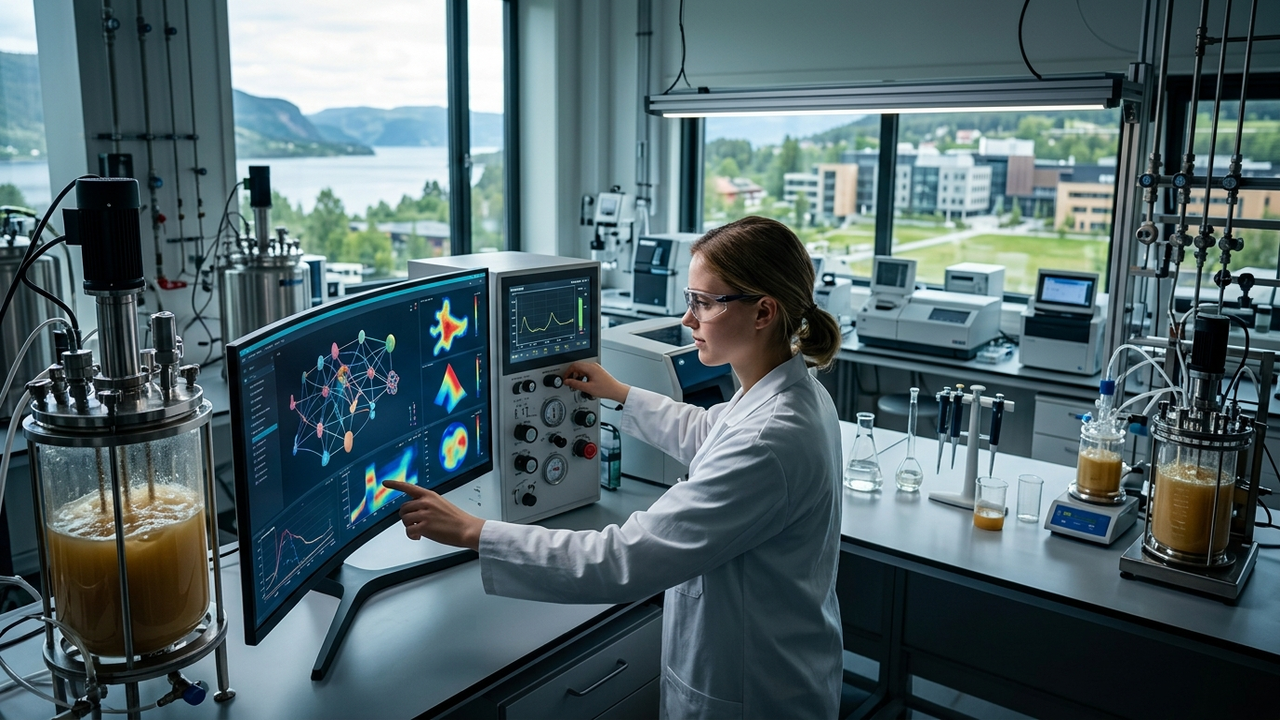
Key Findings: Norwegian University of Life Sciences Advances Real-time Fermentation Process Optimization with AI-Driven Digital Twins
The Norwegian University of Life Sciences (NMBU) is offering a PhD scholarship focused on developing AI-driven digital twin technology for real-time optimization and control of microbial lipid fermentation processes. This advanced research aims to maximize the potential of AI and machine learning in bioprocess engineering, contributing to more efficient and sustainable bioproduction.
Technical and Clinical Details: Fermentation Process Control Through Data Integration and Predictive Modeling
- Development of AI-Driven Digital Twins: At the core of the project is the construction of an AI-driven digital twin that virtually replicates the physical microbial lipid fermentation process. This twin reflects the current state of the process based on real-time data and predicts future behavior.
- Data Integration: The project integrates large volumes of data obtained from online spectroscopy (e.g., NIR, Raman) and standard bioreactor sensors such as pH, dissolved oxygen, and temperature. This enables a comprehensive understanding of the process state.
- Predictive Models and Control Strategies: Utilizing integrated data and AI/machine learning algorithms, the research will develop models to predict critical parameters in the fermentation process, including microbial growth, lipid production, and metabolite concentrations. Furthermore, control strategies will be developed to adjust optimal operating conditions in real-time based on these predictions.
- Application Areas: Microbial lipid fermentation has wide-ranging industrial applications, including biofuels, food additives, and pharmaceutical raw materials. Process optimization achieved through this research will directly lead to reduced production costs and enhanced sustainability for these bio-products.
Background and Industry Context: Rising Demands for Bioprocess Efficiency and Digitalization Progress
The bioprocess industry faces global challenges such as climate change and the need for improved resource efficiency, driving strong demand for more efficient and sustainable production methods. Advances in AI and machine learning provide powerful tools for modeling and optimizing complex bioprocesses. Digital twins, by enabling virtual experimentation and significantly reducing the time and cost associated with physical trial-and-error, are key to accelerating this transformation.
Future Outlook: Transforming Bioproduction Through Real-time Optimization
This PhD project will further deepen the application of AI and machine learning in the field of bioprocess engineering. If real-time process optimization and control are achieved, it will be possible to maximize production efficiency and yields not only in microbial lipid fermentation but also in various other bioprocesses. This represents a significant step towards supporting the growth of the bioeconomy and contributing to the realization of a sustainable society. In the future, such digital twin technology is expected to become a standard tool across the entire process, from the development of novel bio-products to commercial production.
Source: https://www.jobbnorge.no/en/available-jobs/joblisting/pdf/306464
Get our weekly technology intelligence — free
Receive an infographic that lets you judge at a glance whether each field’s analysis report is worth reading.
Subscribe Free — Weekly Tech Intelligence
By subscribing, you’ll receive Troy-Technical’s weekly technology intelligence newsletter.
- Your email and selected fields are used only to deliver the newsletter.
- We never share your information with third parties.
- You can unsubscribe anytime via the link in each email.
See our Privacy Policy for details.
Takes about a minute · Unsubscribe anytime