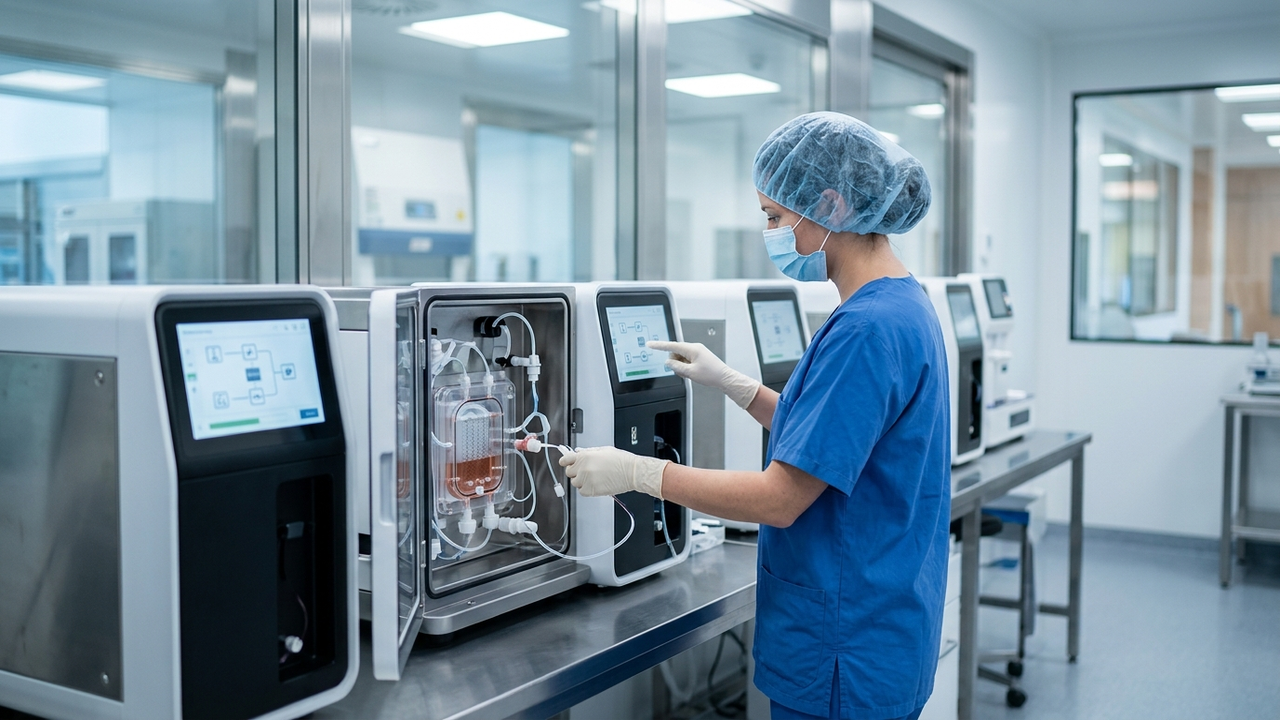
Key Findings: Point-of-Care Manufacturing Advances for Cell and Gene Therapies, Evolving Technology and Business Models
The acceleration of point-of-care (PoC) manufacturing for biopharmaceuticals, especially Cell and Gene Therapy (CGT) products, is gaining significant traction. This shift promises to enable rapid and efficient delivery of complex CGT products, thereby enhancing patient access. Key technology platforms such as Lonza’s Cocoon system and Miltenyi Biotec’s CliniMACS Prodigy are currently being utilized in clinical trials to drive this paradigm.
Technical and Clinical Details: Platforms and Emerging Technologies Supporting PoC Manufacturing
- Key Automated Systems: Lonza’s Cocoon system facilitates automated, closed-system cell manufacturing, crucial for personalized cell therapies tailored to individual patients. Similarly, Miltenyi Biotec’s CliniMACS Prodigy offers automated, closed-system cell isolation, washing, and culture, designed for GMP compliance. These systems simplify complex cell manufacturing processes, minimize human intervention, and enhance product quality and safety.
- Lonza’s Strategic Divestment: In March 2026, Lonza announced the sale of its Cocoon system back to Octane Medical Group, its original developer. This move suggests Lonza’s strategic focus as a CDMO is on broader bioprocess solutions and scaling up large-volume manufacturing capabilities. Octane Medical Group is expected to further develop and commercialize the Cocoon technology following this acquisition.
- Cell-Free Manufacturing: This emerging approach focuses on producing therapeutic molecules (e.g., exosomes, virus-like particles) without using living cells. It addresses complex logistics and storage challenges associated with cell-based manufacturing, potentially enabling easier on-demand production.
- 3D Printing Technologies: 3D bioprinting holds promise for creating complex biological structures in tissue engineering and regenerative medicine. In the future, it could evolve into a technology for rapidly manufacturing customized therapeutic products at the point of care, tailored to individual patient needs.
Background and Industry Context: Characteristics of CGT Products and Supply Chain Challenges
Many CGT products are autologous therapies, manufactured specifically for each patient. They require complex manufacturing processes, have short shelf lives, demand strict temperature control, and necessitate rapid delivery to patients. Traditional centralized manufacturing models struggle to meet these demands, leading to supply chain bottlenecks and increased costs. PoC manufacturing is envisioned as a fundamental solution to overcome these challenges and improve treatment accessibility.
Future Outlook: Standardization and Ecosystem Development for PoC Manufacturing
For widespread adoption of PoC manufacturing, further technological standardization, improved cost-efficiency, and the establishment of clear regulatory guidelines through close collaboration with regulatory authorities are essential. Moreover, building a comprehensive ecosystem that includes logistics, data management, and quality assurance systems to support decentralized manufacturing is imperative. In the future, more CGT products are expected to adopt the PoC manufacturing model, making personalized medicine more accessible.
Get our weekly technology intelligence — free
Receive an infographic that lets you judge at a glance whether each field’s analysis report is worth reading.
Subscribe Free — Weekly Tech Intelligence
By subscribing, you’ll receive Troy-Technical’s weekly technology intelligence newsletter.
- Your email and selected fields are used only to deliver the newsletter.
- We never share your information with third parties.
- You can unsubscribe anytime via the link in each email.
See our Privacy Policy for details.
Takes about a minute · Unsubscribe anytime