Key Findings
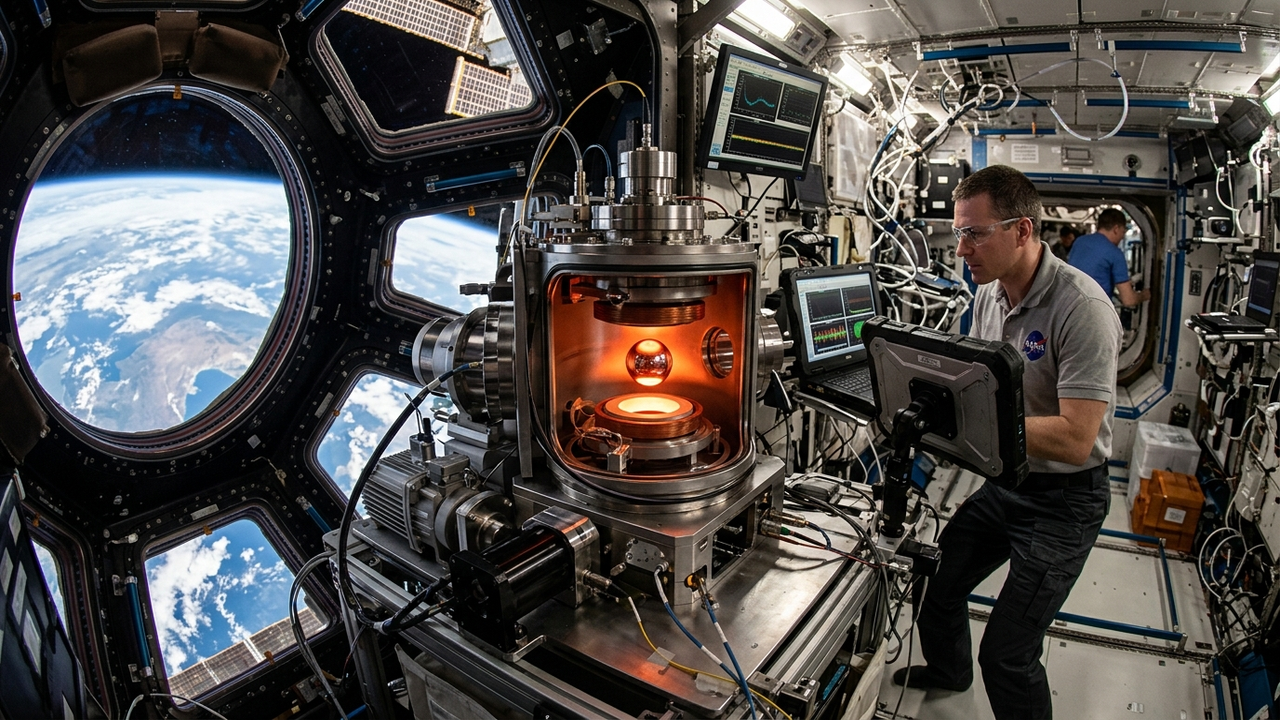
A materials science research team led by Professor Ralf Busch at Saarland University is preparing for the world’s first space science mission to remotely study the properties of metallic glass alloys on the International Space Station (ISS). This groundbreaking initiative is expected to significantly contribute to the development of innovative new materials for applications in spaceflight, medical technology, and high-performance components, by leveraging high-temperature levitating droplet technology in microgravity to acquire data with unprecedented precision, unattainable on Earth.
Technical and Clinical Details
This mission will meticulously investigate the melting behavior and solidification processes of metallic glass alloys under microgravity. On Earth, levitating droplets of molten metal are unstable due to gravity, and contact with containers can introduce impurities or promote crystallization. However, in the microgravity environment of the ISS, it is possible to stably hold high-temperature droplets using electromagnetic levitation without contact. This allows for extremely precise measurements of thermophysical properties such as viscosity, surface tension, specific heat, and thermal diffusivity of alloys under pristine conditions. Understanding the behavior of liquids in supercooled states and the mechanisms of glass transition phenomena is crucial for comprehending the glass-forming ability and stability of metallic glasses. The acquired data will be invaluable for validating and refining computational materials science models, thereby significantly improving the efficiency of new material design and optimization.
Background and Industry Context
Metallic glasses are amorphous materials possessing superior strength, hardness, corrosion resistance, and unique magnetic properties, making them promising for diverse applications in aerospace, medicine, electronics, and sports equipment. However, optimizing compositions and process conditions for manufacturing stable metallic glasses remains challenging due to their complex thermophysical nature. Research in microgravity has the potential to deepen these fundamental materials science insights and feed back into the development of more efficient and reliable metallic glass manufacturing technologies on Earth. The collaboration with the European Space Agency (ESA) and the German Aerospace Center (DLR) further strengthens Europe’s leadership in this field.
Future Outlook
This pioneering mission on the ISS will bring new perspectives to fundamental research on metallic glasses and accelerate the development of next-generation high-performance materials. The acquired data will be directly utilized to optimize the design and manufacturing processes of metallic glasses for specific applications, such as lightweight, high-strength structural materials for spaceflight, medical implants, and precision electronic components. Furthermore, as a successful example of materials science research in microgravity, it will contribute to expanding the possibilities of future in-space manufacturing (ISM). The knowledge gained from this mission will be essential not only for terrestrial industrial applications but also for opening new material frontiers for humanity’s deep-space exploration efforts.
Source: https://www.eurekalert.org/news-releases/1140441
Get our weekly technology intelligence — free
Receive an infographic that lets you judge at a glance whether each field’s analysis report is worth reading.
Subscribe Free — Weekly Tech Intelligence
By subscribing, you’ll receive Troy-Technical’s weekly technology intelligence newsletter.
- Your email and selected fields are used only to deliver the newsletter.
- We never share your information with third parties.
- You can unsubscribe anytime via the link in each email.
See our Privacy Policy for details.
Takes about a minute · Unsubscribe anytime