Key Findings
The YouTube channel “How Engineering Works” released a video titled “Solid-State Batteries: Hype vs. Reality,” acknowledging the potential of all-solid-state batteries (SSBs) to extend EV range, accelerate charging, and enhance safety, while simultaneously shedding light on the pragmatic challenges impeding their commercialization. Significant progress is evident, with Mercedes-Benz reporting an astonishing 1205km range in an updated EQS in 2025, BMW actively testing solid-state cells in i7 development vehicles, and Toyota targeting a 2027-2028 market launch. However, persistent issues such as microscopic gaps, cell pressure variations, material brittleness, manufacturing defects, and lithium dendrite formation continue to pose risks of performance degradation and internal short circuits, presenting formidable obstacles to mass production.
Technical / Clinical Details
All-solid-state battery technology fundamentally replaces the liquid electrolyte found in current lithium-ion batteries with an ion-conductive solid material, promising inherent safety improvements and higher energy densities. This is expected to dramatically boost EV performance. Specific corporate advancements include:
- Mercedes-Benz: Achieved a remarkable 1205km range on a single charge with an updated EQS in 2025, a concrete demonstration of SSB technology’s range extension capabilities.
- BMW: Actively testing all-solid-state battery cells in its new i7 development vehicles, exploring their integration into next-generation EVs.
- Toyota: Targeting a market launch for all-solid-state EVs between 2027 and 2028, with development primarily focused on sulfide-based solid electrolytes.
However, several technical challenges stand in the way of commercial mass production:
- Solid-Solid Interface Issues: Microscopic gaps easily form between electrodes and solid electrolytes, leading to increased interfacial resistance and inhibited ion transport. Additionally, electrode volume changes during charge-discharge cycles can cause this interface to delaminate.
- Cell Pressure Optimization: Solid electrolytes require a certain degree of pressure to maintain good contact with electrodes, but excessive pressure can compromise the cell’s mechanical stability.
- Material Brittleness: Many solid electrolyte materials are brittle and prone to cracking during manufacturing processes or battery operation, increasing the risk of manufacturing defects and internal short circuits.
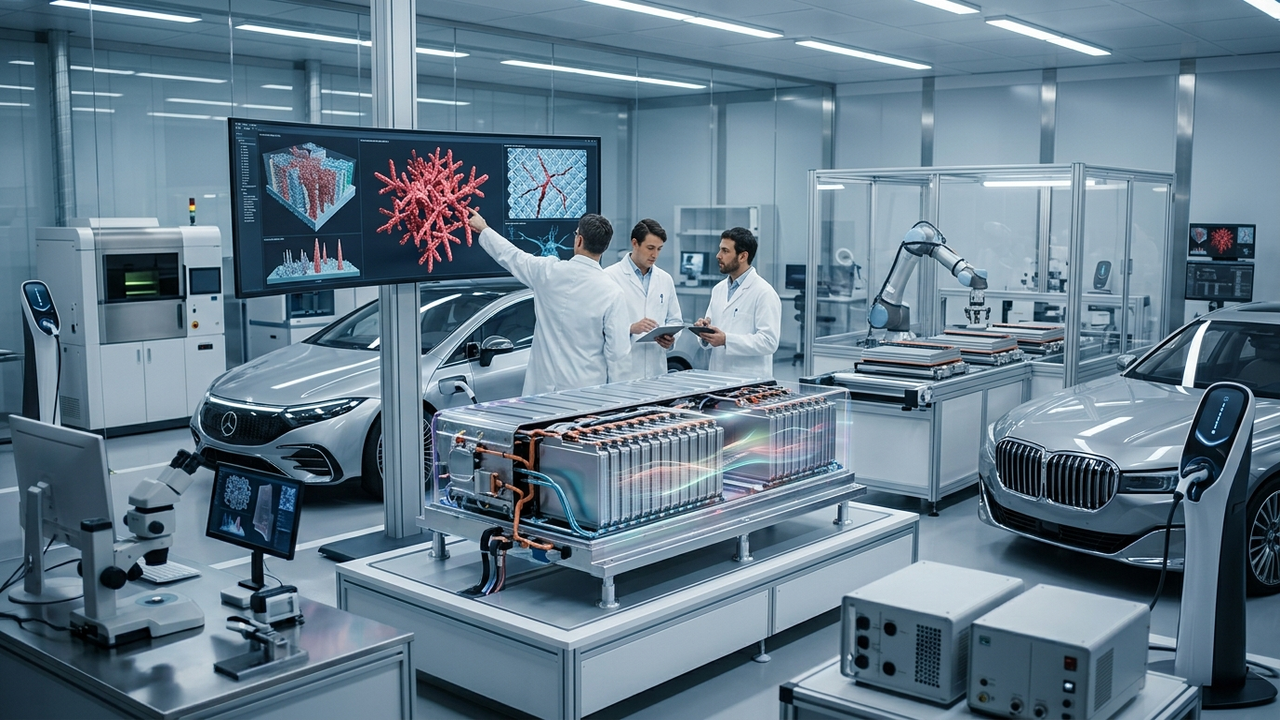
- Lithium Dendrite Formation: Particularly when using lithium metal anodes, lithium can grow into needle-like structures (dendrites) during charging, potentially penetrating the solid electrolyte and causing internal short circuits. While solid electrolytes offer better dendrite suppression than liquid ones, complete prevention remains challenging.
- Manufacturing Defects: Large-scale, low-cost manufacturing techniques for precise solid multi-layered structures are not yet fully established, and even small manufacturing defects can significantly impact overall battery performance and safety.
Background & Context
The explosive growth of the electric vehicle (EV) market has created a strong demand for higher-performance and safer batteries. As lithium-ion batteries approach their performance limits, all-solid-state batteries are garnering significant anticipation as the next-generation “game-changer.” Many automakers and battery developers are making massive investments, targeting commercialization in the late 2020s to early 2030s. This video clearly illustrates the gap between the “expectations” presented by media and companies and the “real-world challenges” that the actual technology faces.
Strategic Significance & Outlook
R&D efforts towards mass production of all-solid-state batteries will continue to accelerate. The focus will particularly be on optimizing solid-solid interfaces, completely suppressing dendrite formation, and establishing high-quality, low-cost manufacturing processes. Further innovation in materials science, manufacturing engineering, and simulation technologies is indispensable for overcoming the challenges highlighted in the video. Concrete market entry targets from major manufacturers provide strong incentives for technological development, but the extent to which these challenges can be overcome will determine whether all-solid-state batteries gain widespread adoption as a “real technology.” Ultimately, if these issues are resolved, EV performance will dramatically improve, significantly boosting the transition to a clean energy society.
Source: https://m.youtube.com/watch?v=FUqhv0JjDg
Get our weekly technology intelligence — free
Receive an infographic that lets you judge at a glance whether each field’s analysis report is worth reading.
Subscribe Free — Weekly Tech Intelligence
By subscribing, you’ll receive Troy-Technical’s weekly technology intelligence newsletter.
- Your email and selected fields are used only to deliver the newsletter.
- We never share your information with third parties.
- You can unsubscribe anytime via the link in each email.
See our Privacy Policy for details.
Takes about a minute · Unsubscribe anytime