Key Findings
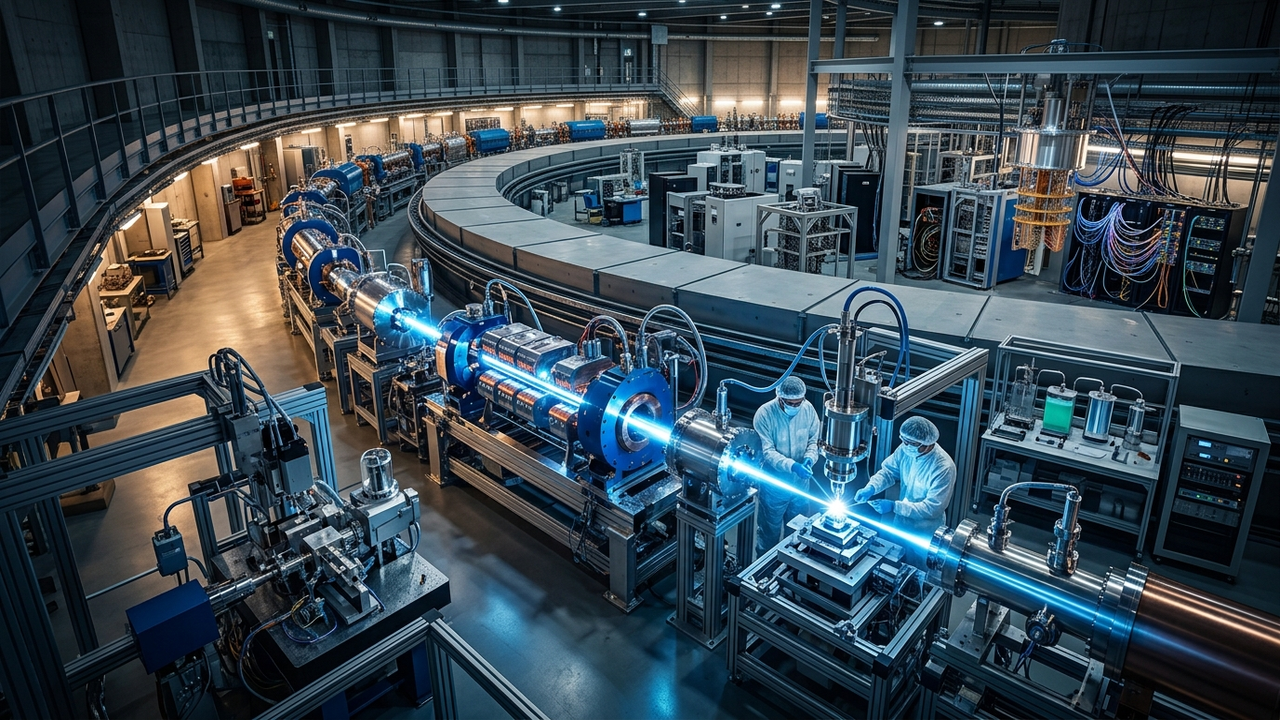
The Advanced Light Source (ALS) at Lawrence Berkeley National Laboratory has successfully completed a major upgrade, now delivering soft X-ray beams that are 100 times brighter and significantly more focused. This profound enhancement enables atomic-precision studies of molecules and materials, poised to dramatically accelerate scientific discoveries in critical fields such as microelectronics, energy storage, quantum computing, and catalysis.
Technical / Clinical Details
The ALS upgrade involved the integration of new magnet systems, more powerful RF cavities, and advanced beam stabilization technologies. The resulting X-ray beams are now more coherent and higher in flux, allowing for nanoscale material characterization, real-time tracking of chemical reactions, and the elucidation of previously unobservable phenomena. For instance, researchers can now visualize ion transport mechanisms at electrode interfaces in novel energy storage materials at an atomic level or capture subtle electronic structural changes in quantum materials. This capability is expected to yield fundamental insights crucial for designing more efficient and durable batteries, room-temperature superconductors, and high-performance quantum bits.
Background & Context
Technological innovation in modern society is highly dependent on the development of high-performance new materials. However, the development process has often been hampered by the inherent difficulty in fully understanding complex atomic structures and dynamic behaviors of materials. Large-scale research facilities like the ALS are crucial tools for overcoming these challenges, and their performance enhancements are constantly sought after. Specifically, in quantum computing and clean energy technologies, precise atomic-level control of materials is indispensable, and the ALS upgrade directly contributes to the advancement of these fields.
Strategic Significance & Outlook
The upgraded ALS is set to usher in a new era of materials science and chemistry research for decades to come. This facility will empower researchers to discover and design new materials more efficiently, thereby providing solutions to major societal challenges in energy, environment, and information technology. In particular, the new capabilities of the ALS will be indispensable for constructing high-performance energy systems from abundant and inexpensive materials, and for deepening our understanding of quantum materials for next-generation information and storage technologies. Industries will be able to leverage these accelerated research findings to bring more innovative products and solutions to market, driving global progress.
Get our weekly technology intelligence — free
Receive an infographic that lets you judge at a glance whether each field’s analysis report is worth reading.
Subscribe Free — Weekly Tech Intelligence
By subscribing, you’ll receive Troy-Technical’s weekly technology intelligence newsletter.
- Your email and selected fields are used only to deliver the newsletter.
- We never share your information with third parties.
- You can unsubscribe anytime via the link in each email.
See our Privacy Policy for details.
Takes about a minute · Unsubscribe anytime







Comments