Key Findings
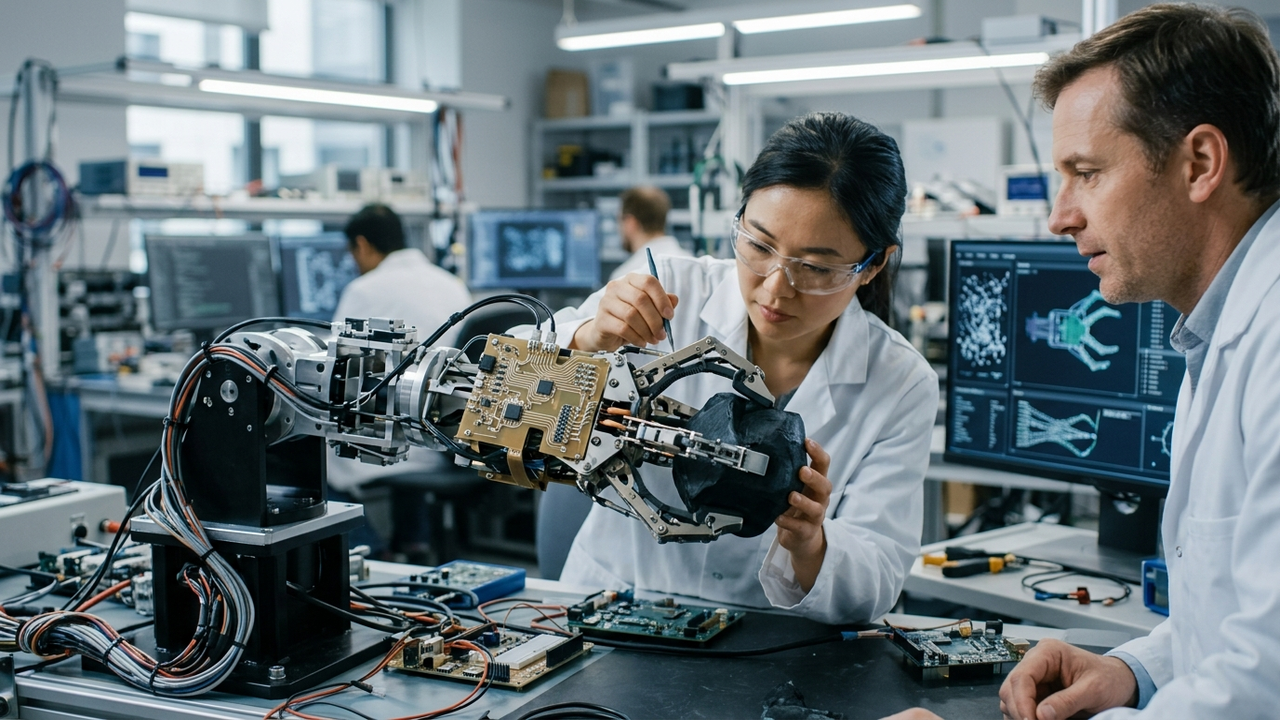
Researchers at the Massachusetts Institute of Technology (MIT) have introduced ‘bifur-circuits,’ a novel system for constructing shape-changing smart devices that maintain persistent electrical connections throughout their transformations. Composed of 3D-printed modular components, this system functions as a mechanical metamaterial capable of self-sensing its shape. This breakthrough fundamentally addresses the challenge of unstable electrical connections typically encountered in conventional flexible devices, opening new frontiers for reconfigurable technology.
Technical / Clinical Details
The ‘bifur-circuits’ leverage specially designed 3D-printed structures that ensure electrical integrity even during complex mechanical actuation. The metamaterial’s inherent ability to sense internal strain and deformation as electrical signals eliminates the need for external sensors to ascertain the device’s physical state. The MIT team has successfully demonstrated diverse applications, including shape-shifting assistive furniture, adaptive robotic grippers that conform to various objects, and reconfigurable antennas for optimal signal transmission. Crucially, rigorous compression tests have validated the high durability of the electrical connectivity, underscoring its robustness for real-world deployment.
Background & Context
For years, the fields of smart devices and robotics have sought to combine physical flexibility with advanced functionality. However, conventional flexible electronics have struggled with maintaining electrical reliability and durability under repeated deformation. MIT’s ‘bifur-circuits’ offer an innovative solution to this problem, providing designers with a platform to create more complex and adaptive devices with ease. This development promises to streamline design and manufacturing cycles, significantly reducing time-to-market for novel products.
Strategic Significance & Outlook
The advent of this modular and reconfigurable system is expected to catalyze rapid prototyping and enable the scalable production of custom-made devices, with ripple effects across various industries. Sectors such as medical devices, consumer electronics, aerospace, and advanced robotics are poised to benefit from the creation of devices with unprecedented capabilities. As integration with diverse materials and manufacturing processes continues to evolve, ‘bifur-circuits’ are well-positioned to become a new paradigm in the design of shape-changing smart devices, driving a wave of innovation.
Source: https://news.mit.edu/2026/mit-engineers-create-system-for-building-shape-changing-smart-devices-0827
Get our weekly technology intelligence — free
Receive an infographic that lets you judge at a glance whether each field’s analysis report is worth reading.
Subscribe Free — Weekly Tech Intelligence
By subscribing, you’ll receive Troy-Technical’s weekly technology intelligence newsletter.
- Your email and selected fields are used only to deliver the newsletter.
- We never share your information with third parties.
- You can unsubscribe anytime via the link in each email.
See our Privacy Policy for details.
Takes about a minute · Unsubscribe anytime








Comments