Key Findings
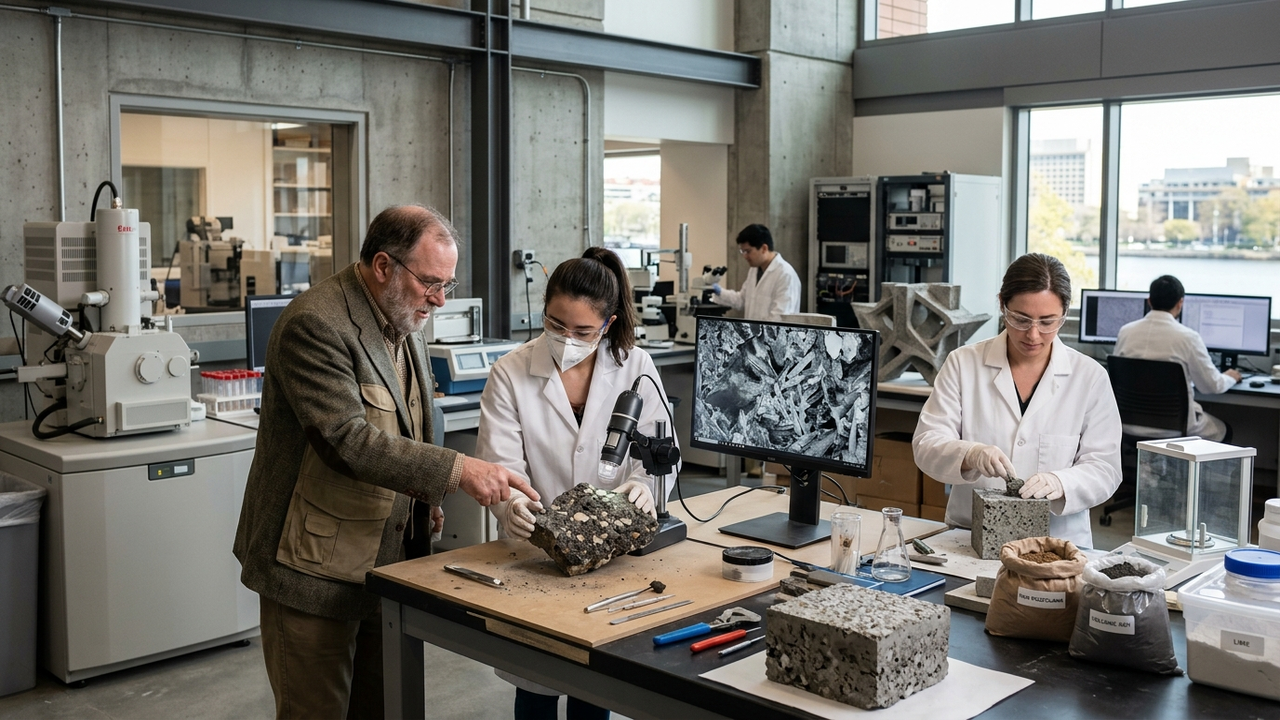
A team of MIT researchers, led by Associate Professor Admir Masic, has successfully reverse-engineered the composition of ancient Roman concrete, uncovering the secret to its remarkable self-healing capabilities. By applying this ancient technology to modern contexts, they have developed new construction materials that can autonomously repair their own cracks. This represents a groundbreaking solution to the pervasive durability challenges faced by contemporary infrastructure.
Technical / Clinical Details
Professor Masic’s team focused on the distinctive calcium-rich ‘lime clasts’ found within Roman concrete. Through detailed analysis, they discovered that these clasts are not merely unreacted lime but active self-healing agents. When cracks form in the concrete and come into contact with water, these lime clasts dissolve and then recrystallize as calcium carbonate, effectively sealing the micro-fissures. This process autonomously maintains the structural integrity of the concrete. MIT researchers have now replicated this mechanism by developing additives that mimic the lime clasts, thus creating new self-healing building materials. This new material is expected to significantly enhance durability in harsh environments, such as those exposed to salt water or freeze-thaw cycles.
Background & Context
Modern concrete structures are prone to cracking and deterioration due to aging, environmental factors, and design issues. These damages not only shorten the lifespan of structures but also incur substantial costs and labor for repairs. The extraordinary durability of ancient Roman architecture has been a subject of debate for centuries, and MIT’s research has now unraveled a key part of this mystery. This discovery is not merely a historical insight; it promises to bring new value in terms of sustainability and longevity to the construction industry.
Strategic Significance & Outlook
This groundbreaking technology from MIT has the potential to revolutionize the construction industry. The widespread adoption of self-healing concrete could dramatically reduce maintenance costs for infrastructure such as bridges, roads, and buildings, while also extending their operational lifespans. Furthermore, it contributes to reducing carbon emissions associated with material production, promoting more environmentally friendly construction practices. The research team plans to proceed with scaling up and commercializing this self-healing concrete, aiming for its adoption in construction projects worldwide. Future work will also involve verifying its performance under various climatic conditions and exploring its applicability to other building materials.
Get our weekly technology intelligence — free
Receive an infographic that lets you judge at a glance whether each field’s analysis report is worth reading.
Subscribe Free — Weekly Tech Intelligence
By subscribing, you’ll receive Troy-Technical’s weekly technology intelligence newsletter.
- Your email and selected fields are used only to deliver the newsletter.
- We never share your information with third parties.
- You can unsubscribe anytime via the link in each email.
See our Privacy Policy for details.
Takes about a minute · Unsubscribe anytime





Comments