Background
The global demand for advanced energy storage solutions is escalating, driven by requirements for higher energy density, enhanced safety, reduced costs, and improved sustainability across diverse applications, from consumer electronics to electric vehicles. For rapidly evolving sectors like wearable technology and flexible electronics, mechanical flexibility presents an additional, critical design imperative. While lithium-sulfur (Li-S) batteries offer a compelling high theoretical energy density, their practical implementation has been hindered by challenges related to achieving sufficient cycle life and inherent safety concerns. This new research originating from China presents a significant advancement, addressing these persistent obstacles through a synergistic integration of cutting-edge material science and innovative structural design.
Key Findings
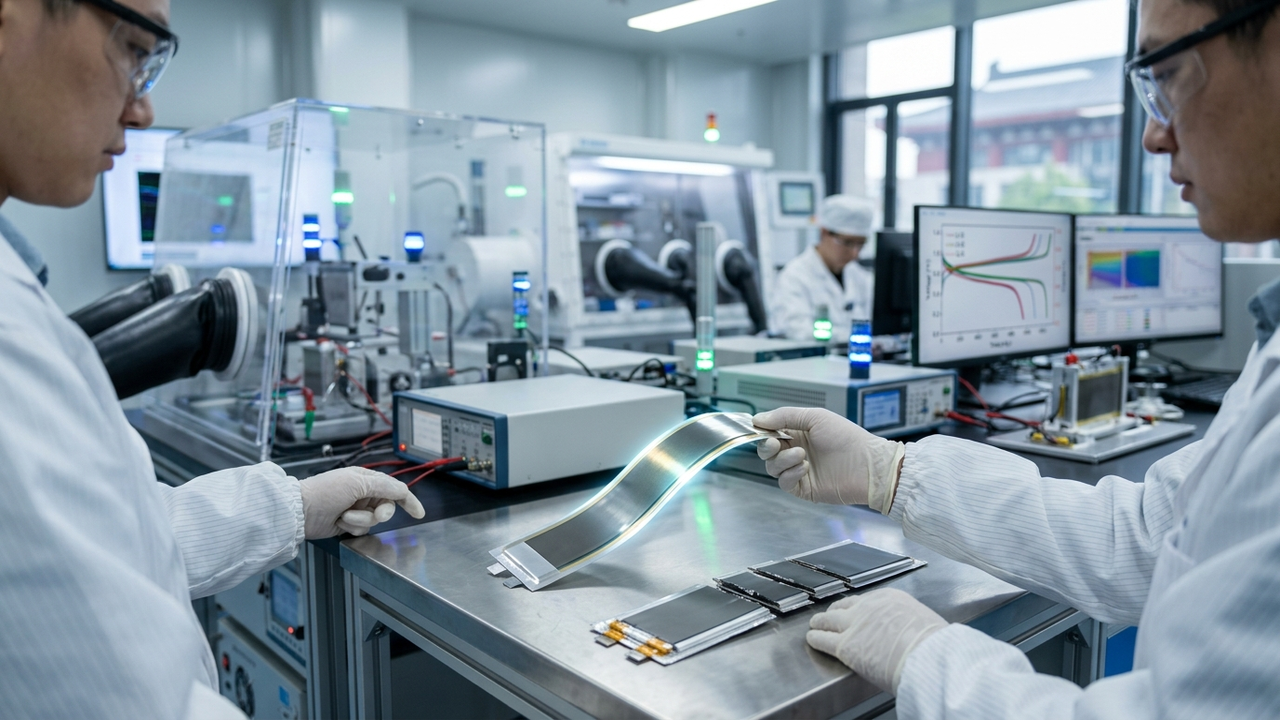
Scientists at the University of Electronic Science and Technology of China (UESTC) have successfully engineered a novel lithium-sulfur (Li-S) battery prototype distinguished by its exceptional flexibility and robust safety profile. This pioneering battery maintains full functionality even after undergoing physical deformation, such as bending or cutting, thereby substantially mitigating common safety concerns—including fire hazards—associated with conventional lithium-ion chemistries. A core innovation underpinning this breakthrough is the application of a polyacrylic acid (PAA) coating to the cathode. This coating critically minimizes sulfur dissolution, a primary mechanism of degradation in Li-S batteries, leading to notable improvements in charge retention and overall cycle life.
Technical Innovation
- The innovative Li-S battery architecture features a specialized polyacrylic acid (PAA)-based coating meticulously applied to the sulfur cathode. This PAA layer functions as an effective protective barrier, critically preventing the dissolution of polysulfides into the electrolyte—a notorious issue in Li-S chemistry known as the polysulfide shuttle effect. This strategic coating significantly bolsters the structural stability of the electrode and the overall integrity of the electrochemical cell, directly addressing a long-standing challenge in Li-S technology.
- Crucially, the suppression of sulfur dissolution by the PAA coating leads to a substantial extension of the battery’s cycle life and a marked improvement in its charge-discharge efficiency, thereby accelerating the path of Li-S technology towards viable commercial applications.
- The unique “bendable and cuttable” attributes are realized through an intrinsically flexible battery design that preserves optimal electrochemical performance even when subjected to significant physical deformation. This mechanical resilience is indispensable for next-generation applications, including advanced wearable electronics, pliable displays, and robust Internet of Things (IoT) devices designed for deployment in challenging operational environments.
- Furthermore, Li-S batteries inherently leverage sulfur as the active cathode material, an element that is both highly abundant and economically advantageous. This provides a sustainable and cost-effective alternative to conventional lithium-ion batteries, which often depend on more expensive and geopolitically constrained materials such as cobalt and nickel. This fundamental material advantage is poised to contribute to reduced manufacturing costs and a significantly lower environmental footprint.
Implications and Outlook
This novel flexible and safe Li-S battery technology carries profound implications for reshaping the design paradigms and operational capabilities of future consumer electronics, sophisticated medical implants, and advanced IoT sensor networks. Its unparalleled capacity to maintain performance and safety under physical duress is expected to catalyze the emergence of entirely new product categories and substantially enhance user experience. Moreover, the reliance on abundant and readily available raw materials positions this technology advantageously for future large-scale manufacturing, offering a strategic pathway to reduce reliance on vulnerable critical raw material supply chains. Future research and development efforts will concentrate on scaling up manufacturing processes, continuously optimizing key performance metrics, and rigorously conducting extensive real-world validation tests to expedite commercial deployment, ultimately cementing Li-S batteries as a viable, safe, and mechanically adaptable energy storage solution.
Source: #
Get our weekly technology intelligence — free
Receive an infographic that lets you judge at a glance whether each field’s analysis report is worth reading.
Subscribe Free — Weekly Tech Intelligence
By subscribing, you’ll receive Troy-Technical’s weekly technology intelligence newsletter.
- Your email and selected fields are used only to deliver the newsletter.
- We never share your information with third parties.
- You can unsubscribe anytime via the link in each email.
See our Privacy Policy for details.
Takes about a minute · Unsubscribe anytime







Comments