Key Findings
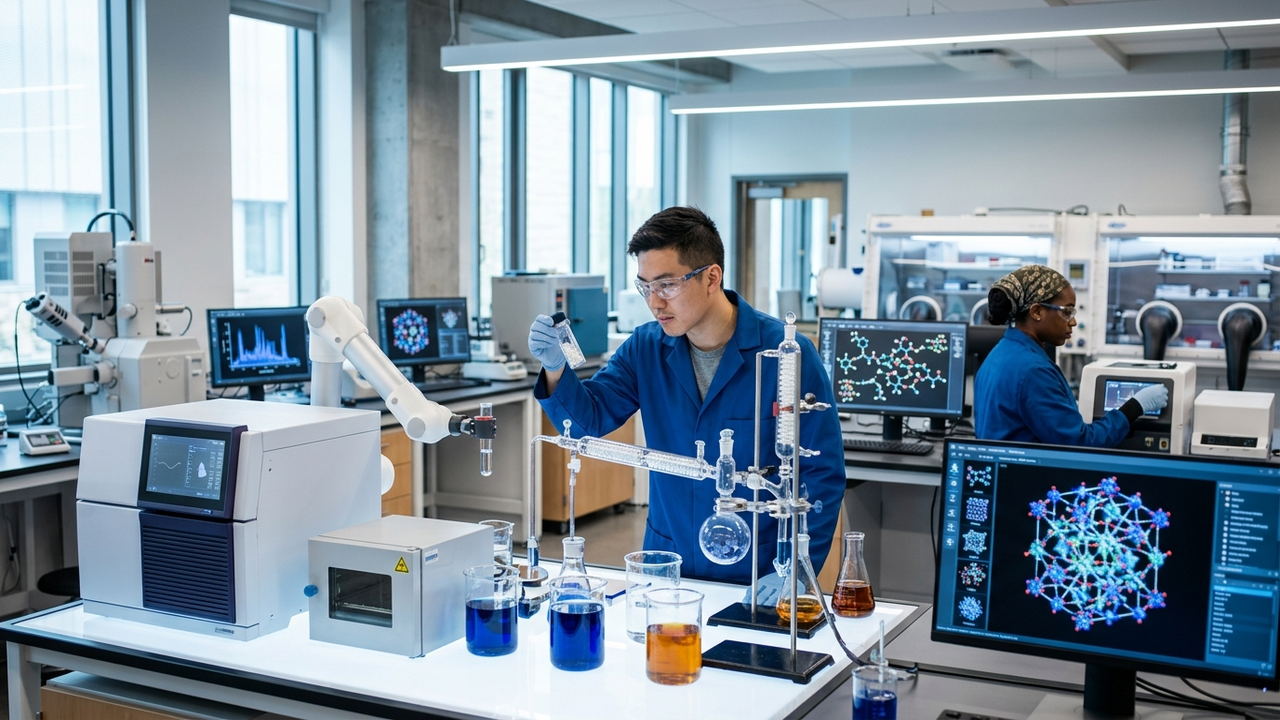
A research team at Washington University has successfully significantly increased the rate of new material and chemical compound discovery by enabling AI systems to model chemical compound synthesis processes and autonomously conduct experiments. This achievement demonstrates AI’s capacity to learn synthesis recipes from extensive chemical literature and leverage that knowledge to propose materials with a high probability of success. This breakthrough is poised to revolutionize the materials science discovery process.
Technical / Clinical Details
The research team first compiled tens of thousands of synthesis recipes from publicly available chemical literature, constructing a large dataset. This dataset was then used to train machine learning models to predict which synthesis pathways are most likely to lead to specific material properties. The AI system interprets these learned instructions and proposes syntheses for new compounds with targeted properties. Furthermore, based on the proposed synthesis pathways, the system actually executes automated experiments in the lab. For example, in the field of dynamic polymers, AI-designed polymers were found to exhibit unique properties that were difficult to discover through conventional methods. This closed-loop discovery process significantly reduces the trial-and-error often performed manually by human chemists, offering the advantage of more rapid and efficient identification of promising material candidates. The AI effectively navigates the exploration space by understanding the ‘why’ and ‘how’ of synthesis and applying this knowledge to new material design.
Background & Context
The discovery of new materials and compounds is fundamental to technological innovation across many industrial sectors, including pharmaceuticals, electronics, energy storage, and aerospace. However, traditional chemical synthesis research has been reliant on labor-intensive, time-consuming trial-and-error processes, often encountering unexpected results. Particularly for materials with complex molecular structures or those requiring multiple synthesis steps, the exploration space expands exponentially, reaching the limits of human capability. This approach, combining AI and robotics, is expected to be a powerful solution to overcome these challenges and resolve bottlenecks in material development.
Strategic Significance & Outlook
Washington University’s research suggests a future where AI transcends being merely a data analysis tool to function as an autonomous partner in scientific discovery. As this technology further develops, AI may emulate chemical intuition, discovering new chemical principles and synthesis routes that humans might overlook. Success in fields like dynamic polymers indicates applicability across a wide range of chemical systems, including other polymer materials, catalysts, and pharmaceuticals. This approach will significantly reduce R&D costs and time, enabling faster technological innovation, and thus bringing substantial economic impact to industries. Furthermore, AI-driven scientific discovery will contribute to creating an environment where scientists can focus on more creative and high-level problem-solving.
Source: https://engineering.washu.edu/news/2026/Some-assembly-required-with-machine-learning.html
Get our weekly technology intelligence — free
Receive an infographic that lets you judge at a glance whether each field’s analysis report is worth reading.
Subscribe Free — Weekly Tech Intelligence
By subscribing, you’ll receive Troy-Technical’s weekly technology intelligence newsletter.
- Your email and selected fields are used only to deliver the newsletter.
- We never share your information with third parties.
- You can unsubscribe anytime via the link in each email.
See our Privacy Policy for details.
Takes about a minute · Unsubscribe anytime







Comments