Key Findings
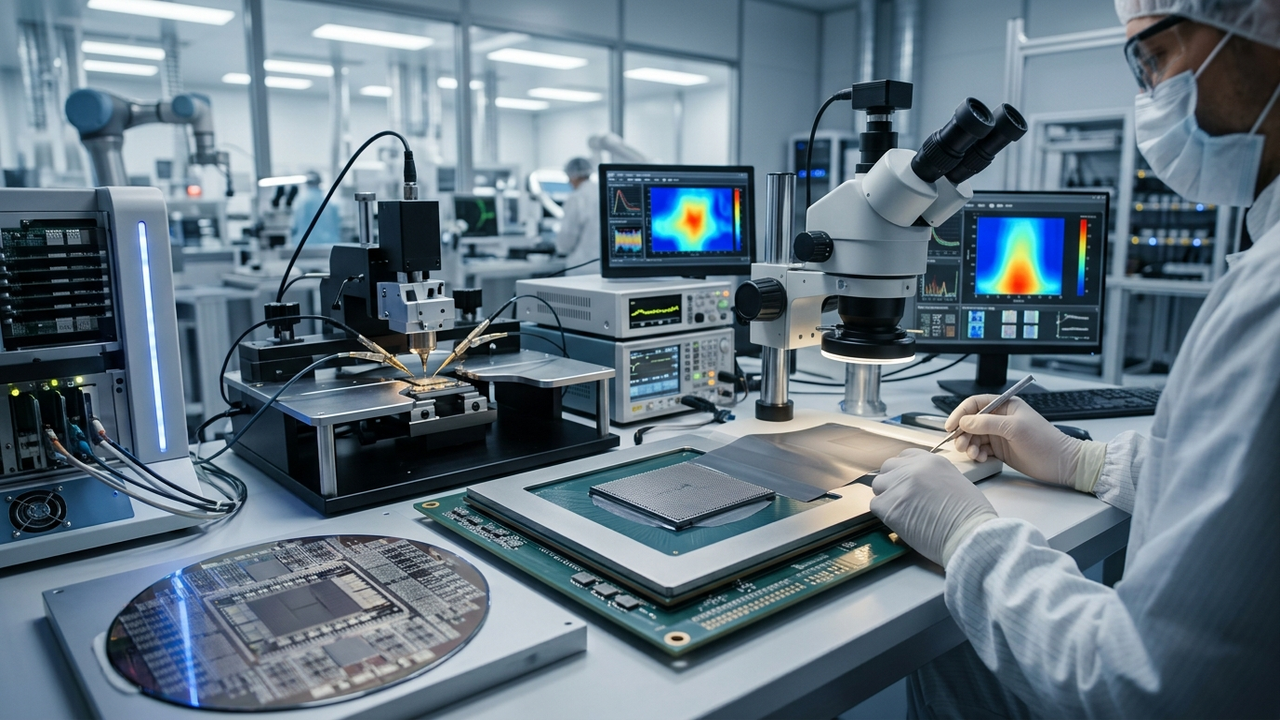
Henkel Adhesive Technologies has announced the new Loctite ABLESTIK CDF900 series of conductive Die Attach Films (cDAF), poised to revolutionize advanced packaging techniques for Artificial Intelligence (AI) accelerators and High-Performance Computing (HPC) processors. This innovative material achieves an exceptionally high thermal conductivity exceeding 8 W/m-K. Critically, it completely eliminates bleed-out and guarantees a uniform bondline thickness, especially in large die packaging. These advancements dramatically improve efficient thermal management and design flexibility for high-heat-generating devices.
Technical / Clinical Details
The Loctite ABLESTIK CDF900 series is specifically engineered to address thermal challenges arising from the increasing chip density and power consumption in AI and HPC advancements. Its film format offers several distinct advantages over traditional paste adhesives:
- Ultra-High Thermal Conductivity: Boasting a thermal conductivity greater than 8 W/m-K, it efficiently transfers heat from high-power chips to the heatsink. This capability is indispensable for maintaining the performance and extending the lifespan of devices like AI accelerators.
- Elimination of Bleed-Out: As a film, it prevents the “bleed-out” phenomenon, where adhesive seeps beyond the die edges. This prevents package contamination and eliminates adverse effects on surrounding components.
- Uniform Bondline Thickness: The physical properties of the film ensure a consistently uniform adhesive layer thickness. This is crucial for maintaining the consistency of the thermal conduction path and enhancing overall reliability.
- Optimization for Large Die Packaging: Provides design flexibility to accommodate larger chips and effectively controls warpage and component stress in large packages.
In addition to this cDAF series, Henkel also offers a broad portfolio of semiconductor packaging materials, including high thermal conductivity liquid molding compounds for warpage and component stress control, and capillary underfills. These are essential for supporting the reliability and performance of advanced 5G/6G front-end modules and other highly integrated electronic devices.
Background & Context
The rapid evolution of technologies such as AI, HPC, and 5G/6G communications has led to exponential increases in semiconductor chip performance and integration density. However, the accompanying rise in power density and heat generation presents one of the biggest challenges for long-term device reliability and performance sustainability. Material suppliers are focused on developing more efficient heat transfer materials and form factors that simplify manufacturing processes and improve reliability to overcome this thermal barrier. Film-based die attach materials, due to their precise application and uniformity, are emerging as a critical solution to meet this need.
Strategic Significance & Outlook
Innovative cDAFs like the Loctite ABLESTIK CDF900 series will serve as foundational technologies supporting the future growth of the AI and HPC sectors. By combining high thermal conductivity with process advantages, semiconductor manufacturers can develop and bring to market more powerful and reliable chips. This technology is expected to be widely adopted across all high-performance demanding sectors, including data centers, autonomous vehicles, and consumer electronics, accelerating the next generation of innovation. Henkel is poised to further strengthen its leadership in this domain.
Get our weekly technology intelligence — free
Receive an infographic that lets you judge at a glance whether each field’s analysis report is worth reading.
Subscribe Free — Weekly Tech Intelligence
By subscribing, you’ll receive Troy-Technical’s weekly technology intelligence newsletter.
- Your email and selected fields are used only to deliver the newsletter.
- We never share your information with third parties.
- You can unsubscribe anytime via the link in each email.
See our Privacy Policy for details.
Takes about a minute · Unsubscribe anytime






Comments