Key Findings
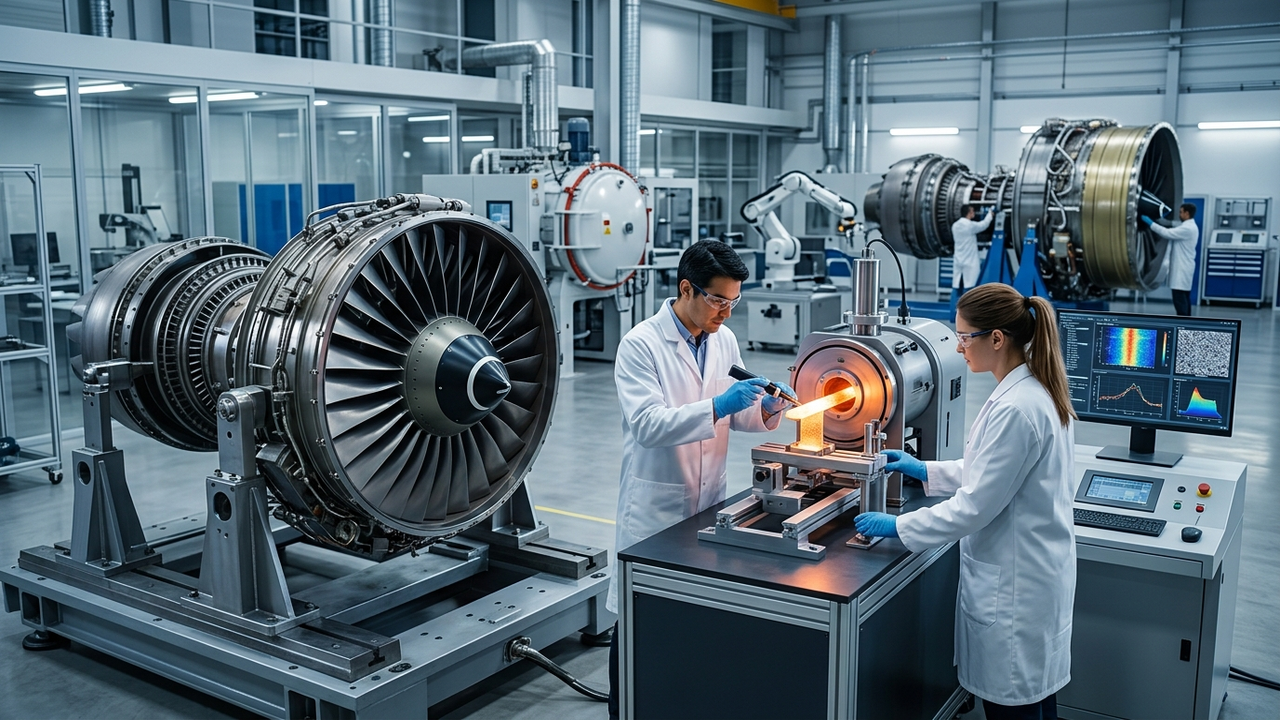
A research group has successfully developed a novel Refractory High-Entropy Alloy (RHEA) that exhibits superior strength and creep resistance compared to existing nickel-based superalloys. This material is specifically designed for components operating in extreme high-temperature environments, such as aircraft engines and gas turbines. This materials innovation holds the potential to significantly improve engine fuel efficiency, extend component lifetimes, and substantially reduce operational costs.
Technical / Clinical Details
RHEAs are a class of materials characterized by their unique microstructures and exceptional properties, which arise from mixing five or more metallic elements in nearly equiatomic ratios, unlike conventional alloys. The newly developed RHEA primarily consists of refractory metals (e.g., tungsten, molybdenum, niobium, tantalum), and through precise composition design and optimized heat treatment processes, it dramatically enhances strength and resistance to long-term creep deformation (the phenomenon of slow material deformation) at ultra-high temperatures (e.g., above 1200°C). Compared to traditional nickel-based superalloys, its tensile strength and fracture toughness under identical temperature conditions are significantly improved, with its resistance to loading at high temperatures being particularly outstanding. Detailed microstructural analysis has revealed that specific atomic arrangements and nanoscale precipitated phases suppress grain boundary movement at elevated temperatures, thereby maintaining excellent mechanical properties. This achievement provides new guidelines for the design of high-temperature materials.
Background & Context
Improvements in the performance of aircraft engines and power generation gas turbines directly translate to better fuel efficiency and reduced CO2 emissions, making them critically important for both environmental load reduction and economic enhancement. These machines can maximize efficiency by operating at higher combustion temperatures, but this has been challenged by the thermal limits of existing materials. While current dominant nickel-based superalloys offer excellent performance, a materials breakthrough has been deemed essential for achieving even higher operating temperatures. RHEAs have recently garnered attention as next-generation materials capable of overcoming this ‘materials barrier.’
Strategic Significance & Outlook
The development of this new RHEA is expected to have a profound impact on the aerospace and energy industries. If high-performance RHEAs are commercialized, aircraft engines could become lighter, more fuel-efficient, and benefit from extended maintenance cycles, leading to reduced operating costs and improved safety. Furthermore, increased efficiency in gas turbine power generation will contribute to stabilizing electricity supply and reducing environmental impact. Future efforts will focus on establishing large-scale manufacturing processes, exploring applicability to complex component geometries, and conducting long-term reliability assessments under even more extreme conditions. This technology is poised to become an indispensable foundational material for the development of high-efficiency energy systems vital for realizing a sustainable society.
Source: #
Get our weekly technology intelligence — free
Receive an infographic that lets you judge at a glance whether each field’s analysis report is worth reading.
Subscribe Free — Weekly Tech Intelligence
By subscribing, you’ll receive Troy-Technical’s weekly technology intelligence newsletter.
- Your email and selected fields are used only to deliver the newsletter.
- We never share your information with third parties.
- You can unsubscribe anytime via the link in each email.
See our Privacy Policy for details.
Takes about a minute · Unsubscribe anytime








Comments