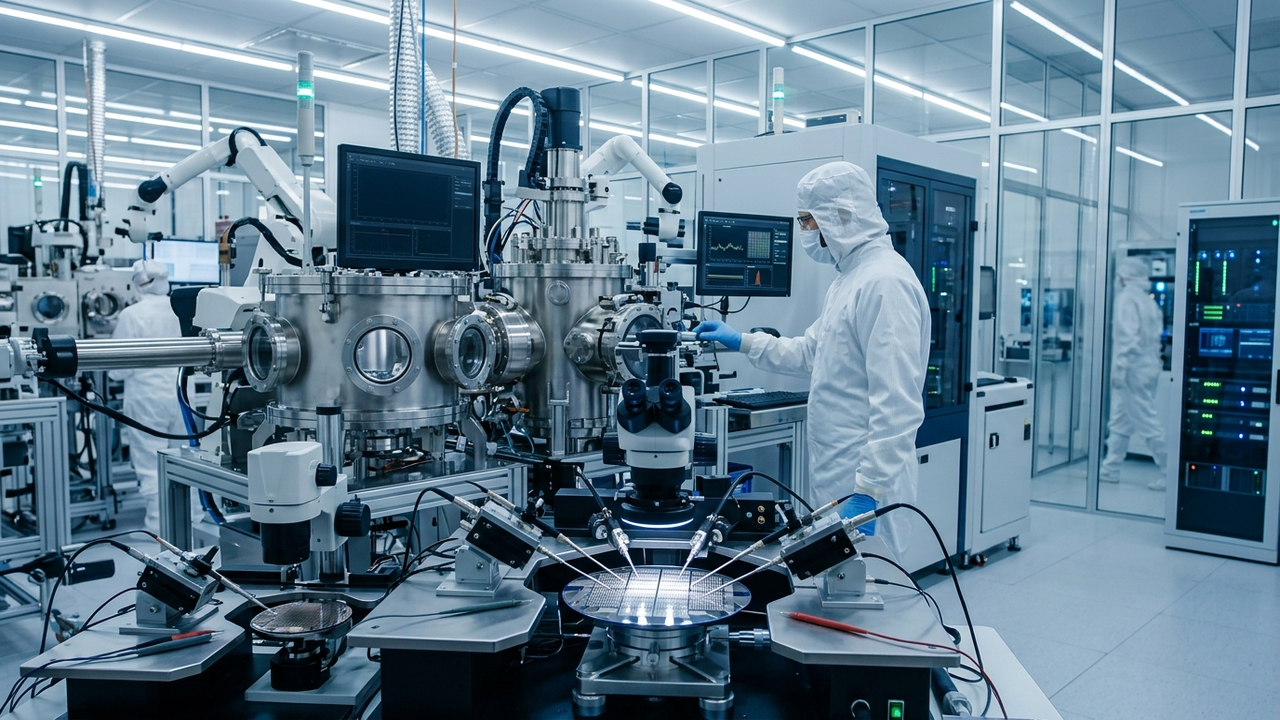
Key Findings
In next-generation spintronic MRAM (Magnetic Random Access Memory), a key contender for non-volatile memory, the writing technology utilizing spin-orbit torque (SOT) has been significantly improved, leading to a dramatic enhancement in device operational endurance. This breakthrough is projected to accelerate the application of SOT-MRAM, with its combination of high speed, low power consumption, and non-volatility, in data storage systems and particularly in edge AI devices that demand real-time processing capabilities.
Technical / Clinical Details
MRAM is a non-volatile memory that stores information using the direction of magnetization, meaning data persists even when power is off. Among MRAM types, SOT-MRAM employs a writing method that leverages the spin-orbit torque phenomenon generated when current flows, to flip magnetization directions at high speed and low power. Conventional MRAM writing methods (Spin-Transfer Torque, STT) faced endurance challenges (write cycle limitations) due to current flowing directly through the magnetic tunnel junction (MTJ) element, causing degradation of the insulating layer. The improved SOT writing technology announced in this study generates spin-orbit torque by passing current through a path separate from the MTJ element, thereby reducing physical stress on the MTJ element. Through this new design and material optimization, the write endurance of SOT-MRAM has increased several-fold to tens-of-fold compared to conventional methods, demonstrating that the expected lifespan for gigabyte-scale memory has reached practical levels. This makes the possibility of SOT-MRAM as a ‘universal memory,’ combining the advantages of both high-speed DRAM and low-power NAND flash memory, more tangible.
Background & Context
Modern computing systems face challenges such as latency in data transfer speeds between CPU and memory (the von Neumann bottleneck), memory’s own power consumption, and the immense power consumption in data centers. The evolution of AI, IoT, and big data processing, in particular, is accelerating the demand for high-speed, large-capacity, and power-efficient non-volatile memory. MRAM is anticipated as a next-generation memory to solve these challenges, with SOT-MRAM especially garnering attention due to its high speed and low power consumption. However, limitations in endurance have been a factor hindering its widespread application.
Strategic Significance & Outlook
The enhanced endurance of SOT writing technology paves the way for the full-scale adoption of SOT-MRAM in both the data storage and edge AI markets. High-performance, non-volatile SOT-MRAM could be used as main memory in data center servers, replacing DRAM, which would significantly reduce overall system power consumption and improve the efficiency of big data processing. For edge AI devices, it will enable high-speed, low-power data processing and learning directly on the device, reducing reliance on the cloud. In the future, it is expected to be integrated into all electronic devices, including smartphones, wearables, and IoT sensors, contributing to the realization of always-on, low-power smart devices. This technology is expected to fundamentally transform how information is processed and stored, becoming a cornerstone of next-generation IT infrastructure.
Source: #
Get our weekly technology intelligence — free
Receive an infographic that lets you judge at a glance whether each field’s analysis report is worth reading.
Subscribe Free — Weekly Tech Intelligence
By subscribing, you’ll receive Troy-Technical’s weekly technology intelligence newsletter.
- Your email and selected fields are used only to deliver the newsletter.
- We never share your information with third parties.
- You can unsubscribe anytime via the link in each email.
See our Privacy Policy for details.
Takes about a minute · Unsubscribe anytime







Comments