Key Findings
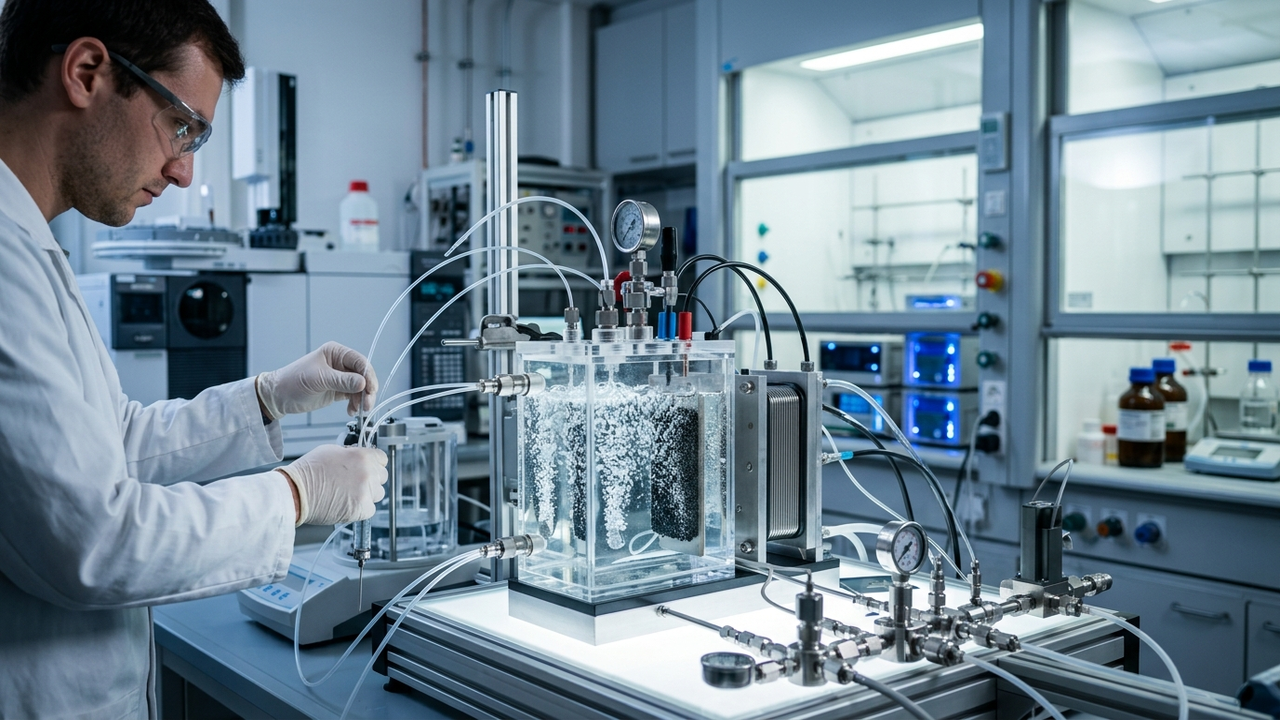
A research team has developed a novel High-Entropy Oxide (HEO) catalyst that demonstrates performance comparable to, or even surpassing, conventional noble metal catalysts in the process of green hydrogen production via water electrolysis. This innovative catalyst combines high catalytic activity with long-term stability, attracting significant attention as a next-generation material that enables low-cost and high-efficiency hydrogen production.
Technical / Clinical Details
Green hydrogen production is a process that uses electricity derived from renewable energy to electrolyze water, yielding hydrogen without emitting carbon dioxide. In this process, the catalyst is a crucial factor determining the efficiency of the water splitting reaction. Currently, the most efficient catalysts are noble metals such as platinum (Pt) and iridium (Ir); however, these materials are expensive and scarce, which drives up the cost of large-scale hydrogen production. The HEO catalyst developed in this study possesses a unique electronic structure and lattice distortion, different from conventional oxide catalysts made of single or a few elements, by uniformly mixing five or more different metal oxides. This high-entropy effect increases the diversity of catalytic active sites and optimizes the adsorption/desorption behavior of reaction intermediates, successfully reducing the overpotential (the excess voltage required for the reaction) of the water splitting reaction. This means hydrogen can be generated efficiently with less energy. Furthermore, it demonstrated excellent stability in both acidic and alkaline environments, with minimal degradation of catalytic performance observed even during prolonged continuous operation. This suggests its applicability to various water electrolysis systems.
Background & Context
As a measure against global warming, the transition from fossil fuels to hydrogen energy is an urgent task, and particularly the production of ‘green hydrogen,’ which emits no CO2 during its manufacturing process, is considered key to achieving a decarbonized society. Governments worldwide are investing heavily in green hydrogen production technologies, but one of the biggest factors hindering its widespread adoption has been the high cost of noble metal catalysts and the consequent high cost of hydrogen production. The development of inexpensive, high-performance non-noble metal catalysts is essential to significantly reduce the cost of green hydrogen and accelerate its large-scale societal implementation.
Strategic Significance & Outlook
The development of this HEO catalyst holds the potential to be a game-changer in green hydrogen production technology. If a low-cost, high-efficiency catalyst is commercialized, the cost of hydrogen production through water electrolysis will drop significantly, dramatically improving the market competitiveness of green hydrogen. Future efforts will focus on establishing large-scale synthesis processes for the material, further evaluating its durability, and integrating it into actual water electrolysis stacks for long-term operational testing. This technology is expected to accelerate the establishment of a hydrogen society in conjunction with renewable energy and is highly anticipated as a fundamental technology indispensable for decarbonization in the industrial, transportation, and power sectors.
Source: #
Get our weekly technology intelligence — free
Receive an infographic that lets you judge at a glance whether each field’s analysis report is worth reading.
Subscribe Free — Weekly Tech Intelligence
By subscribing, you’ll receive Troy-Technical’s weekly technology intelligence newsletter.
- Your email and selected fields are used only to deliver the newsletter.
- We never share your information with third parties.
- You can unsubscribe anytime via the link in each email.
See our Privacy Policy for details.
Takes about a minute · Unsubscribe anytime






Comments