Key Findings
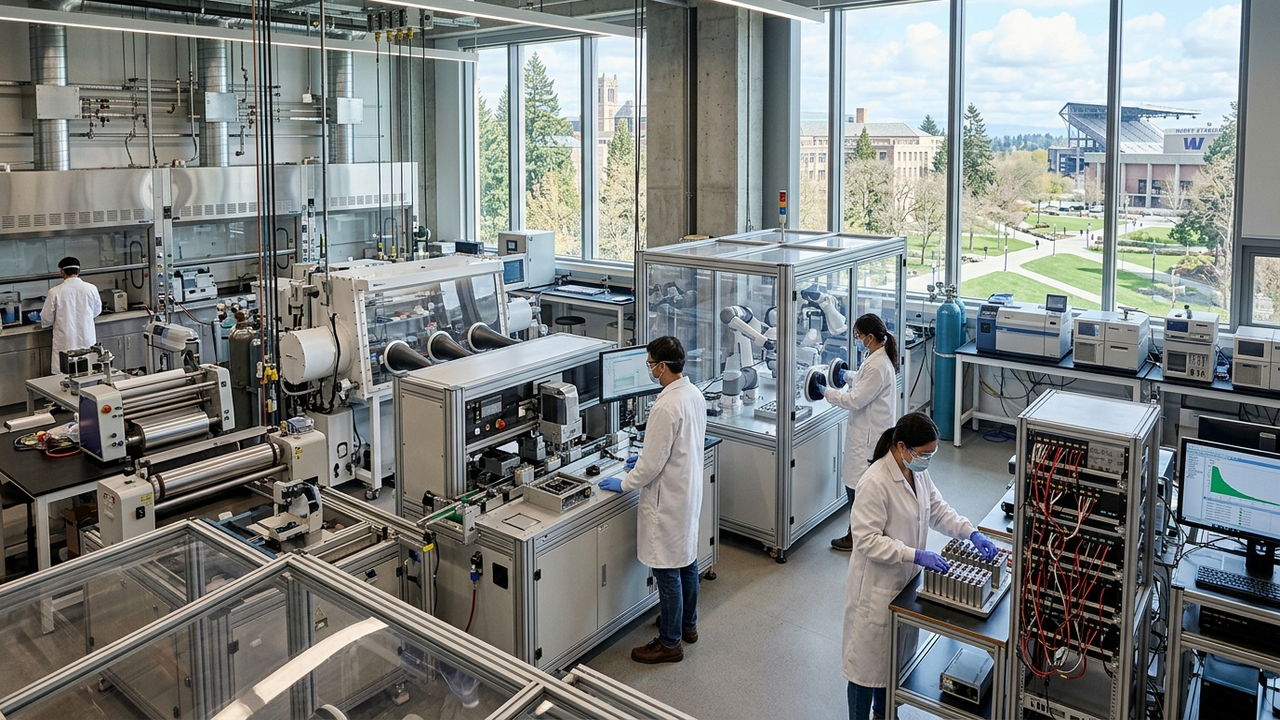
The University of Washington (UW) has officially opened the first public-access battery manufacturing lab on the U.S. West Coast, backed by a $7.5 million investment. This groundbreaking facility is designed to accelerate battery innovation within the United States, specifically addressing the surging demand for large-scale battery storage to support solar energy integration and grid operations.
Technical / Clinical Details
Located within UW’s Clean Energy Testbeds, this state-of-the-art laboratory provides an open-access platform for researchers, startups, and industry to engage in various stages of battery technology development, from initial concept to prototyping and small-scale manufacturing. The lab will foster research and development in next-generation battery technologies, including:
- Sodium-ion batteries: Utilizing sodium, a more abundant and cheaper alternative to lithium, these batteries are a focus for sustainable, resource-unconstrained energy storage.
- Lithium-ion batteries with silicon-carbon anodes: Aiming to significantly boost energy density and charging speeds by replacing traditional graphite anodes with silicon-carbon composite materials. Silicon can store approximately ten times more lithium ions than graphite, offering potential for extended EV range and improved stationary storage efficiency.
These technologies hold the promise of transcending the limitations of current lithium-ion batteries, making them crucial enablers for the clean energy transition.
Background & Context
The U.S. energy infrastructure is experiencing a rapid increase in electricity demand, driven by the integration of renewable energy sources and the proliferation of data centers, necessitating vast energy storage capacities. In this context, bolstering domestic battery technology development and manufacturing capabilities has become a national priority. The government is actively investing in R&D to reduce reliance on foreign supply chains, particularly from countries like China, and to establish a robust domestic industry. UW’s new lab is expected to serve as a vital hub, fostering collaboration among academia, government, and industry to propel battery innovation under this strategic imperative.
Strategic Significance & Outlook
The University of Washington’s new facility will play a pivotal role in bridging the gap from fundamental research to commercialization, thereby significantly enhancing the competitiveness of the U.S. battery industry. The public-access model enables a diverse range of researchers and companies to utilize cutting-edge equipment and rapidly materialize their ideas. This will accelerate the practical application of innovative technologies like sodium-ion batteries and high-performance lithium-ion batteries, potentially leading to breakthroughs in widespread applications such as EVs, grid-scale storage, and even defense sectors. This lab is anticipated to become a central component of an important innovation ecosystem, supporting the sustainability and resilience of future energy systems.
Source: https://www.geekwire.com/2026/how-a-new-7-5m-uw-facility-aims-to-spark-u-s-battery-innovation/
Get our weekly technology intelligence — free
Receive an infographic that lets you judge at a glance whether each field’s analysis report is worth reading.
Subscribe Free — Weekly Tech Intelligence
By subscribing, you’ll receive Troy-Technical’s weekly technology intelligence newsletter.
- Your email and selected fields are used only to deliver the newsletter.
- We never share your information with third parties.
- You can unsubscribe anytime via the link in each email.
See our Privacy Policy for details.
Takes about a minute · Unsubscribe anytime








Comments